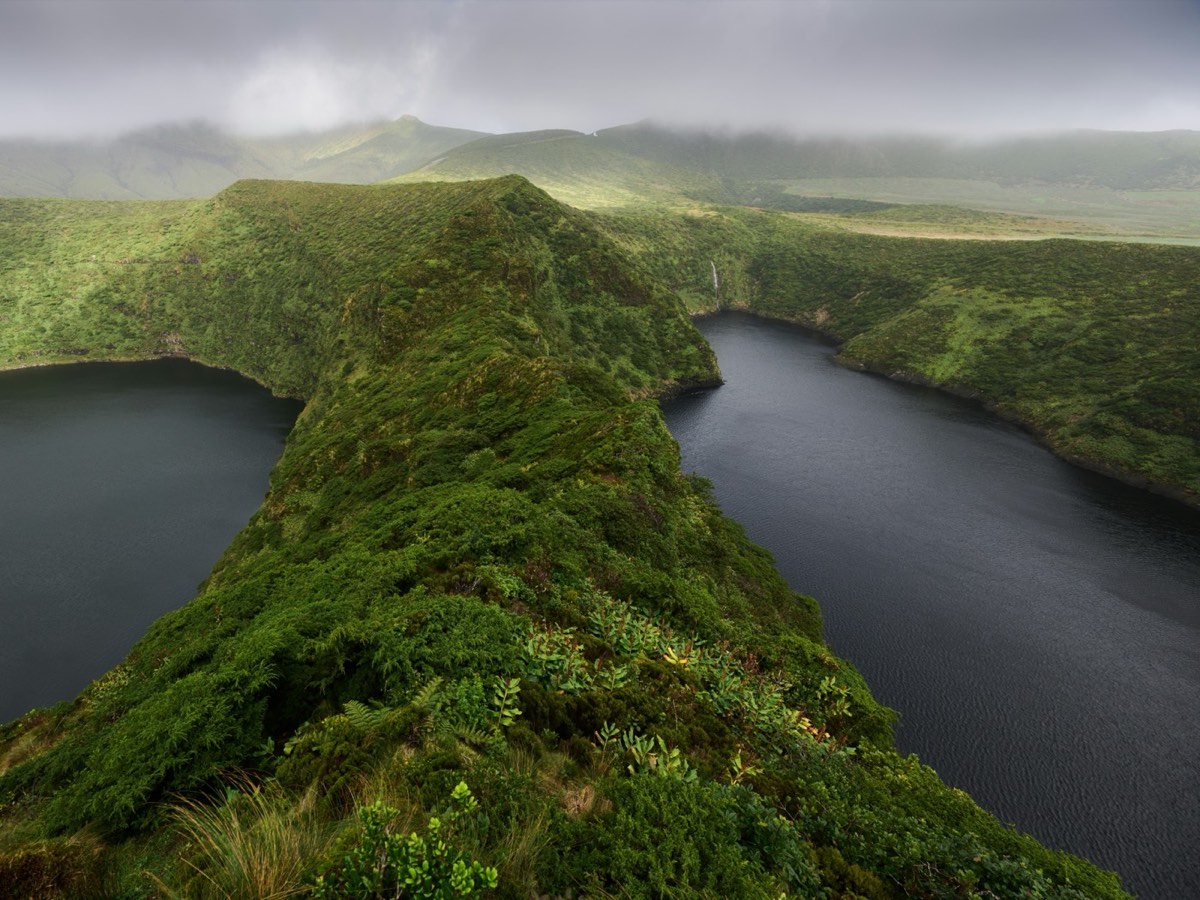
Pico and Flores represent two very different faces of the Azores: one is defined by a single dramatic vertical objective, the other by remote lateral beauty spread across a small island. Pico is for people who want to climb Portugal’s highest point, watch sperm whales from one of the world’s best departure bases, and drink wine from UNESCO-listed volcanic vineyards. Flores is for people who want to feel genuinely remote — walking empty trails to 100-metre waterfalls, swimming in dark crater lakes, and seeing almost no one else for days. They are not easily combined on a short trip, and they suit distinctly different travel styles.
Quick Verdict
| Category | Pico | Flores |
|---|---|---|
| Summit hiking | Winner (2,351m volcano) | No significant peaks |
| Whale watching | Winner (best in Azores) | Limited |
| Remoteness | Moderate (Triangle ferry links) | Winner (western group) |
| Waterfalls | — | Winner (Cascata do Poço do Bacalhau, 100m) |
| Crater lakes | — | Winner (Caldeira Funda, Caldeira Comprida) |
| Accessibility | Easier (Faial ferry, SATA) | Harder (connection via São Miguel) |
| Accommodation range | Better | Very limited |
| Food and restaurants | Good | Basic |
| Wine | Winner (UNESCO Verdelho vineyards) | — |
| Crowds | Low | Very low |
| Best for | Active adventure, whale watching | Remote nature, solitude |
Choose Pico if you want to summit Portugal’s highest mountain, whale watch with the best operators in the Azores, and use the Triangle ferry network to combine with Faial and São Jorge. Choose Flores if you want maximum remoteness, dramatic waterfall and crater lake scenery, and a genuinely off-grid island experience with almost no other tourists.
Getting There
Pico: Pico Airport (PIX) is near Madalena on the western coast. SATA flies from Lisbon (approximately 2 hours) and inter-island from São Miguel. The most common approach for many travellers is the Faial–Pico ferry from Horta to Madalena: 30 minutes, approximately €6, running multiple times daily. A car is useful for reaching the Pico Mountain Visitor Centre, the Whalers Museum in Lajes, and the UNESCO vineyards — all spread around the island.
Flores: Flores Airport (FLW) is near Santa Cruz das Flores. SATA operates connecting flights from Lisbon via Ponta Delgada (São Miguel); there is no direct service from Lisbon or from Pico. Total journey time from Lisbon is typically 4–5 hours including connection. From Pico, the routing goes via Faial or São Miguel depending on schedules. Summer frequency is significantly higher than winter — some routes to Flores run only 2–3 times per week in the off-season. Inter-island ferry to Flores is infrequent and weather-dependent; flying is the only practical option.
Hire a car at the Flores airport immediately. Roads are steep, winding, and narrow, but distances are small (the island is 17km long). There is no usable public transport.
Between the islands: There is no direct route. The standard connection is SATA Flores → São Miguel or Flores → Faial → Pico, adding 3–5 hours of travel time. Plan to spend at least 3 days on each if combining them.
Pico Island
Pico is the second-largest Azores island at 447km² and the most vertical. The island is essentially a single enormous shield volcano — Montanha do Pico — rising to 2,351m, the highest point in Portugal and one of the most prominent island peaks in the North Atlantic. The mountain is visible from Faial on clear days, its summit cone rising above or through the cloud layer.
Hiking Pico Mountain
The trailhead is at the Pico Mountain Visitor Centre at 1,217m elevation on the mountain’s south flank. All hikers must register before ascending. The route to the true summit (Piquinho) is approximately 7.5km return. The lower section — from the Visitor Centre to the caldera rim — takes about 1h30 on steep loose volcanic scoria. The upper section (caldera to Piquinho) is 30–45 minutes of exposed scrambling on the true summit cone, with significant drops and fixed chains on the steepest sections; trekking poles are a hindrance here.
Logistics: Start between 4am and 6am. The summit is typically cloud-free at dawn and closes in by 10am–noon. Bring layers (10–15°C colder at the summit than the coast), wind protection, a head torch if starting before dawn, 2+ litres of water (no water above the Visitor Centre), and sturdy footwear. The descent takes 3–4 hours. The total round trip is 7–8 hours.
Whale Watching
Pico is considered the best whale watching base in the Azores. The deep Atlantic trough passes close to the island’s southern coast, providing habitat for resident sperm whales and migration routes for blue, fin, humpback, and sei whales. Pico’s operators use the Azorean tradition of shore-based vigias — lookout towers that spot whales before boats depart — giving shorter transit times and higher sighting rates.
Operators in Lajes do Pico: Espaço Talassa, Pico Sport. Tours run 3–4 hours, cost approximately €60–80. April–October is peak season; blue whales are most common April–May, sperm whales year-round. Sighting rates on good-weather days run around 95%.
UNESCO Vineyards and Wine
Pico’s vineyards are grown inside a landscape of hand-built basalt rock walls (currais) that protect individual vines from Atlantic wind and salt spray. The entire system — hundreds of kilometres of black lava walls across the western part of the island — was listed as a UNESCO Cultural Landscape in 2004. The primary grape is Verdelho, used for dry table wines and a semi-fortified style similar to Madeira. The Cooperativa Vitivinícola da Ilha do Pico in Madalena offers tours and tastings.
Whalers Museum
Pico had an active whaling industry until 1981 — the last whale was caught here, using traditional hand-thrown harpoons from open wooden boats. The Museu dos Baleeiros (Whalers Museum) in Lajes do Pico occupies the former whaling station with original factory equipment, restored hunting boats, logbooks, and scrimshaw (whale-tooth carving). Entry approximately €3.
Accommodation on Pico: Hotels in Madalena from approximately €80–130/night. Rural houses near the mountain trailhead and vineyard guest rooms are available from €70–110.
Search hotels in Pico on Booking.com
Flores Island
Flores is the westernmost inhabited island in the Azores and, by extension, one of the westernmost points of Europe. At 143km² with a population of 3,900, it is among the smallest and least-visited islands. The name — “Flowers” — reflects the dense blue and pink hydrangeas that line every road and field boundary in summer.
The island’s character is defined by rainfall and remoteness. Flores receives more precipitation than most Azores islands, which already sit in a wet Atlantic weather pattern, and the result is a saturated landscape of waterfalls, crater lakes, and clifftop bog vegetation. The island rewards patience: cloud closes over the crater lakes without warning, and a waterfall you planned to visit may be shrouded in mist. Come back the next morning.
Cascata do Poço do Bacalhau
The most dramatic waterfall in the Azores. A single drop of approximately 100m falls from a basalt cliff into a pool below, accessible via a short path from the main road near Fajã Grande in the southwest. No admission charge; the pool is swimmable in July–August. Two smaller falls are visible nearby from the same area.
Crater Lakes
Flores has several small crater lakes in its interior.
Caldeira Funda — the most photogenic: deep, usually clear blue water enclosed by steep caldera walls. Access via a path from the EN1 road above Santa Cruz; 20–30 minutes on foot.
Caldeira Comprida — an elongated lake in the interior with rougher access than Caldeira Funda. More remote feel; less visited.
Both lakes can be swum in July–August and are frequently cloud-covered outside that window — factor in a return visit if your first attempt is misty.
What to Expect
Flores is not a resort island. Accommodation consists of a handful of guesthouses and Turismo Rural properties rented directly — no large hotels, no chains, no nightlife. Guesthouses in Santa Cruz das Flores run approximately €65–90/night for a double; rural quinta properties range from €80–130. Restaurants serve straightforward local food (fish, potatoes, island cheese) with mains typically €10–16. The island’s comparative emptiness is the attraction. Budget 3–5 days.
Accommodation on Flores: Guesthouses and rural properties; very limited compared to Pico. Book well ahead in July–August.
Search hotels in Flores on Booking.com
Comparing the Two
For hiking: Pico wins if summit climbing is your goal — the Pico Mountain ascent is one of the best island hikes in Europe. Flores wins for trail scenery at lower elevations: the combination of waterfall walks, crater lake paths, and coastal cliffs is excellent and uncrowded.
For wildlife: Pico is the stronger base for whale watching, with resident sperm whales and the archipelago’s best specialist operators. Flores sees cetaceans occasionally offshore but has no dedicated whale watching industry.
For solitude: Flores is significantly more remote and less visited than Pico. On Pico, you will share the mountain with other hikers and the Triangle ferry links mean Faial visitors pass through regularly. On Flores, you may walk trails for hours without seeing another person.
For wine: Pico is unique in Europe for its UNESCO-listed volcanic vineyards and the Verdelho grape. Flores has no wine tradition.
For logistics: Pico is easier — accessible via the Faial ferry or direct SATA from Lisbon. Flores requires a connection and more forward planning.
When to Visit
Pico: June–September for the clearest summit conditions. Start the Pico Mountain hike by 6am at the latest from June to August. Whale watching is April–October; blue whale season peaks April–May. The island is accessible year-round but summit hikes in winter are frequently impossible due to wind and cloud.
Flores: June–September only for most purposes. Outside this window, guesthouses may close, the crater lakes are frequently cloud-covered, and weather makes the island less rewarding. The waterfalls run all year and are most powerful after autumn rains, but the rest of the island is markedly better in summer.
For broader Azores planning, see our Azores island-hopping itinerary — it focuses on the central group (Faial, Pico, São Jorge, Terceira, São Miguel) but includes guidance on extending to Flores. The Azores region guide covers all nine islands.
For guided experiences on Pico, browse tours in Pico — whale watching, Pico Mountain climb support, and vineyard walks. For Flores, tours in Flores covers guided waterfall and lagoon tours.
For accommodation, see our Pico hotels guide and Flores hotels guide.
Final Verdict
Visit Pico if: you want to summit Portugal’s highest point, whale watch at the best base in the Azores, and complement the climb with the Triangle ferry to Faial and São Jorge. The mountain ascent alone justifies the trip.
Visit Flores if: you want one of the most remote and scenically striking islands in the Atlantic, with dramatic waterfalls, dark crater lakes, and genuine isolation. Accept the logistics and limited infrastructure; the reward is an island that feels untouched.
Pico is the active adventure island of the Azores; Flores is its wild, quiet opposite. They attract different people for different reasons, and both deliver on their promises.
More Portugal Comparisons
- Madeira vs Azores — how Portugal’s two Atlantic island groups compare
- São Jorge vs Faial — two more of the Azores Triangle islands
- São Jorge vs Pico — hiking the fajãs versus summiting Portugal’s highest peak
- São Miguel vs Faial — the gateway island versus the Triangle hub
Plan Your Trip
🏨 Search hotels in Pico 🏨 Search hotels in Flores 🎯 Tours in Pico 🎯 Tours in Flores ✈️ Book your flights to Portugal 🛡️ Get travel insurance 📱 Stay connected with an eSIM 🚗 Rent a car