Portugal’s two island groups - Madeira in the subtropical Atlantic and the Azores in the mid-Atlantic - are among Europe’s most spectacular island destinations. Both are wild, green, and mountainous. Both offer outstanding hiking and remarkable scenery. But they deliver very different experiences. Madeira is more developed, more accessible, and better for first-time island visitors. The Azores are wilder, more varied (nine islands rather than one), and a stronger choice for wildlife and adventure.
Quick Verdict
| Category | Madeira | Azores |
|---|---|---|
| Accessibility | Easier | More complex |
| Hiking (levadas) | Winner | - |
| Hiking (volcanoes) | - | Winner |
| Whale watching | Good | Winner |
| Sandy beaches | Porto Santo only | Limited |
| Swimming | Rock pools | Rock pools |
| Food scene | Winner | Good |
| Year-round warmth | Warmer | Cooler |
Choose Madeira for a first Atlantic island visit, year-round warmth, excellent food, and the famous levada walks. Choose the Azores for multi-island adventure, world-class whale watching, and more dramatic volcanic scenery.
Getting There
Madeira: Direct flights from the UK (Gatwick, Manchester, Birmingham, Bristol), Germany (Frankfurt, Munich), and Scandinavia operate year-round on Jet2, easyJet, TUI, and TAP. TAP flies from Lisbon in approximately 1.5 hours. Flight prices from the UK start around €100–150 return booked 6–8 weeks ahead; last-minute prices rise to €250–400.
Azores: SATA/Azores Airlines flies from Lisbon to São Miguel (1.5 hours), Faial, Pico, and Terceira. Ryanair operates seasonal routes from various UK airports to São Miguel. TAP also serves the route from Lisbon. Direct UK–São Miguel flights run from Gatwick and Manchester. Inter-island flights within the Azores are operated by SATA and cost approximately €50–120 each way depending on route and season. Ferry services connect some islands (notably the Triangle: Faial, Pico, São Jorge) from approximately €25 each way.
The Islands
Madeira
Madeira is a single large island (742 km²) with its capital Funchal on the south coast. The island is dramatically mountainous - the interior reaches 1,862m at Pico Ruivo - and covered in ancient laurisilva forest. The north coast receives significantly more rain than the sunny south; Funchal averages 26°C in August and 16°C in January.
The Azores
The Azores archipelago consists of nine islands spread across 600 km of Atlantic Ocean, divided into three groups: Eastern (São Miguel, Santa Maria), Central (Faial, Pico, São Jorge, Graciosa, Terceira), and Western (Flores, Corvo). Most visitors focus on one or two islands.
São Miguel: The largest island and most visited. Ponta Delgada is the capital. The twin Sete Cidades lakes in a caldera, the Furnas geothermal valley (boiling mud pools, traditional cozido cooked underground), and whale watching from Vila Franca do Campo are the highlights.
Faial: Blue hydrangeas lining every road in summer, a marina famous as a transatlantic sailing waypoint, and the Caldeira volcano crater (6 km across, walk around the rim in 2.5 hours).
Pico: Portugal’s highest point - Pico volcano (2,351m) - is the reason most visitors come. The ascent takes 3–5 hours and requires a guide and advance permit (€15–20, booked through the Pico island mountain guides association). Also: wine from vines grown in UNESCO-protected volcanic soil, and some of the world’s best whale watching.
Terceira: UNESCO World Heritage capital Angra do Heroísmo - baroque churches, fortresses, and colourful streets. The Algar do Carvão lava tube (€10) is an extraordinary volcanic cave.
Hiking
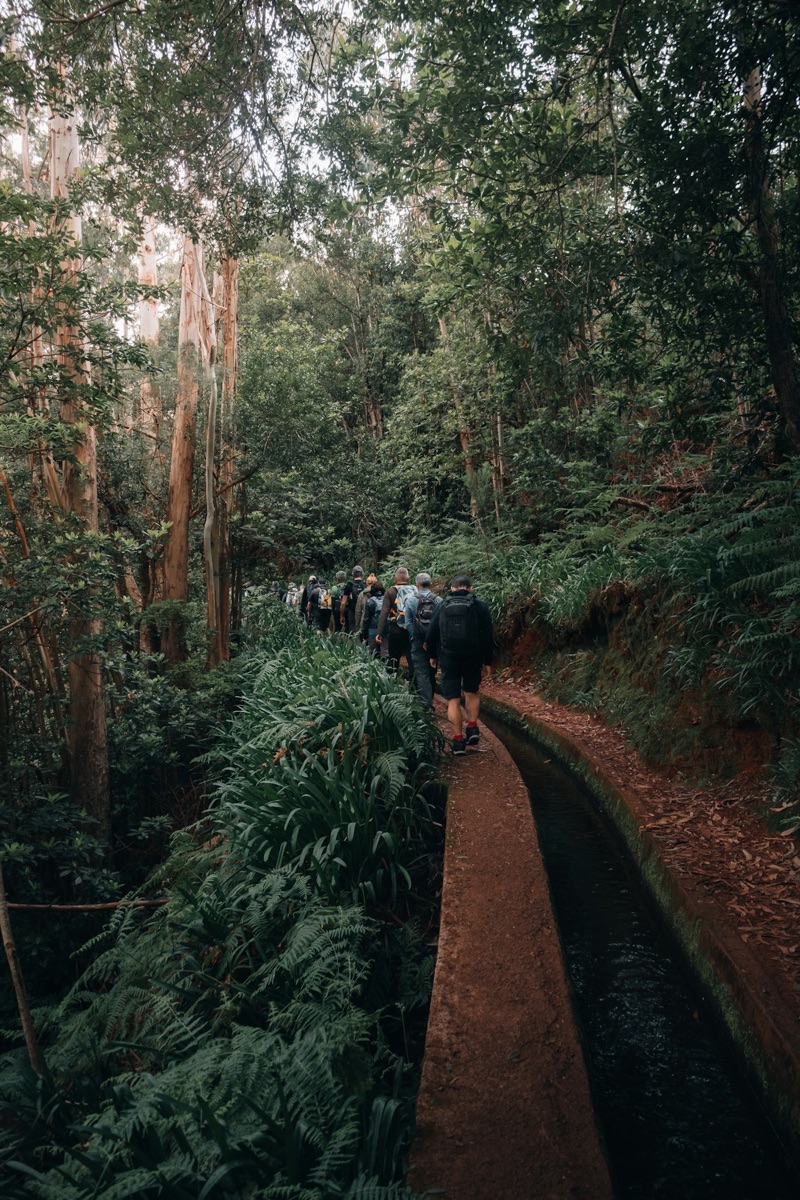
Madeira’s levada network is the island’s signature offering - over 2,000 km of paths following ancient stone irrigation channels through the mountains. The channels run at near-level gradients, making many routes accessible even to non-hikers. Top walks:
- PR1 Levada do Caldeirão Verde: 13 km round trip; through four tunnels (bring a torch), ending at a 100m waterfall; moderate
- PR6 Ponta de São Lourenço: 8 km; along a narrow volcanic peninsula with sea on both sides; moderate-hard
- PR1.2 Levada do Caldeirão do Inferno: 16 km; past several waterfalls into a narrow gorge; moderate
The Azores has different hiking - more volcano-oriented, in some cases more physically demanding.
- Sete Cidades caldera walk (São Miguel): 12 km rim walk above the twin green-and-blue caldera lakes; views are extraordinary; moderate
- Pico volcano ascent: 8 km round trip, 1,200m elevation gain; hard; requires guide and advance booking
- Caldeira walk, Faial: 9 km rim circuit above a 6 km-wide caldera; easy-moderate; can be combined with a visit to the Capelinhos volcanic peninsula
Winner for hiking: Both are world-class; Madeira for unique levada walks, Azores for volcano hiking.
Wildlife and Whale Watching
The Azores is one of the top five global destinations for cetacean watching. The deep mid-Atlantic waters around the archipelago support year-round sperm whale populations and seasonal migrations of blue, fin, sei, humpback, and minke whales. Over 25 cetacean species have been recorded. Tours operate from Pico (Espaço Talassa, from €55 per person), Faial, and São Miguel from April through October, with October generally seeing the highest activity.
Madeira also has year-round cetacean activity - resident spinner dolphin and short-finned pilot whale populations, with sperm whales passing through. Riosol Madeira and Lobosonda both run tours from Funchal from approximately €50 per person for a 3-hour trip.
Winner: Azores for wildlife, comprehensively.
Food
Madeira has the stronger food scene. Funchal has a range of restaurants from traditional espetada (beef skewers hung over open-fire coal, approximately €18–22) to modern Portuguese cuisine. The Black Scabbard fish (peixe espada) is a Madeira speciality found nowhere else - typically pan-fried with banana (€16–20). The market in Funchal (Mercado dos Lavradores) is excellent for local produce: passion fruit, custard apples, and honey cake (bolo de mel).
The Azores food is simpler but very good: the Furnas thermal cozido (a stew cooked underground in geothermal hot springs, approximately €18–22 at the restaurants around Caldeira Velha) is a unique experience. Pico wine - produced from Verdelho grapes on volcanic soil - is outstanding, particularly the white. Azorean cheese and beef are both excellent quality.
Winner: Madeira for restaurant variety and food scene; Azores for unique experiences (underground-cooked cozido, volcanic wine).
Cost
Both destinations are comparable in cost to mainland Portugal or slightly above due to island import costs.
Madeira: Mid-range hotel in Funchal €100–160/night. Restaurant mains €14–22. Guided levada walks from €35–55 per person. Porto Santo ferry €55 return.
Azores: Mid-range hotel in Ponta Delgada €90–140/night (São Miguel). Restaurant mains €13–20. Whale watching tour €55–75. Inter-island flights €50–120 each way (adds significantly to a multi-island trip). A Pico volcano guided ascent runs €80–120 per person.
Winner: Roughly equal for a single-island visit; Azores becomes more expensive if you do multiple islands.
See our Azores island hopping itinerary and Madeira one-week guide for detailed planning.
When to Visit
Madeira: Year-round destination. The New Year fireworks display is one of the world’s most spectacular (Guinness World Record holder) and draws large crowds in late December. The flower festival in April/May fills Funchal’s streets with elaborate floral arrangements. Summer (June–September) is warmest and most consistent. Even January sits around 16–18°C in Funchal.
Azores: Best from May through October for whale watching and outdoor activities. The islands receive more rain than Madeira year-round - the Azores are positioned in the path of North Atlantic weather systems - but summers are generally good. The shoulder season (May–June, September–October) offers the best balance of conditions and fewer crowds.
The Azores region guide covers all nine islands in more detail.
If you’re heading to Madeira, tours in Madeira covers guided experiences and day trips. For the Azores, tours in the Azores has the same.
Car hire in Madeira (Funchal Airport) and car hire in the Azores (Ponta Delgada Airport) are both essential — neither island group is well served by public transport beyond the main towns.
Final Verdict
Visit Madeira if: you want a relaxing, warm island holiday with excellent food, year-round sun, world-class levada walking, and the ease of a single-destination trip.
Visit the Azores if: you want raw, dramatic volcanic scenery, world-class whale watching, and multi-island adventure - and you do not mind a bit more rain and planning complexity.
Both deserve to be on every Portugal itinerary. If you have time for both, the contrast is remarkable.
More Portugal Comparisons
- Algarve vs Madeira — mainland beach holiday versus Atlantic island escape
- Pico vs Flores — two of the Azores’ most dramatic islands compared
- São Miguel vs Terceira — the Azores’ two most accessible islands
- Lisbon vs Algarve — if you’re deciding between mainland Portugal options too
Plan Your Trip
🏨 Search hotels in the Azores 🎯 Tours in Madeira 🎯 Tours in the Azores 🏨 Search hotels in Madeira on Booking.com
✈️ Book your flights to Portugal 🛡️ Get travel insurance 📱 Stay connected with an eSIM 🚗 Rent a car