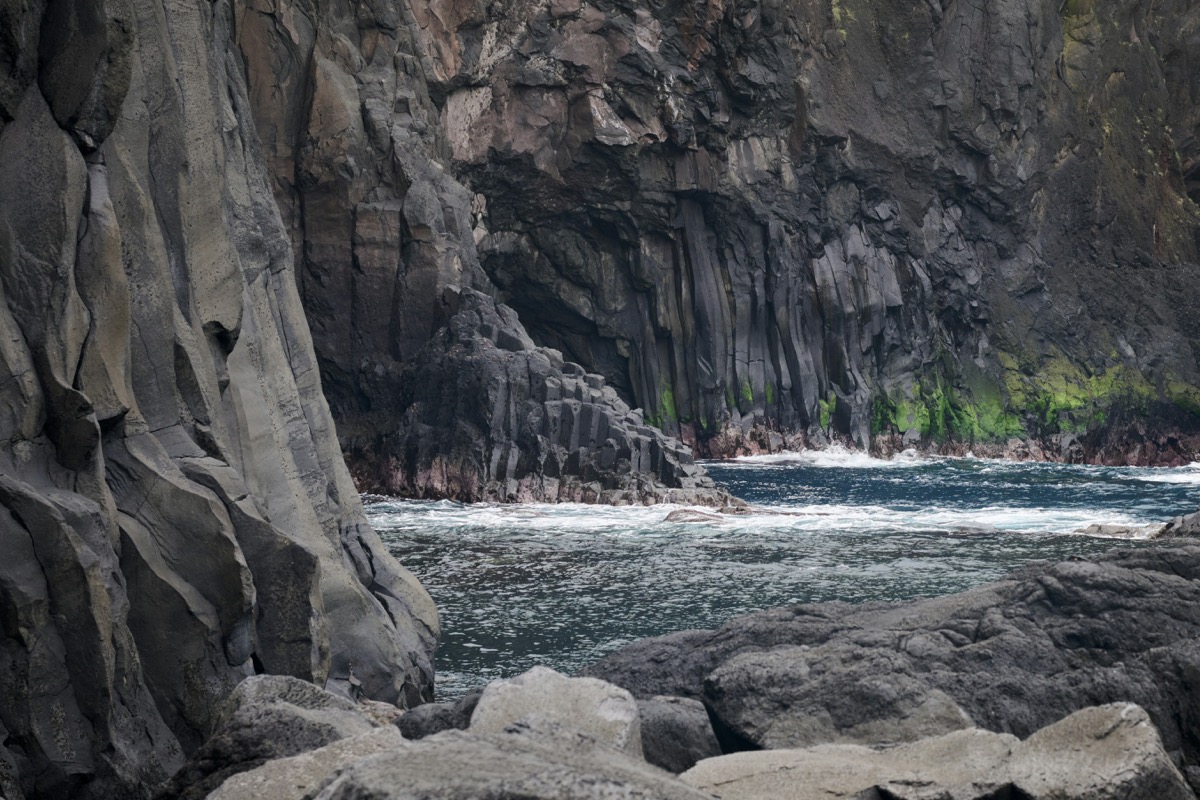
São Jorge and Pico are the two most overlooked islands of the Azores Triangle, overshadowed by the Triangle’s more famous hub at Faial and the archipelago gateway at São Miguel. Both reward the travellers who make the extra ferry hop, but they attract different types. São Jorge is a narrow, elongated ridge of an island, 55km long and never more than 8km wide, whose most distinctive feature is a series of fajãs — flat coastal platforms created by ancient lava flows at the base of dramatic sea cliffs — reached by steep trails through laurisilva forest. Pico is dominated by a single geological fact: a 2,351m shield volcano, Portugal’s highest point, which shapes everything about the island from its character to its wine to its whale watching. If your Azores trip is about hiking, you are choosing between lateral coastal walking through one of the archipelago’s most singular landscapes, or a vertical summit climb that tests serious mountain fitness.
Quick Verdict
| Category | São Jorge | Pico |
|---|---|---|
| Fajã hiking | Winner (unique Atlantic coastal platforms) | — |
| Summit climbing | — | Winner (2,351m, Portugal’s highest) |
| Trail variety | Good (coastal + ridge) | Limited (Pico Mountain dominates) |
| Whale watching | Occasional | Winner (best operators in Azores) |
| Wine | — | Winner (UNESCO Verdelho vineyards) |
| Cheese | Winner (DOP Queijo São Jorge) | — |
| Crowds | Very low | Low |
| Accommodation range | Limited | Better |
| Ferry connections | Faial + Pico | Faial + São Jorge |
| Best for | Coastal hiking, quiet island life | Summit challenge, whale watching, wine |
Choose São Jorge if you want to walk the fajãs — the island’s defining coastal trail experience has almost no equivalent in the Azores and sees very few tourists. Choose Pico if you want to summit Portugal’s highest point, whale watch from the archipelago’s best departure base, and drink wine from a UNESCO-protected volcanic landscape.
Getting There
São Jorge: Velas Airport (SJZ) is the island’s only airport. SATA flies from Ponta Delgada (São Miguel) and occasionally from Lisbon; frequency is lower than Faial or Pico. Most travellers reach São Jorge via ferry from Horta (Faial) — 75 minutes, approximately €9 — or directly from Madalena (Pico) — 45 minutes, approximately €7. Ferries are operated by Atlanticoline and run daily in summer, with reduced winter frequency. Hire a car in Velas; São Jorge has no usable public transport and the fajã trailheads are spread around the island.
Pico: Pico Airport (PIX) is near Madalena. SATA flies from Lisbon (approximately 2 hours) and inter-island from São Miguel. The Faial–Pico ferry from Horta to Madalena is the most-used route: 30 minutes, approximately €6, running up to 8 crossings daily in summer. A car is essential for reaching the Pico Mountain Visitor Centre (south coast road), the Lajes whale watching operators, and the UNESCO vineyards on the western coast.
Between the islands: The Madalena (Pico) to Velas (São Jorge) ferry runs typically 1–2 times daily in summer (45 minutes, ~€7–9). Check Atlanticoline schedules in advance; winter frequency drops significantly. The Triangle ferry network — Horta, Madalena, Velas — is one of the Azores’ great pleasures when weather cooperates.
São Jorge Island
São Jorge is the Azores’ ridge island: a narrow volcanic range running roughly southwest to northeast, with the interior at 400–900m elevation dropping suddenly to sea cliffs on both the north and south coasts. The fajãs — flat platforms created where ancient lava flows reached the sea and cooled — are its signature feature, found nowhere else in the Azores at this scale. There are over 40 fajãs on São Jorge; a handful are accessible by trail, and three are inhabited.
Fajã dos Cubres and Fajã da Caldeira de Santo Cristo
The most visited and most dramatic pairing on the island. Both sit on the north coast, accessed from the village of Norte Grande.
Fajã dos Cubres is the easier of the two: a broad flat platform with a natural lagoon (Lagoa dos Cubres) and reed beds that attract migrating seabirds. The descent from the EN2 road takes approximately 30–40 minutes on a steep but clear path. At the base, the platform is flat and walkable; the lagoon is calm and sheltered, and in summer the water is swimmable. Distance from Norte Grande road junction: approximately 2.5km each way.
Fajã da Caldeira de Santo Cristo requires an additional 2km of mostly flat walking along the coast from Fajã dos Cubres. This fajã is larger, inhabited (about 10 permanent residents), and is one of the only places in Portugal where clam cultivation takes place in natural saltwater pools. The clams (berbigão) from Santo Cristo are a regional delicacy; if the small restaurant in the settlement is open, the clam rice (arroz de berbigão) costs approximately €14–18 and is worth planning your trip around. The round trip from the road takes 4–5 hours.
Practical notes: Wear proper hiking shoes — the descent is steep, the lava path is uneven, and the return climb is strenuous. Start early; the north-coast cliffs shade the fajãs in afternoon. No shade on the platform itself. Carry 1.5 litres of water and food; nothing is available at the fajã (the Santo Cristo restaurant has unpredictable hours).
Fajã do Ouvidor
On the south coast, this smaller but atmospheric fajã is reached from Urzelina village via a 1.5km descent (approximately 30 minutes). The platform has a small dark beach, sea stacks, and dramatic basalt cliff walls rising directly behind. Fewer visitors than the north coast fajãs; better for solitude. The volcanic rock formations around the waterline are extraordinary at low tide.
Fajã de São João
Accessible from the north coast road near Pico da Esperança (São Jorge’s highest point at 1,053m). A longer descent of approximately 45 minutes leads to one of the island’s more remote inhabited fajãs, with a handful of traditional stone houses, lemon groves, and a natural swimming channel between the lava shelf and a sea stack. Almost no visitors; carry everything you need.
Ridge Walking
The EN1 road runs the length of the island at ridge level through the Parque Natural do Pico and São Jorge. Between Topo in the east and Rosais in the west, the ridge provides views over both coastlines simultaneously — on clear days you see Pico’s volcano to the south and Graciosa to the north. A walking route along the ridge (PR2 SJ trail, approximately 14km one way from Pico da Esperança) is signed but requires a car shuttle or taxi to return. Allow 4–5 hours.
Queijo São Jorge: The island’s DOP-protected cheese is available at the Uniqueijo factory in Velas, where tours (€5) show the production process. The aged version (more than 3 months) has a firm paste and a nutty, slightly spicy character that becomes more pronounced in the extra-aged (6+ month) version. Buy direct from the factory; it is significantly cheaper than buying in Lisbon.
Accommodation on São Jorge: Options are limited compared to Faial or Pico. Guesthouses in Velas and Norte Grande from approximately €65–95/night; a handful of rural Turismo Rural properties offer full kitchens from €70–120. Book ahead in July–August.
Search hotels in São Jorge on Booking.com
Pico Island
Pico at 447km² is the second-largest Azores island and the most vertical. The island is essentially one enormous shield volcano — Montanha do Pico — rising from the ocean floor to 2,351m above sea level, the highest point in Portugal. The mountain is visible from Faial, São Jorge, and Graciosa on clear days, its upper section frequently capped in cloud.
Climbing Pico Mountain
The trailhead begins at the Pico Mountain Visitor Centre on the south flank at 1,217m elevation. All hikers must register before ascending; registration is mandatory and checked. The route to the caldera rim is approximately 3.5km, gaining 600m on loose volcanic scoria — 1h30 to 2 hours up. The caldera rim sits at around 1,815m. From here, the true summit (Piquinho) is a further 30–45 minutes of exposed scrambling on the summit cone, involving fixed chains, significant drops, and no room for error in poor visibility.
Total: approximately 7.5km return, 7–8 hours, 1,134m elevation gain from the Visitor Centre.
Start no later than 5–6am to reach the summit before cloud closes in, typically by 10am–noon. The summit is frequently 10–15°C colder than the coast and wind-exposed. Bring: trekking poles for the scoria descent (not for the Piquinho scramble), warm layers, wind and rain protection, a head torch if starting before dawn, 2+ litres of water (nothing available above the Visitor Centre), and robust footwear. Guidebooks are not required, but the trail is marked.
Guided ascent: A certified mountain guide is strongly recommended for first-timers on the Piquinho section. Local guide associations offer half-day summit services for approximately €60–90 per person in small groups; book in advance in July–August. The Pico Mountain Visitor Centre can provide referrals.
Whale Watching
Pico is the Azores’ best whale watching base. The deep Atlantic trough passes close to the island’s south coast, and Pico’s operators use traditional shore-based vigias (lookout towers) to spot whales before boats depart — cutting transit time and increasing sighting rates. The resident population of sperm whales is year-round; blue, fin, humpback, and sei whales pass through on migration routes between spring and autumn.
Primary operators in Lajes do Pico: Espaço Talassa (long-established, shore-based vigias, €65–80 for 3–4 hours) and Pico Sport (smaller group size, specialist focus, similar pricing). Book ahead in peak season; morning departures have the calmest conditions.
UNESCO Vineyards
Pico’s wine landscape is listed as a UNESCO Cultural Landscape (2004). Thousands of individual grapevines are grown inside hand-built basalt enclosures (currais) — low walls that protect each vine from Atlantic salt wind. From above, the entire western end of the island looks like a giant black grid. The Cooperativa Vitivinícola da Ilha do Pico in Madalena offers tasting tours (approximately €8–10). The main grape, Verdelho, produces a fresh dry white and a fortified style. Buy at the cooperative — retail prices start around €7 a bottle.
Whalers Museum
Pico’s whaling industry ran until 1981, the last in Portugal. The Museu dos Baleeiros in Lajes do Pico occupies the former whaling station: original factory machinery, restored handmade hunting boats, logbooks from 19th-century voyages, and an extraordinary collection of scrimshaw (whale-tooth and whale-bone carving). Entry approximately €3. Allow 1.5–2 hours.
Accommodation on Pico: Hotels in Madalena from approximately €80–130/night. Rural guest houses near the vineyard area and near the mountain trailhead offer more atmosphere and slightly lower prices.
Search hotels in Pico on Booking.com
Head-to-Head: Hiking
São Jorge fajã trails: The descents to Fajã dos Cubres and Santo Cristo are the island’s signature experience. They are strenuous, steep, and entirely unlike anything else in the Azores — lateral coastal walking across ancient lava platforms with the ocean on one side and 400m basalt cliffs on the other. Total round trip including the walk between the two fajãs: 10–12km, 4–5 hours. Suitable for fit walkers who are comfortable on uneven terrain; not for people with knee problems or a fear of heights on steep descents.
Pico Mountain: The Pico ascent is in a different category — a high-altitude volcanic summit with genuine mountaineering elements on the Piquinho section. The hike demands altitude tolerance, good weather judgement, and physical fitness. For non-summit hikers, there is little else on the island; Pico’s lowland terrain is not especially interesting on foot.
Winner for hiking variety and accessibility: São Jorge. Winner for summit challenge: Pico.
When to Visit
São Jorge: May–September. The fajã trails are hikeable year-round in dry weather, but cloud and rain are frequent outside summer and the descents become dangerous when wet. July–August is the driest period and the clam restaurant at Santo Cristo has the best opening consistency. Avoid the fajã trails in wet or misty conditions; the lava surfaces become slippery and sections near cliff edges are not forgiving.
Pico: June–September for summit conditions. Blue whale season peaks April–May; sperm whales year-round. Winter summit attempts are frequently impossible due to wind, cloud, and icing above 1,500m. Vineyard tours run spring through autumn.
See our Azores island-hopping itinerary for a complete Triangle routing that combines São Jorge, Pico, and Faial, and the Azores region guide for all nine islands.
For guided tours on São Jorge, browse tours in São Jorge — fajã guided hikes and island jeep tours are the most popular options. For Pico, tours in Pico covers whale watching, Pico Mountain guided climbs, and vineyard visits.
For accommodation guides, see our São Jorge hotels guide and Pico hotels guide.
Final Verdict
Visit São Jorge if: you want a genuinely unique Azores hiking experience — the fajã trails are unlike anything else in the archipelago, the island is extremely quiet, and the combination of coastal geology, aged cheese, and minimal tourist infrastructure suits travellers who want the Azores at its most raw. This is the island for the hiker who has done São Miguel and wants something harder to reach and more rewarding.
Visit Pico if: you want to summit Portugal’s highest mountain, whale watch from the best base in the Atlantic, and drink wine from a UNESCO volcanic landscape. The Pico ascent is one of the best island summit hikes in Europe; if that objective resonates, nothing else in the Azores competes.
São Jorge is for the lateral walker who wants to feel the island from the coast up; Pico is for the vertical climber who wants to stand above the clouds. Both are essential to understanding what the Triangle actually offers.
More Portugal Comparisons
- Madeira vs Azores — the Atlantic island groups of Portugal compared
- Pico vs Flores — Pico compared to the Azores’ most remote island
- São Jorge vs Faial — São Jorge compared to the Triangle’s hub island
- São Miguel vs Terceira — the Azores’ two most accessible islands
Plan Your Trip
🏨 Search hotels in São Jorge 🏨 Search hotels in Pico 🎯 Tours in São Jorge 🎯 Tours in Pico ✈️ Book your flights to Portugal 🛡️ Get travel insurance 📱 Stay connected with an eSIM 🚗 Rent a car