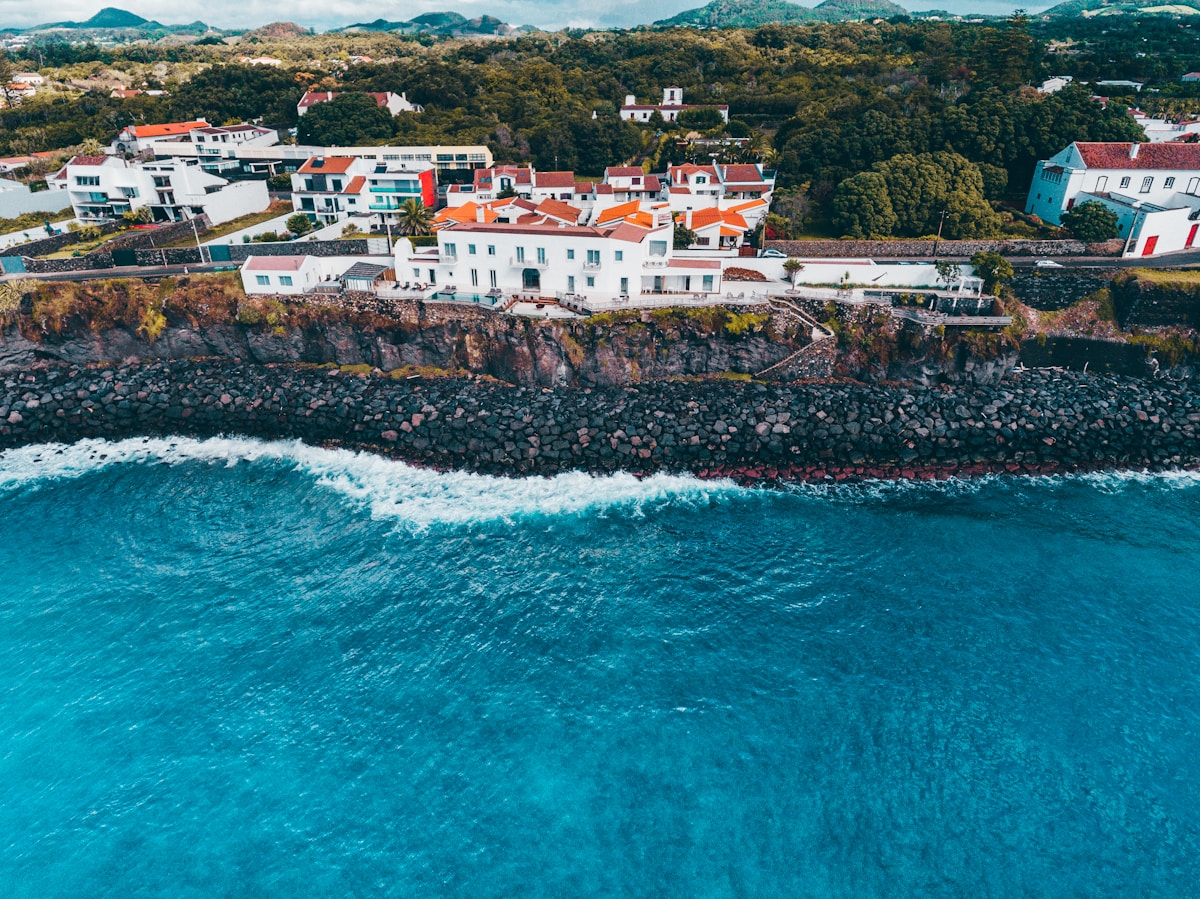
The Azores are a Portuguese archipelago in the mid-Atlantic, positioned roughly equidistant between Lisbon and New York. Nine volcanic islands, formed by the same geological hotspot that still feeds the Mid-Atlantic Ridge, have a character shaped entirely by their position and their origin: the landscape is relentlessly green, the sea is rarely calm, and the volcanic geology appears in everything from boiling calderas to thermal baths to the black sand of the beaches.
São Miguel - The Starting Point
São Miguel is the largest island (746 km²) and home to Ponta Delgada, the archipelago’s capital and its main transport hub. Most visitors start here, and most first-time visitors to the Azores see only São Miguel - which is understandable given that the island packs an exceptional range of landscapes into a small area.
Sete Cidades - two lakes (one green, one blue) inside a volcanic caldera - is the archipelago’s most photographed landscape. The viewpoint at Vista do Rei gives the full panorama; the caldera floor, reached by a winding descent, allows you to walk between the lakes. The difference in colour between the lakes is caused by the angle at which sunlight reflects from each side of the caldera.
Furnas - a village built around a geothermal area where the ground steams visibly and the lake contains active volcanic vents. The local cozido das Furnas (a slow-cooked stew) is buried in canisters underground and cooked for 8–9 hours in the volcanic heat. Terra Nostra park, with its thermal pool the colour of iron-rich mud, costs €8 to enter.
Sete Cidades and Lagoa do Fogo (a crater lake in the island’s centre) are the two other landscapes that define São Miguel. Lagoa do Fogo has no visitor infrastructure - it sits in a nature reserve and the descent to the lake edge is steep - which keeps it less crowded than Sete Cidades.
Pico - The Volcano
Pico is defined by its namesake mountain - Ponta do Pico, at 2,351m the highest point in Portugal and visible from Faial on clear days. The climb to the summit is a 7–8 hour return hike, requiring a permit (€15 per person, book in advance at montanhaspico.azores.gov.pt). The route begins at Casa da Montanha at 1,200m and crosses exposed volcanic lava fields. Summit views on clear days extend across the central group islands.
Pico’s other distinction is its UNESCO-listed wine landscape - basalt walls laid by hand across the entire coastal plateau, creating a black grid of small parcels that shelters vines from Atlantic wind. The wine produced (Pico wine, from Verdelho grapes) is crisp, mineral, and unusual. The Museu do Vinho in Madalena explains the landscape’s history.
Faial - Blue Island
Faial, 7 km across the channel from Pico, is called the Blue Island for its hydrangea hedgerows that line every road from June to August. Horta, its main town, has the most visited marina in the North Atlantic - transatlantic sailors stop here to refuel and rest, and Peter Café Sport (open since 1918) is their traditional meeting point. The wall of business cards, badges, and boat names inside the café spans decades of maritime crossings.
The Capelinhos volcano erupted in 1957–58, extending the island’s western tip by 2.4 km in 13 months and forcing the evacuation of 2,000 people. The abandoned lighthouse and the hardened lava landscape are now a visitor site with an underground museum (€6) that tells the eruption’s story. The moon-like terrain around the lighthouse is the most otherworldly landscape in the Azores.
Terceira - History and Bulls
Angra do Heroísmo, Terceira’s capital, is a UNESCO World Heritage Site - a 16th-century city laid out on a grid plan with Renaissance churches, Portuguese baroque palaces, and a castle overlooking the harbour. It was the administrative capital of the Portuguese Empire’s Atlantic operations and remains one of the best-preserved colonial-era towns in Portugal.
Terceira’s bullfighting tradition (tourada à corda) is unique - bulls are controlled by ropes held by eight men (pastores) rather than confined to a ring, and they run through the streets of villages during summer festivals. Attendance is free and the festivals run from June to October.
The Algar do Carvão, a lava tube open for visits (€8), descends 45m into the earth and contains a subterranean lake.
São Jorge - For Walkers
São Jorge is a long, narrow ridge island - 54 km long, 8 km wide - characterised by fajãs: flat platforms of land created by ancient lava flows that now sit at sea level below the island’s steep cliffs. Some fajãs are accessible only by cliff path; others have small fishing communities accessible by road. The walking routes between fajãs are among the best in the archipelago, with vertiginous paths above the sea.
Queijo de São Jorge - a firm, slightly spicy cow’s milk cheese aged for a minimum of 60 days - is the island’s export and one of Portugal’s best cheeses.
The Western Islands - Flores and Corvo
Flores and Corvo receive a fraction of the visitors of the central group despite being - for many who go - the archipelago’s most impressive islands. Flores has waterfalls that drop directly into the sea, seven crater lakes within walking distance of each other, and a vegetation density that the eastern islands can’t match. Corvo, with 380 inhabitants, has one road and one caldera lake - the Caldeirão - that dominates the island.
Getting to Flores requires an inter-island flight (45 minutes from São Miguel or Faial) or the summer ferry from Faial. Weather can prevent access for days at a time in autumn and winter.
Practical Island-Hopping
By air: SATA Air Açores operates between all nine islands. Flights are short (20–45 minutes) and book well in advance in summer. Expect €80–150 for inter-island flights. The airline’s punctuality is affected by Atlantic weather.
By ferry: Atlanticoline runs seasonal ferry connections between Faial, Pico, São Jorge, Graciosa, and Terceira from approximately June to September. Timetables change annually. The Faial–Pico crossing (40 minutes, €6) is the most-used route - frequent and reliable.
A suggested 10-day structure: São Miguel (3–4 days) → Faial + Pico (3 days, ferry between them) → Terceira (2–3 days). This covers the three most distinct landscapes without overfilling the schedule.
What to Eat
- Cozido das Furnas - volcanic slow-cooked stew, São Miguel speciality, €15–18
- Alcatra - beef marinated in wine and spices, Terceira speciality
- Lapas grelhadas - grilled limpets with butter and garlic, ubiquitous and excellent
- Queijo de São Jorge - aged cow’s milk cheese, sold across all islands
- Pico wine - Verdelho-based wines from the UNESCO lava landscape
- Azorean dairy - the milk, butter, and cream are noticeably richer than mainland equivalents
When to Go
May–September: Best for inter-island travel, whale watching, swimming, and hiking. July and August are warmest (24–26°C) and most crowded.
October–April: Rain increases, ferry services reduce, but the islands are quieter and whale watching remains active. Sperm whales are resident year-round. Winter storms create dramatic surf and scenery.
For guided experiences in the region, tours across Portugal covers day trips, food and wine tours, and activity bookings.
Car hire in the Azores gives you the most flexibility for exploring - particularly useful in rural areas where public transport connections are limited.
Planning Your Azores Trip
Most visitors start at São Miguel and may extend to Terceira or the central group (Faial, Pico). For wildlife, our dedicated whale watching in the Azores guide covers operators on Pico, São Miguel, and Faial, with booking details and species expectations. Our Azores island-hopping itinerary builds a suggested 10-day circuit. For those deciding between the islands and the mainland, see Madeira vs Azores. New air connections from North America are covered in our news article on the Air Canada Azores-Toronto nonstop.
Search hotels in Azores on Booking.com to compare rates and availability.