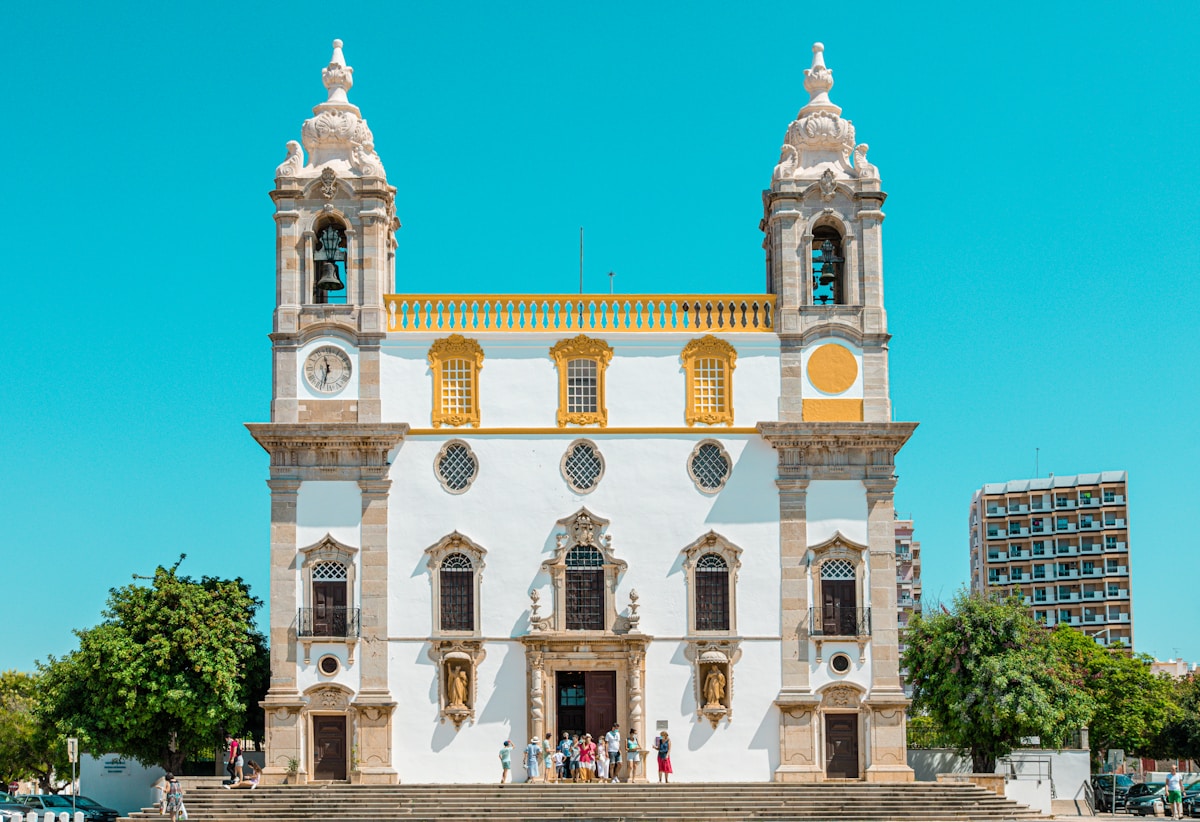
Tavira and Lagos sit at opposite ends of the Algarve — Tavira in the east, Lagos in the west — and the 100 km between them represents a genuine difference in character, not just distance. Tavira is the Algarve before the mass-tourism era: Roman bridges, Moorish castle ruins, a barrier island beach reached by ferry, and a town that feels genuinely Portuguese. Lagos is the Algarve at its most dramatic and most visited: golden limestone sea stacks, cliff-backed coves, a well-developed old town, and more evening energy than anywhere else in the region.
Neither is better in any absolute sense. The right choice depends entirely on what you want from a base.
Quick Verdict
| Category | Tavira | Lagos |
|---|---|---|
| Beach scenery | Good (barrier island) | Winner |
| Crowd levels | Winner (quieter) | Busy in peak season |
| Authentic atmosphere | Winner | More tourist-facing |
| Sea caves & cliffs | — | Winner |
| Nightlife | Very limited | Winner |
| Families | Winner | Good (Meia Praia) |
| Price | Winner (cheaper) | — |
| Surf access | — | Winner |
| Eastern Algarve day trips | Winner | — |
| Western Algarve day trips | — | Winner |
Choose Tavira if you want a quieter base, a barrier island beach without Atlantic swell, genuine Portuguese character, and access to the eastern Ria Formosa coast. Choose Lagos if you want dramatic cliff beaches, sea cave boat tours, more evening energy, and a base for Sagres and the wild western Algarve.
The Cities
Tavira
Tavira is consistently described as the most elegant town in the Algarve — a description that fits. The Roman bridge crossing the Gilão River, the remains of the 11th-century Moorish castle, and the distinctive four-sided pyramid roofs (unique to Tavira, a legacy of the town’s connections with North Africa) give it an architectural coherence that larger Algarve towns lack. The historic centre has 37 churches — most in disrepair, but the Igreja de Santa Maria do Castelo (free entry) and the Igreja de Santiago contain notable azulejo tile work. The Museu Municipal de Tavira (€2) covers the town’s Roman-through-Moorish history with a worthwhile archaeological collection.
Tavira sits on the eastern edge of the Ria Formosa Natural Park. The lagoon landscape — tidal channels, oyster beds, flamingos, and barrier islands — defines the town’s character as much as its architecture. It’s a place that rewards slow exploration: a morning at the market (Mercado da Ribeira, riverside, open until early afternoon), an afternoon on the island, an evening along the river.
Lagos
Lagos had a significance in Portuguese history that its current reputation as a beach destination understates. The town walls date from the Moorish period and were extended during the Age of Discovery — Vasco da Gama and Gil Eanes both departed from here, and the waterfront Forte da Ponta da Bandeira (€3, good views from the tower) marks the spot. The Mercado de Escravos (Municipal Museum, €3) — Europe’s first slave market, built in 1444 — is sobering context for the Age of Discovery narrative. The Igreja de Santo António (€3) contains one of the most exuberant gilt Baroque interiors in the Algarve.
The old town is compact and well-preserved. The streets inside the medieval walls between Praça Gil Eanes and the waterfront have a good concentration of independent restaurants, bars, and craft shops — it feels less generic than Albufeira’s old town. The marina is the departure point for boat tours to Ponta da Piedade, the sea cave formation 2 km south that justifies Lagos’s reputation for dramatic coastal scenery.
Beaches
Tavira’s beaches are accessed by ferry. The aquatáxi (water taxi) from below Praça Dr. António Padinha departs frequently in summer, costs €1.50 each way (€3 return), and reaches Ilha de Tavira in 10 minutes. A longer route runs from Quatro Águas, 2 km east of town. Ilha de Tavira is a 12 km barrier island with calm, lagoon-sheltered water on one side and gentle Atlantic surf on the other — the water is shallower and calmer than the exposed Atlantic beaches of the western Algarve. The island has beach bars and a campsite; most of it remains largely undeveloped. In peak July and August the island gets busy, but the long beach distributes visitors more effectively than enclosed cove beaches.
Lagos’s beaches are the reason most people book the town in the first place:
- Meia Praia: 5 km long, gently shelving, sheltered from the main Atlantic swell by the bay configuration. Water sports rental available. Reached by ferry from the marina (€1.50) or a short drive east.
- Praia Dona Ana: Golden rock formations and a small cove, 15 minutes’ walk from the centre. Excellent on calm days; wave-exposed in swell.
- Praia do Camilo: Reached via cliff steps. One of the most photographed beaches in Portugal for good reason — extraordinary rock arch backdrop and good snorkelling.
- Ponta da Piedade sea caves: Not a swimming beach but Portugal’s most photographed coastal feature, accessible by boat from the marina (€15–20/person for a 45-minute motorboat tour) or by kayak (€35–45/person for a 2.5-hour guided paddle from Lagos Kayak or Kayaking the Algarve). Book kayak tours at least a day ahead June through August.
Winner: Lagos for scenic drama. Tavira for calm, family-friendly water and barrier island character.
Things to Do
In Tavira, the best activity beyond the beach is exploring the Ria Formosa by boat. Tours in Tavira include guided lagoon kayak tours, birdwatching trips (flamingos, spoonbills, and avocets are year-round residents), and day trips to the Roman ruins of Cacela Velha — a fortified village on a clifftop 8 km east with sweeping views over the eastern lagoon. The castle ruins above the town provide a free viewpoint over the rooftops and river. In the lagoon, oyster and clam farms offer occasional tasting tours (check locally in summer).
In Lagos, tours in Lagos cover sea cave boat tours, kayak expeditions to Ponta da Piedade, dolphin watching trips from the marina, and surf lessons at Meia Praia. Sagres is 30 km west — Europe’s most south-westerly point, with its own fort (€3) and consistent surf breaks — making an easy day trip by car. The Benagil sea cave, the most famous on the Algarve, is about 50 km east and takes around 50 minutes to reach by car; boat tours depart from Carvoeiro and Armação de Pêra. See the Algarve boat trips guide for a full breakdown of departure points and operators.
Winner: Lagos for variety and activity volume. Tavira for nature-based experiences and day trips into the Ria Formosa.
Food and Drink
Tavira’s restaurant scene is smaller but more local-facing than Lagos. The riverside restaurants along both banks of the Gilão serve broadly similar seafood menus; better value is found a block back from the water. The local speciality is atum (bluefin tuna) — look for tuna moqueca, tuna açorda, and tuna escalopes on the menu. Bivalves from the Ria Formosa (ameijoas à bulhão pato, grilled oysters) are reliably good and fresh. Restaurante O Pátio on Rua Dr. António Cabreira is the consistently recommended choice for traditional Algarve cooking; mains run approximately €12–18. The covered Mercado da Ribeira in the mornings has good local produce.
Lagos has more variety and caters to a larger, more international crowd. The waterfront strip around the marina tends toward tourist pricing (views compensate, food varies); better value is found two streets back in the old town. The cataplana — a copper pot stew of shellfish, pork, and tomatoes — is the Algarve’s signature dish and is well-represented in Lagos restaurants; expect to pay €18–28 for a single-person cataplana at mid-range restaurants. Restaurante O Camilo, perched above Praia do Camilo, is the best combination of setting and food quality; O Páteo on Rua Lancarote de Freitas is more affordable for straightforward grilled fish. The Portuguese seafood guide covers both towns’ kitchen traditions in more detail.
Winner: Tavira for price and authenticity. Lagos for variety.
Cost
Tavira is meaningfully cheaper than Lagos across most categories.
Accommodation in Tavira: Guesthouses and small hotels in and near the historic centre run approximately €70–110/night in shoulder season (May, June, September, October), rising to €120–150 in peak July–August. Search hotels in Tavira for current availability.
Accommodation in Lagos: Mid-range hotels run €90–150/night in shoulder season, rising sharply to €180–280 in peak July–August. The broader choice of international-brand and boutique hotels means more options at the upper end, but budget and mid-range options fill well in advance for July and August — book at least 6–8 weeks ahead for peak season. Search hotels in Lagos for current rates.
Eating out: Expect to pay approximately €12–18 for a main in a mid-range Tavira restaurant vs €14–22 in Lagos. Coffee, beer, and snacks are similarly lower-priced in Tavira.
Tours and activities: Comparable prices — boat tours run €15–20/person in both towns for the standard lagoon or sea cave option.
Winner: Tavira for budget-conscious travellers.
Getting There and Between the Two
Both towns are on the Algarve rail line operated from Faro. From Faro, Tavira is 30–35 minutes east by direct train (€3.20–4.00); Lagos requires a change at Tunes and takes approximately 1 hour 45 minutes (€7–10). By hire car from Faro airport, Tavira is 30 km east (25 minutes on the A22) and Lagos is 80 km west (55 minutes on the A22).
Travelling directly between Tavira and Lagos without a car is slow — approximately 2 hours 30 minutes by train via Faro and Tunes, with at least one change. Car hire at Faro airport is the most practical approach for any itinerary that combines the eastern and western Algarve. Picking up at the airport and dropping off at the same point makes a Tavira-then-Lagos (or Lagos-then-Tavira) circuit straightforward.
The tolled A22 motorway (Via do Infante) connects the two towns; the direct Tavira–Lagos toll costs approximately €6–8 each way. The N125 national road runs parallel and is toll-free but significantly slower.
Who Should Choose Each?
Choose Tavira if you:
- Want a quieter, more authentically Portuguese base with fewer package tourists
- Are travelling with young children (calm barrier island beach, compact walkable centre)
- Plan to explore the eastern Algarve — Olhão, the Ria Formosa, Castro Marim, the Spanish border
- Prefer nature-based activities: birdwatching, lagoon kayaking, local seafood
- Are visiting on a tighter budget
Choose Lagos if you:
- Want dramatic Atlantic cliff beaches and sea cave boat tours
- Plan to explore the western Algarve — Sagres, Aljezur, the Vicentina coast
- Enjoy evening atmosphere, restaurant variety, and some nightlife
- Are travelling as independent travellers or a group who appreciate a lively town
- Want surf lesson access or easy day-trip range to Benagil Cave
For a week-long Algarve trip with a hire car, combining both works well: fly into Faro, drive east to Tavira first (2–3 nights), then cross the Algarve to Lagos (3–4 nights), and return to Faro to fly. Our 7-day Algarve road trip covers this exact circuit. For a broader east-vs-west comparison, the Faro vs Lagos guide puts Tavira in the context of the Algarve’s main transport hub.
Final Verdict
Tavira and Lagos are not competing for the same traveller. Tavira is for the Algarve visitor who wants elegance, quiet, a genuinely Portuguese town, and a beach experience that doesn’t involve fighting for cliff step access. Lagos is for the visitor who wants the full-throttle Algarve — sea caves, cliff beaches, evening atmosphere, and a base for the dramatic western coast.
If you can only pick one and the decision is genuinely difficult, ask yourself this: do you want to watch flamingos from a lagoon kayak and eat fresh tuna beside a Roman bridge, or do you want to kayak inside a golden limestone sea arch and eat a cataplana on a restaurant terrace above the Atlantic? Both are excellent choices. They’re just different Algarvian versions of the same coastline.
Browse tours in the Algarve to compare activities across both towns before committing to your base.
More Portugal Comparisons
- Faro vs Lagos — the Algarve’s gateway city versus its beach capital
- Lagos vs Albufeira — two different takes on the central and western Algarve
- Lagos vs Sagres — how far west to go on the Algarve coast
- Lisbon vs Algarve — city culture versus the classic beach holiday
Plan Your Trip
✈️ Book your flights to Portugal 🛡️ Get travel insurance 📱 Stay connected with an eSIM 🚗 Rent a car at Faro Airport