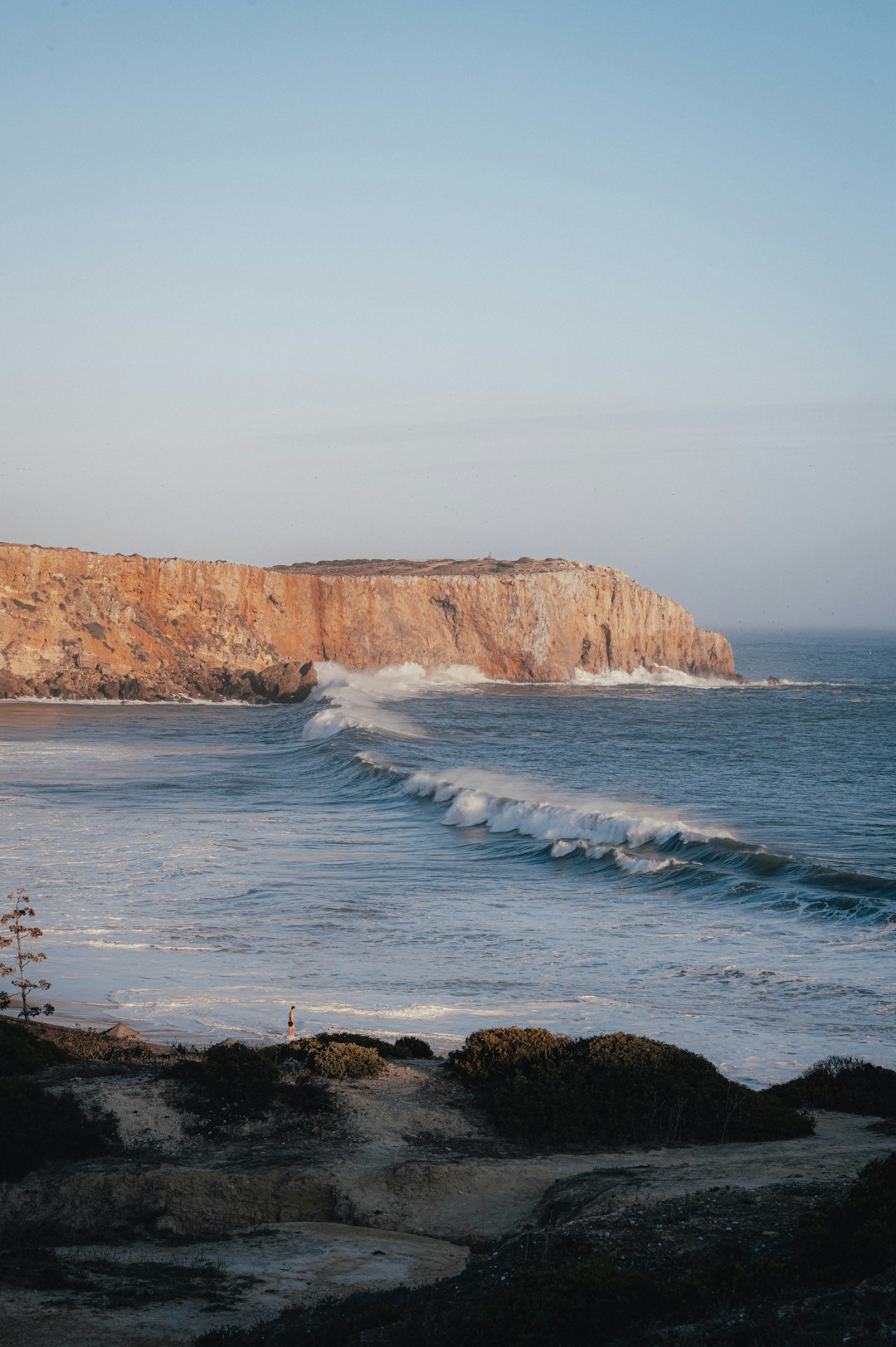
Lagos and Sagres are 32 kilometres apart on the western Algarve coast, but they are very different destinations. Lagos is a working town of around 31,000 people — the Algarve’s most popular independent traveller base, with spectacular sea caves and cliff beaches, a proper old town, a buzzing marina, and enough restaurants and nightlife to fill a week. Sagres is a small fishing village of around 2,000 at Portugal’s southwestern corner, exposed to the full force of the Atlantic, with world-class surf, dramatic coastal fortress ruins, and almost nothing to do after dark.
Choosing between them depends entirely on what kind of holiday you want.
Quick Verdict
| Category | Lagos | Sagres |
|---|---|---|
| Beach variety | Winner | Fewer options |
| Sea caves (Ponta da Piedade) | Winner | — |
| Surf quality | Limited | Winner |
| Nightlife | Winner | Almost none |
| Restaurants | Winner | 4–6 options |
| Scenery / drama | Excellent | Winner |
| Accommodation range | Winner | Budget/mid mostly |
| Day trip access | Easy | More remote |
| Diving | Good | Winner (richer marine life) |
| Transport connections | Winner | Remote |
Choose Lagos for a classic beach holiday with variety — beautiful beaches, sea caves, good restaurants, and easy access to the rest of the Algarve. Choose Sagres if you surf, dive, or want a genuinely remote, dramatic setting with minimal crowds.
The Beaches
Lagos
Lagos has four beaches within or close to the town, each with a different character.
- Praia Dona Ana: A sheltered cove framed by dramatic limestone stacks and arches, 1.5km south of the old town and walkable. Consistently rated among the most beautiful beaches in the Algarve. Gets crowded by mid-morning in July–August — arrive before 9am or after 4pm for breathing room.
- Praia do Camilo: Accessed via a long wooden staircase descending the cliff face, smaller and more secluded than Dona Ana despite being directly adjacent to Ponta da Piedade. A favourite for snorkelling.
- Meia Praia: A 4km flat sandy beach east of the marina, on the sheltered bay side. More family-friendly, gently sloping, with beach bars and parking. Accessed by ferry from the marina (€1.50) or by car.
- Praia da Luz: A wider beach in the village of Luz, 8km west of Lagos, with a large expat community and somewhat more space than central Lagos beaches in peak season.
Ponta da Piedade, 2km south of Lagos, is the star attraction — a headland of golden limestone carved into arches, stacks, grottoes, and caves by Atlantic erosion. Kayak tours (€35–50, 2–3 hours) take you inside the cave systems; boat tours from the marina (€15–20) cover the exterior formations. Book a kayak or boat tour in Lagos to explore Ponta da Piedade at its best.
Sagres
Sagres has fewer beaches but they punch above their weight.
- Praia de Mareta: The main beach below the village, facing south into a sheltered bay. Calmer than the Atlantic-facing beaches, good for swimming, and set against dramatic headland views. Less crowded than Lagos beaches even in summer.
- Praia do Tonel: Just north of Sagres Fortress, facing northwest into the full Atlantic. The main surf beach — a powerful beach break producing consistent waves for intermediate to advanced surfers year-round. Unsuitable for casual swimming in most conditions due to strong rip currents.
- Praia do Beliche: Between Sagres and Cabo de São Vicente, tucked into a cliff channel. The best-protected surf beach in the area, working in a wide range of swell sizes. Small and atmospheric.
- Praia da Ingrina and Praia do Zavial: Two small beaches east of Sagres (15–20 minutes by car) in sheltered bays with calm clear water. Rarely crowded.
Winner for beach variety: Lagos. Winner for surf beaches: Sagres.
The Towns
Lagos’s old town is enclosed within 16th-century walls, largely intact. The Praça Gil Eanes and Praça da República are the main squares. The Igreja de Santo António (€4 combined with the Municipal Museum) has one of the finest gilded baroque interiors in the Algarve. The Forte da Ponta da Bandeira at the marina waterfront (€3) covers the Age of Discovery. The marina has a good concentration of restaurants and boat tour operators; the streets behind it — around Rua Câmara dos Reis — have bars that stay open late in summer.
Sagres is a strip of restaurants, surf shops, and guesthouses around a central square (Praça da República), with the main commercial street running a few hundred metres. The village has no significant nightlife — a few bars close by 11pm. What Sagres does have is the Fortaleza de Sagres (€3), a fortified headland directly above the Atlantic. The fortress enclosure contains a giant stone wind compass (the Rosa dos Ventos), a small whitewashed church, and cliffs that drop vertically into the sea. The views across the cape are among the most dramatic in Portugal.
Six kilometres west of Sagres is Cabo de São Vicente — Europe’s most southwesterly point, a 75-metre cliff face with a functioning lighthouse (free exterior, gift shop inside). Every evening at sunset, dozens of people gather here to watch the sun descend into the Atlantic. It sounds like a tourist cliché; it genuinely is not.
Winner for town character: Lagos. Winner for scenery: Sagres.
Accommodation
Lagos: A full range from budget hostels to boutique hotels.
- Hostel Solmar (backpacker social hostel, dorms from €18/night)
- Hotel Tivoli Lagos (4-star, from €140/night)
- Quinta dos Carriços (rural guesthouse, 10 minutes east, from €95/night)
- Abundant Airbnb apartments (€70–140/night in shoulder season)
Search hotels in Lagos for current rates and availability.
Sagres: Smaller supply, mostly guesthouses, surf camps, and self-catering.
- Pousada do Infante (converted fortress hotel above the sea, from €130/night in shoulder season)
- Memmo Baleeira (design hotel with Atlantic views, from €170/night in peak season)
- Sagres Natura Surf Camp (week packages from €400 including board and lessons)
- Casas Brancas (boutique guesthouse, from €95/night)
Search hotels in Sagres for availability across all property types.
Across both towns, car hire in Portugal is strongly recommended — Sagres has no Uber service and taxis are scarce; Lagos has Uber but the surrounding coast and beaches are more accessible by car.
Activities
Lagos: The primary activities are coastal — kayaking and boat tours at Ponta da Piedade, dolphin watching (€35–45 from the marina), coasteering, SUP, and snorkelling. The old town, fort, and church provide cultural content for a half-day. Several operators run full-day tours combining Lagos, Sagres, and Cabo de São Vicente for visitors who don’t have a car.
Sagres: Surfing and diving are the main draws. The cape’s position produces exceptional diving conditions — calm on one side, Atlantic-exposed on the other — with dense marine life including rays, moray eels, and occasional large pelagics. Several surf schools operate year-round: a 2-hour group lesson runs €35–45 per person, a week’s intensive surf camp (accommodation, board hire, and lessons) from €400. The cape trail from Sagres Fortress to Cabo de São Vicente (6 km along the clifftops, about 1.5 hours one way) is one of the most dramatic coastal walks in Portugal — free, waymarked, and extraordinary at any time of day. Book surf or coastal tours in Sagres through GetYourGuide for guided options.
Getting There
Lagos: By train from Faro airport: Algarve line, approximately 1h45, €7–9. By bus (Eva Transportes): 1h30, approximately €6. By car on the A22: 80km, 55 minutes. Lagos is the best-connected town in the western Algarve. From Lisbon by bus: 3h30–4h (Rede Expressos from Sete Rios), approximately €22. The Faro airport to Lagos transfer can be pre-booked for convenience.
Sagres: No direct rail access. By bus from Lagos: 50–60 minutes, €4–5 (Eva Transportes). By car from Lagos: 32km, 35 minutes on the N268 coast road or A22/N268. By bus from Faro: 2h30+ with a change at Lagos or Portimão. Sagres is the most transport-challenging destination in the Algarve — a car or a base in Lagos with day trips is the practical solution for most visitors.
Winner for transport: Lagos, clearly.
When to Go
Both destinations work year-round for surfing; Lagos works year-round for beach tourism.
Spring (March–May): The best mix of conditions and low crowds. Sagres gets strong Atlantic surf from North Atlantic winter swell systems still present in March–April. Lagos’s beaches are empty and the old town is at its most pleasant.
Summer (June–August): Lagos crowds significantly, particularly in July–August. Sagres remains relatively quiet — the Atlantic exposure means afternoon winds pick up from 2pm, which keeps the casual beach crowd away. Sagres in summer is consistently 3–5°C cooler than sheltered Algarve resorts further east.
Autumn (September–October): An excellent window for both. Surf at Sagres is reliable, Lagos’s beaches are accessible without peak congestion, and prices drop noticeably after the end of August.
Winter (December–February): Sagres is cold and windswept — fine for surfers and genuinely dramatic for those who appreciate empty landscapes, but not a beach holiday. Lagos functions better in winter: the old town, restaurants, and fort are accessible, the hike to Ponta da Piedade is impressive on a clear winter morning, and accommodation is very cheap.
Final Verdict
Lagos wins as an all-around holiday base. The beaches are among the best in Portugal, Ponta da Piedade is unmissable, transport connections are good, and there is enough variety — restaurants, nightlife, a proper town — to sustain a full week. It is the right choice for most visitors to the western Algarve.
Sagres wins for surfers, divers, and anyone who specifically wants a remote, dramatic setting with minimal tourism infrastructure. Cabo de São Vicente alone is worth a day trip from Lagos. But as a base for a week’s holiday for non-surfers, Sagres’s limited dining and nightlife will feel restrictive for most travellers.
Our recommendation for most visitors: base in Lagos, day-trip to Sagres and Cabo de São Vicente. The 35-minute drive is straightforward by hire car, and you get the best of both.
More Portugal Comparisons
- Faro vs Lagos — the Algarve’s gateway city versus its beach capital
- Lagos vs Albufeira — two very different takes on the Algarve
- Tavira vs Lagos — eastern elegance versus western drama
- Silver Coast vs Algarve — Portugal’s two Atlantic coastlines compared
Plan Your Trip
🏨 Search hotels in Lagos 🏨 Search hotels in Sagres 🎯 Book tours in Lagos 🎯 Book tours in Sagres ✈️ Book your flights to Portugal 🛡️ Get travel insurance 📱 Stay connected with an eSIM 🚗 Rent a car