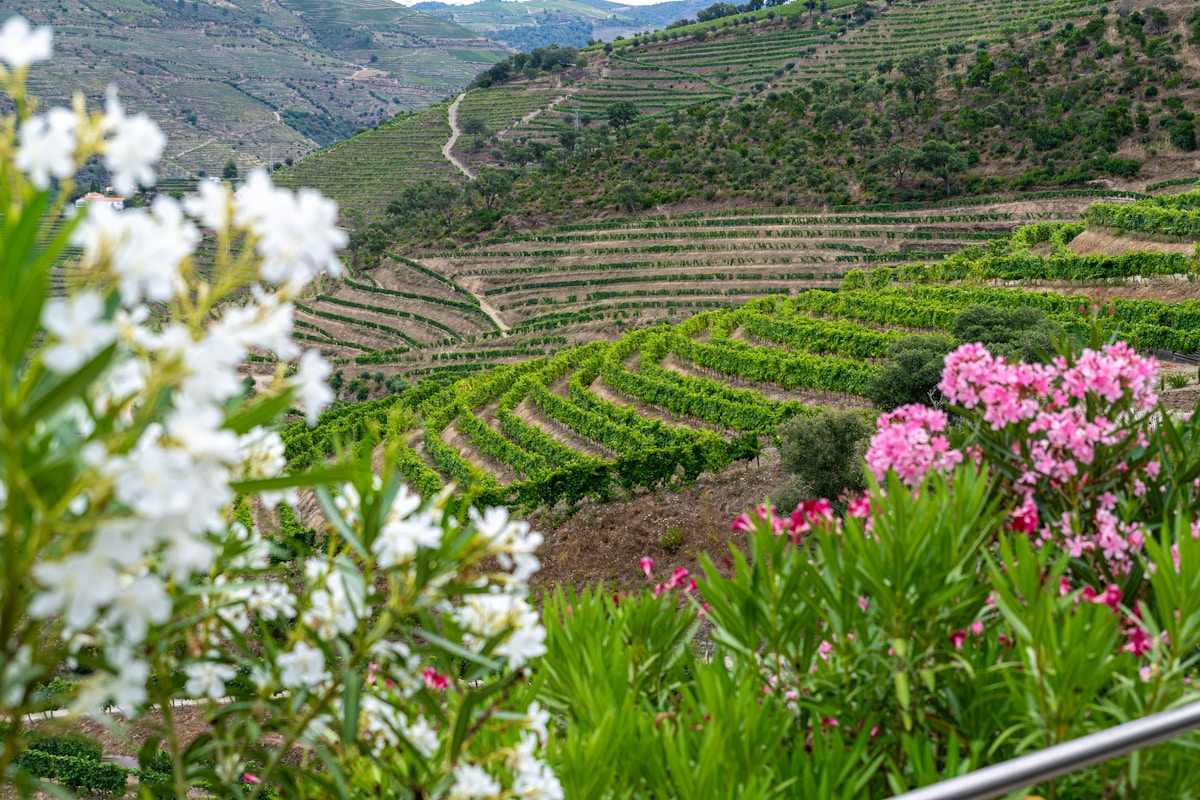
Portugal’s two most distinctive wine regions are as different as the landscapes that produce them. The Douro Valley in the north is all drama: precipitous terraced vineyards stepping down to the Douro River, schist hillsides carved over centuries of back-breaking labour, and ancient quintas (wine estates) that have been making port for 300 years. The Alentejo in the south is all space: a vast, flat plateau of cork oak trees, sunflowers, and ancient hilltop villages, where the world’s largest concentration of megalithic monuments stands in the same open countryside as modern wine estates. Both are worth visiting. But they deliver entirely different experiences.
Quick Verdict
| Category | Douro Valley | Alentejo |
|---|---|---|
| Scenery | Dramatic terraced hills | Open plains, medieval villages |
| Wine variety | Port + unfortified Douro reds | Full range, very accessible |
| Accessibility from Porto | Winner (2–3 hours) | Far (5+ hours) |
| Accessibility from Lisbon | Further (3–4 hours) | Winner (1.5–2 hours) |
| Accommodation variety | Smaller range of quintas | Strong mid-range to luxury |
| Food scene | Quinta dining, local towns | Winner — Évora, Monsaraz |
| Road trip potential | Good | Winner |
| Budget | Similar | Slightly cheaper |
| History and archaeology | Wine heritage | Winner (megaliths, Roman, Moorish) |
Choose the Douro Valley if you are based in or visiting Porto, want dramatic scenery, and are passionate about port wine. Choose the Alentejo if you are based in or visiting Lisbon, want a slower road trip through medieval villages, and prefer still wines over port.
The Douro Valley
The Douro Valley begins in earnest at Pinhão, a small town about 120km east of Porto, where the river valley narrows and the terraced vineyards crowd both banks. The Douro is a UNESCO World Heritage viticultural landscape — not just the vineyards, but the entire system of schist terrace walls, the socalcos, which have been built up by hand over more than 2,000 years.
The valley divides into three sub-regions: the Baixo Corgo near Régua (coolest, lightest wines), the Cima Corgo around Pinhão (the heart of premium port and Douro wine production), and the Douro Superior further east (hotter, drier, more remote). Most visitors concentrate on the Cima Corgo: Pinhão as a base, with day drives east to the quintas around Tua and Figueira de Castelo Rodrigo.
The primary wine experience is the quinta visit and tasting. Quinta do Crasto near Ferrão (Cima Corgo) runs tastings of their acclaimed Douro red and white wines from €10 per person. Quinta da Roêda — one of Croft’s prestige estates — overlooks the river at Pinhão and offers tours by appointment. For port specifically, the Ramos Pinto quinta at Quinta de Bons Ares above Pinhão offers guided tours with tastings from €10.
The Linha do Douro train from Porto Campanhã to Pinhão (3 hours, €12.30) is one of Europe’s most scenic rail journeys: the line follows the river through the terraces for the final hour, with views that shift with every bend. A one-day round trip from Porto — train to Pinhão, lunch, one quinta visit, train back — is one of the best day trips in Portugal. See our Douro Valley by train guide for timing and booking details.
The Alentejo
The Alentejo is Portugal’s largest region: a plateau covering roughly a third of the country’s total land area, stretching from the Tagus River in the north to the Algarve in the south. It is fundamentally a landscape of plains — rolling fields of wheat, cork oak, and olive trees, punctuated by whitewashed villages and the occasional granite hill with a castle on top.
Évora is the region’s capital and its cultural centrepiece: a walled city with a Roman temple (1st or 2nd century AD, partially intact), a Gothic cathedral, and the haunting Chapel of Bones (Capéla dos Ossos) at the Church of São Francisco — a small chapel lined with the skulls and femurs of approximately 5,000 monks. Entry to the chapel costs €5; it is not for the faint-hearted, but it is extraordinary. Évora’s restaurants are among the best in rural Portugal — Tasquinha do Oliveira and Taberna Típica Quarta-Feira both serve traditional Alentejo cooking for around €25–35 per person.
Monsaraz is a fortified medieval village on a hilltop above the Alqueva reservoir, with a single main street of whitewashed houses, a 14th-century castle, and views across the largest artificial lake in Western Europe. It is the most atmospheric village in the Alentejo — small enough to walk in 20 minutes, worth staying overnight for the sunset over the water.
For wine, Herdade do Esporão near Reguengos de Monsaraz is the region’s most accessible large estate: restaurant, shop, and guided tours with tasting (€12–20 per person), open daily. The Esporão Reserva red is one of Portugal’s best-value wines at around €15. Adega Mayor near Campo Maior in the northern Alentejo is a more modern estate (Álvaro Siza designed the winery building) with tastings from €10. The wines here are full-bodied, sun-drenched reds and whites — quite different from the tighter, more mineral Douro reds.
Wine: The Key Difference
The Douro produces two fundamentally different wine styles: fortified port wine (both vintage and tawny) and increasingly acclaimed unfortified Douro reds and whites. Port is a wine tradition unlike anything else in the world — the great vintage ports from houses like Graham’s, Niepoort, and Quinta do Noval are made for decades-long ageing. Unfortified Douro reds (Touriga Nacional, Tinta Roriz, Touriga Franca) have improved enormously in the last 20 years and now rival the best reds from Spain and southern France.
Alentejo wine is simpler to navigate but no less enjoyable. The region produces some of Portugal’s most commercially successful wines — accessible, fruit-forward, and available in almost every Portuguese restaurant. Alentejo reds are warmer and more generously fruited than Douro reds; the whites are less celebrated but improving. The pipa (barrel) wines poured by the glass in Évora tascas for €2–3 are often local estate wines at exceptional value.
For port wine specifically: you must go to the Douro. There is no alternative. For an introduction to Portuguese wine more broadly: the Alentejo is easier to navigate and more affordable.
Food
Both regions have strong food traditions rooted in the same peasant ingredients: pork, lamb, chickpeas, bread, olive oil, and coriander. But the Alentejo has the richer restaurant culture.
Douro Valley: Food in the valley itself is concentrated in quinta restaurants (excellent but expensive) and the small towns. Régua has some good local restaurants: Castas e Pratos on the riverside is reliable for regional dishes at €15–25 per person. Pinhão has limited options — the Veladouro restaurant at the Vintage House Hotel is the best choice (from €35 per person). The food tradition of the Trás-os-Montes border region further east is distinctive: alheira sausage (a smoked meat sausage, originally a way to disguise pork during the Inquisition) and caldo verde (kale soup) are everywhere.
Alentejo: The regional cuisine is built around açorda (a bread-thickened soup with eggs, coriander, and olive oil, €7–10), slow-cooked lamb or kid, migas (fried bread crumbs with pork), and cured meats. Évora has the highest concentration of good restaurants. Black pig (porco preto) — the same free-ranging Iberian breed that produces jamón in Spain — is the quality pork of the Alentejo: the secretos and presa cuts grilled over oak cost €18–26 at most decent restaurants.
Winner: Alentejo for food variety and restaurant quality.
Accommodation
Douro Valley: The classic stay is in a quinta — many of the wine estates have rooms, cottages, or guesthouses. Quinta de la Rosa (Pinhão, from €180/night) has 26 rooms, a swimming pool, and offers its own wine tastings and tours. Quinta do Vallado near Peso da Régua (from €200/night) has a beautiful contemporary wine estate hotel. The Vintage House Hotel in Pinhão (from €220/night) is the most polished option in the valley with river views and a good restaurant.
Alentejo: More variety at different price points. Convento do Espinheiro in Évora (a 15th-century convent converted to a five-star hotel, from €250/night) is the region’s most acclaimed historic property. L’And Vineyards near Montemor-o-Novo (Michelin-starred restaurant, vineyard views, from €220/night) is one of Portugal’s most innovative wine resort hotels. For Monsaraz, São Lourenço do Barrocal — a converted 19th-century farm estate near the Alqueva reservoir — has 22 rooms and a working organic farm with restaurant (from €280/night). Budget travellers have good options in Évora: mid-range guesthouses in the walled city run €70–110/night.
Search hotels in the Douro Valley — Search hotels in the Alentejo
Getting There
Douro Valley: From Porto, the Linha do Douro train to Pinhão takes 3 hours (€12.30 one way) and is the most scenic option. By car, Porto to Pinhão is about 1.5 hours via the A4/IP4 motorway, then the N322 river road. From Lisbon, driving takes approximately 3.5–4 hours.
Alentejo: Évora is 1.5 hours from Lisbon by Rede Expressos bus (€13 return, several daily from Sete Rios terminal) or by car on the A6 motorway. A car is almost essential for exploring the wider Alentejo — villages like Monsaraz, Marvão, Mértola, and the megaliths around Évora are not served by public transport.
When to Visit
Douro Valley: September and October are the finest months — the grape harvest (vindimas) transforms the valley with activity, the light turns golden on the terraces, and the temperatures are pleasant (22–27°C). Spring (April–May) is also beautiful, with the terraces flowering. July and August are extremely hot in the valley interior — often 40°C+.
Alentejo: March through June and September through November are best. Summer in the Alentejo is brutal — temperatures regularly exceed 40°C inland — and most of the agricultural landscape goes brown. Spring is spectacular: wildflowers across the plains, mild temperatures (18–24°C), and the megalith sites essentially empty.
Final Verdict
The Douro Valley is the more dramatic destination and the essential experience for port wine lovers — nowhere else on earth offers terraced vineyards at this scale, and the river valley in September during the harvest is among the most beautiful sights in Europe. It works best as a day trip or a two-night stay based in Pinhão, combined with Porto.
The Alentejo is the better choice for a multi-day road trip, for history and archaeology, and for those who want a broader Portugal experience beyond wine. Évora alone justifies the trip. The slower pace, cheaper prices, and extraordinary medieval landscape make the Alentejo one of the most underrated regions in Western Europe.
If you can do both, the contrast is one of Portugal’s pleasures: the vertiginous green north and the wide sunbaked south. Start with the Alentejo road trip itinerary if you are planning from Lisbon; combine with the Douro on a longer trip north.
More Portugal Comparisons
- Lisbon vs Porto — Portugal’s two great cities and which to visit first
- Coimbra vs Braga — two historic university cities between Porto and the north
- Évora vs Óbidos — Alentejo’s Roman capital versus the Silver Coast’s walled village
- Porto vs Algarve — city break in the north versus beach holiday in the south
Plan Your Trip
✈️ Book your flights to Portugal 🛡️ Get travel insurance 📱 Stay connected with an eSIM 🚗 Rent a car