Coimbra and Braga are Portugal’s two great historic university cities - both with deep roots in Portuguese intellectual and religious life, both with outstanding architecture, and both significantly undervisited by international tourists who concentrate on Lisbon and Porto. They deserve to be on any extended Portugal itinerary.
Quick Verdict
| Category | Coimbra | Braga |
|---|---|---|
| University heritage | Winner | - |
| Religious architecture | - | Winner |
| Library (Joanine) | Winner | - |
| Bom Jesus sanctuary | - | Winner |
| Student nightlife | More distinctive | Strong |
| Proximity to Porto | 2h train | 30 min train |
| Food scene | Good | Good |
| Roman heritage | Winner | - |
Choose Coimbra for one of Europe’s most spectacular university campuses, the Joanine Library, and a distinctive cultural identity. Choose Braga for easier access from Porto, outstanding religious architecture, and one of Portugal’s most energetic student cities.
The Cities
Coimbra
Coimbra was Portugal’s capital before Lisbon - the country was ruled from here until 1255 - and the University of Coimbra has operated continuously since 1290, making it one of the oldest universities in the world. The upper city (Alta) is dominated by the university hilltop; the lower city (Baixa) runs along the Mondego River.
The fado coimbrão - the Coimbra variant of fado, traditionally sung by male university students in black cloaks (capas negras) - gives the city a distinctive musical identity separate from Lisbon’s tradition. The students still wear these black cloaks to formal university events.
Braga
Braga is Portugal’s third largest city and its religious capital - often called the “Portuguese Rome” for its concentration of churches, convents, and religious monuments. Founded by the Romans as Bracara Augusta (the Roman forum is partially visible beneath the Sé), Braga has more churches per capita than almost anywhere in Portugal.
The city is also a modern, energetic place - the Universidade do Minho brings a large student population, and the Braga Industrial Association has driven economic growth that makes it feel less static than many historic Portuguese cities.
Architecture
Coimbra
The Universidade de Coimbra campus is the reason to visit. The approach through the Porta Férrea (iron gate) into the ceremonial patio is memorable; the university tower (tickets included in campus pass, €13.40) offers views over the city and Mondego.
The Biblioteca Joanina (Joanine Library, €6.40): Coimbra’s most extraordinary single attraction - a three-room Baroque library built between 1717 and 1728, with gilded wooden shelving from floor to ceiling, painted ceilings, and exotic wood galleries. Access is timed and limited to 20 people per slot for 10 minutes. Book online weeks in advance (universidade.uc.pt/en). The resident bat colony - kept in the library to eat book-destroying insects - is real and occasionally visible.
Sé Velha (Old Cathedral, €2.50): One of Portugal’s finest Romanesque churches, largely unchanged since the 12th century - a rarity in a country where most medieval churches were rebuilt in the Manueline or Baroque periods. The cloisters (€1.50 extra) are quiet and lovely.
Santa Clara-a-Nova Convent: High above the Mondego on the opposite bank, this Baroque convent (€3) houses the silver tomb of the patron saint of Coimbra, Queen Santa Isabel. The view from the terrace back over Coimbra is worth the climb.
Braga
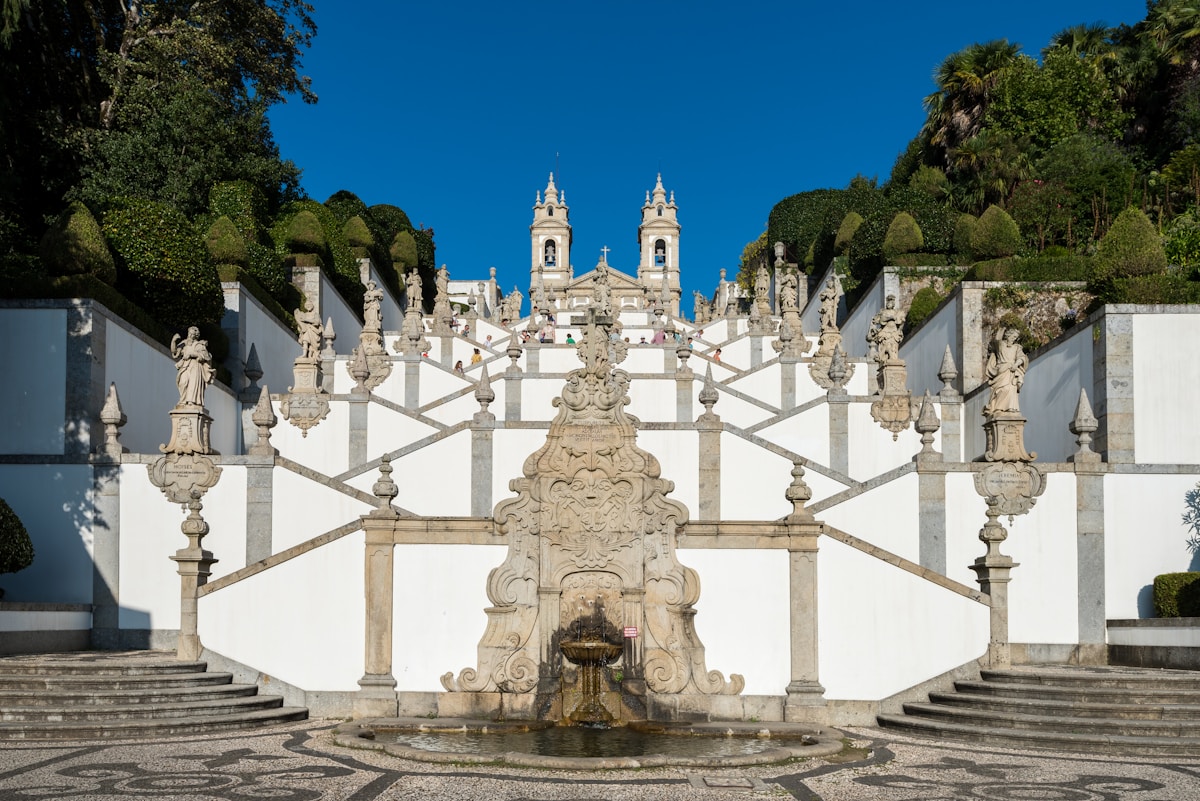
Bom Jesus do Monte: The defining image of Braga - a twin-tower Baroque church perched 116 metres above the city, reached via a monumental zigzag staircase (the Escadaria do Bom Jesus) decorated with fountains, chapels, and allegorical figures representing the Stations of the Cross and the five senses. The staircase is free to climb; the hydraulic funicular (oldest in the Iberian Peninsula, 1882) costs €1.50 each way. The gardens at the top are a pleasant picnic spot. Church entry is free.
Sé Catedral de Braga: Portugal’s oldest cathedral (construction from 1070), with a Romanesque exterior, a Gothic-Manueline-Baroque interior accumulated over centuries, and a treasury museum (€3) with exceptional gold and silver ecclesiastical objects. The original Manueline choir stalls are outstanding.
Santuário do Sameiro: 3 km from the Bom Jesus, Portugal’s second most visited Marian shrine after Fátima. The views from the terrace extend on clear days to the Douro Valley.
Palácio dos Biscainhos (€3): An 18th-century aristocratic palace with Baroque interiors and formal gardens - a peaceful contrast to the religious monuments.
Winner: Both outstanding but for different reasons. Coimbra for the Joanine Library (unique in Portugal); Braga for the Bom Jesus staircase (iconic in European religious architecture).
Food
Coimbra: The student city dynamic creates a solid mid-range restaurant scene. The chanfana - a Coimbra specialty of goat slow-cooked in red wine - is the dish to order; Restaurante Zé Manel dos Ossos (Beco do Forno, booking essential, mains €12–16) has served it since 1960 and queues form before opening. Café Santa Cruz, installed in a former Gothic chapel on the main square, is a mandatory coffee stop (€1.50 per coffee, stunning interior).
Braga: Café A Brasileira (Largo do Barão São Martinho) is one of Braga’s oldest cafés - mahogany interior, coffee from €1.30. Taberna Belga (Rua Paio Mendes, mains €13–19) serves creative Portuguese food in a former grocery. O Inácio (Campo das Hortas, mains €14–20) is the traditional choice for hearty Minho cuisine - braised kid, rojões (fried pork pieces), and caldo verde (kale soup).
Winner: Coimbra for the chanfana experience; Braga for the broader Minho culinary tradition.
Nightlife
Coimbra’s nightlife has a distinctly academic character. The university student association (Associação Académica de Coimbra) controls much of the entertainment calendar - the Queima das Fitas festival in May is the year’s peak, with concerts, parades, and the burning of the coloured faculty ribbons that students have worn throughout the year. During the academic year, bars around Rua das Padeiras and Praça da República are busy from 10pm. The Fado de Coimbra experience - A Capella bar in a 14th-century church at Rua Corpo de Deus - is authentic and reasonably priced (entrance approximately €10–15 including a drink).
Braga has a solid student scene around the Bairro dos Congregados (near the cathedral) and a growing craft beer culture. The city is more outward-facing commercially than Coimbra - newer bars, a busier nighttime restaurant scene, and less of the closed-circle academic culture.
Winner: Coimbra for cultural distinctiveness; Braga for energy and openness.
Getting There
Coimbra sits on the main Lisbon–Porto rail line, making it highly accessible:
- From Lisbon: Alfa Pendular, approximately 1 hour 45 minutes, from €15–20
- From Porto: Alfa Pendular, approximately 1 hour, from €12–18
- The main train station (Coimbra-B) is 3 km from the centre; a local connecting train runs to Coimbra station (city centre) included in the ticket price
Braga is near Porto:
- From Porto: Regional or Inter-City train from Porto Campanhã, 30–45 minutes, €3.70–5.20
- From Lisbon: train to Porto then change to Braga, approximately 3.5–4 hours total
- Guimarães (Portugal’s birthplace, 25 km from Braga) is easily combined in a day trip
Winner for accessibility from Porto: Braga, significantly. From Lisbon: Coimbra is a better stop.
Cost
Both cities are among Portugal’s most affordable for travellers - student cities generally suppress restaurant prices.
Coimbra: Mid-range hotels near the university run €80–120/night. Guesthouses and B&Bs start from €60/night. Restaurants: €12–18 for mains.
Braga: Comparable prices - hotels from €75–110/night, restaurants €12–18 for mains. Both cities are notably cheaper than Lisbon and Porto.
How Long to Spend
Coimbra: One full day covers the university, Joanine Library, Sé Velha, and a chanfana lunch. Two days allows the Santa Clara convent, the Roman ruins, and an evening Fado show. On the Portugal road trip, Coimbra works as an overnight stop between Lisbon and Porto.
Braga: A half-day covers the Bom Jesus and Sé Cathedral. A full day allows the Sameiro, Palácio dos Biscainhos, and time in the old centre. Braga pairs naturally with Guimarães - 25 km east by bus (€3) or train (€2, 20 minutes) - making a very full day or overnight from Porto.
If you’re heading to Coimbra, tours in Coimbra covers guided experiences and day trips. For Braga, tours in Braga has the same.
car hire in Portugal is the most practical way to combine both destinations without relying on bus timetables.
Final Verdict
Coimbra and Braga deserve each other’s company on a Portugal itinerary that goes beyond Lisbon and Porto. They are not really in competition - their characters are distinct enough that a traveller wanting to see both has a clear route (Porto → Braga/Guimarães day trip → Coimbra overnight → Lisbon).
If you have to choose one: choose Coimbra if the Joanine Library and university atmosphere is what draws you - it is one of the most extraordinary academic environments in Europe. Choose Braga if you are based in Porto and want an excellent day trip to a religious and historically significant city that can be comfortably done in a day.
More Portugal Comparisons
- Lisbon vs Porto — Portugal’s two great cities compared end to end
- Évora vs Óbidos — the Alentejo’s Roman capital against a medieval walled village
- Douro Valley vs Alentejo — Portugal’s two great wine and landscape regions
- Sintra vs Cascais — the great Lisbon day-trip debate: palaces or beaches
Plan Your Trip
🏨 Search hotels in Braga 🎯 Tours in Braga 🏨 Search hotels in Coimbra on Booking.com
✈️ Book your flights to Portugal 🛡️ Get travel insurance 📱 Stay connected with an eSIM 🚗 Rent a car