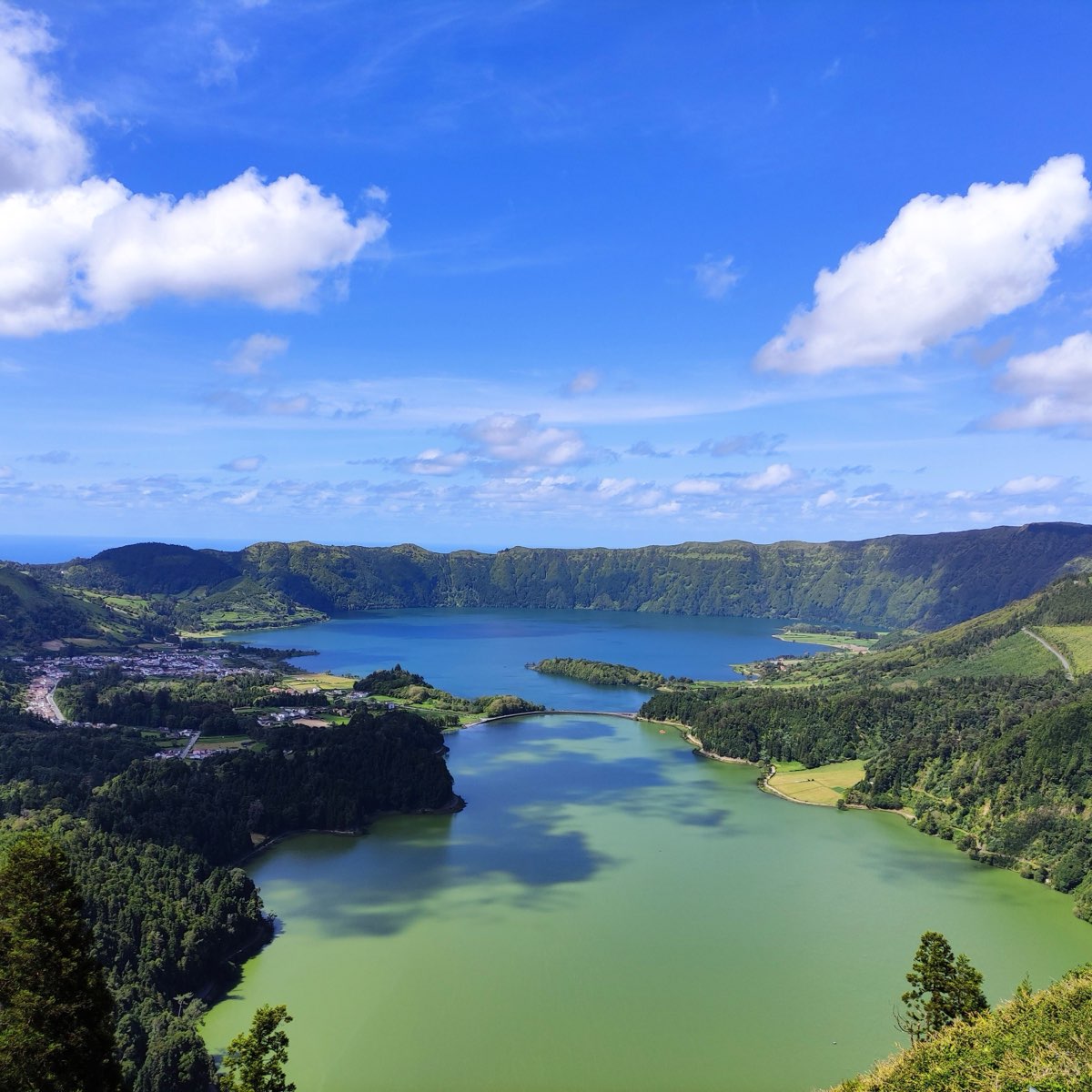
The Azores and Hawaii share a geological identity — both are volcanic archipelagos rising from the ocean floor, still tectonically active, with dramatic crater lakes, black lava coastlines, and extraordinary marine wildlife. Beyond geology, they diverge sharply: the Azores are a mid-Atlantic Portuguese archipelago, greener and wilder, with far fewer visitors and dramatically lower prices. Hawaii is a Pacific island state with world-famous surf, developed tourism infrastructure, and a distinct Polynesian-American culture. The comparison matters most for travellers who can realistically choose either — and for those, geography and budget are the most important inputs.
Quick Verdict
| Category | Azores | Hawaii |
|---|---|---|
| Cost | Winner | - |
| Whale watching | Winner | Good (seasonal) |
| Multi-island variety | 9 islands | Multiple islands |
| Sandy beaches | Limited | Winner |
| Surf | Limited | Winner |
| Volcanic hiking | Excellent | Excellent |
| Lush tropical scenery | Winner (greener) | Good |
| Wildlife variety | Winner | Good |
| Crowd levels | Much fewer | More (but still varies) |
Choose the Azores if you are travelling from Europe, want outstanding whale watching, dramatic volcanic scenery without crowds, and one of the most underrated multi-island destinations in the Atlantic. Choose Hawaii if you are in North America, want genuine Pacific surf beaches, the Polynesian-American cultural experience, and the Kauai or Maui landscape in its full tropical richness.
The Islands
The Azores
The Azores comprises nine islands spread across 600 km of Atlantic Ocean, divided into three groups. Most visitors start on São Miguel — the largest island, with the twin Sete Cidades caldera lakes (green and blue in the same crater), the Furnas geothermal valley with boiling mud pools and the famous cozido das Furnas (stew cooked underground in geothermal heat), and whale watching from Vila Franca do Campo.
Pico is Portugal’s highest point — the Pico volcano (2,351m) is a serious but accessible ascent requiring a guide and advance permit (€15–20). Pico also produces wine from vines grown in UNESCO-protected volcanic soil and is arguably the best base for whale watching in the entire archipelago.
Faial offers the Caldeira volcano rim walk (9 km circuit, easy-moderate), the striking Capelinhos volcanic peninsula formed by a 1957 eruption, and a marina famous as a transatlantic sailing waypoint.
Terceira: UNESCO World Heritage capital Angra do Heroísmo has baroque churches and coloured facades. The Algar do Carvão lava tube (€10) is one of the most accessible volcanic caves in the Atlantic.
Flores: One of the westernmost points of Europe, with cascading waterfalls, blue hydrangeas lining every road, and some of the Azores’ most dramatic coastal scenery.
Hawaii
Hawaii consists of six main visitor islands, each with a distinct character.
Maui: The most popular island, offering Road to Hana (a winding coastal drive past waterfalls and black sand beaches), the Haleakalā crater at sunrise (a 3,055m dormant volcano), and whale watching January–March. Lahaina, once the whaling capital of the Pacific, is rebuilding after the 2023 wildfire.
Kauai: The most verdant island — the Nā Pali Coast’s dramatic sea cliffs are accessible by boat, helicopter, or the Kalalau Trail. Waimea Canyon (nicknamed the “Grand Canyon of the Pacific”) is an extraordinary red-rock gorge. Kauai has fewer crowds than Maui and Oahu.
Big Island (Hawaii Island): Active lava from Kilauea volcano is the headline attraction — Hawai’i Volcanoes National Park (€35 weekly pass) allows close-up viewing of volcanic activity that is unique on earth. Also: Mauna Kea (4,207m) for stargazing, the black sand beaches of Punalu’u, and green sand beach at Papakolea.
Oahu: Where Honolulu and Waikiki Beach are located. Most accessible and most developed; home to Pearl Harbor, the North Shore surf scene (Pipeline, Sunset Beach), and the Polynesian Cultural Center.
Whale Watching
The Azores is a globally recognised whale watching destination — consistently ranked among the top five in the world alongside the Sea of Cortez, Sri Lanka, and the Dominican Republic. The deep mid-Atlantic waters around the archipelago support year-round sperm whale populations. Blue whales — the largest animals on earth — migrate through from March to May. Fin, sei, humpback, and minke whales pass through at various points in the season. Over 25 cetacean species have been recorded.
Tours operate from Pico (Espaço Talassa, from approximately €55 per person), Faial, and São Miguel. The traditional shore-based vigia (lookout) system, where observers on cliffs radio whale positions to boats, is still used on Pico — the same system used by whalers historically, now directed by marine biologists and guides. Sighting success rates are very high between April and October.
Hawaii’s whale watching centres on North Pacific humpback whales, which gather in the warm waters around Maui to breed and calve from December to April. In peak season (January–March), whale numbers are extraordinary — the channel between Maui, Lanai, and Molokai contains one of the largest humpback aggregations in the world. Tour prices run USD 40–80 per person for a 2-hour whale watch. Outside of humpback season, whale watching is less reliable.
Winner: Azores for year-round variety and species diversity; Hawaii for the peak humpback season spectacle.
Volcanic Hiking
The Azores offers multiple volcanic hiking destinations in a compact multi-island format:
- Pico volcano ascent (2,351m): 8 km round trip, 1,200m elevation gain, 3–5 hours up; hard; advance permit required (parquesnaturais.azores.gov.pt)
- Sete Cidades caldera rim (São Miguel): 12 km moderate circuit above the twin caldera lakes; outstanding views on clear days
- Furnas valley walk (São Miguel): 4 km easy loop through geothermal fumaroles, hot springs, and the Caldeira Velha thermal pools (€2)
- Caldeira walk, Faial: 9 km easy-moderate rim circuit above a 6 km-wide caldera
- Capelinhos volcanic peninsula, Faial: 45-minute walk across a 1957 lava flow to a lighthouse museum
Hawaii’s volcanic hiking is dominated by the Big Island:
- Kilauea Iki Trail (Big Island): 6.5 km loop across a solidified lava lake with steam vents; moderate; spectacular
- Devastation Trail (Big Island): 1.6 km easy walk through a landscape swept by a 1959 eruption
- Haleakalā summit and Sliding Sands Trail (Maui): 12 km in and out of a crater with cinder cones; moderate-hard; sunrise viewing requires a timed entry reservation
- Kalalau Trail (Kauai): 22 km one-way along the Nā Pali Coast; extremely difficult; permit required
Winner: Roughly equal — the Azores offers more islands for volcanic hiking in a compact area; Hawaii’s Big Island offers active lava.
Beaches
The Azores has limited sandy beach options — the coastline is predominantly volcanic rock with natural swimming pools. Black sand beaches exist on São Miguel (Praia de Santa Bárbara, good for surfing) and scattered across other islands. The best swimming is in volcanic rock pools and in the calmer bays. Porto Santo in Madeira (a separate island) has the best sandy beach in the broader Portuguese Atlantic.
Hawaii’s beaches need little introduction. Waikiki Beach in Oahu is a wide golden crescent with reliable surf. Kaanapali on Maui is backed by resort hotels with calm, warm water. Big Island’s Punalu’u black sand beach and Papakolea green sand beach are geologically unique. The North Shore of Oahu hosts the world’s most famous big wave surfing — Pipeline and Sunset Beach.
Winner: Hawaii, comprehensively for beach quality and variety.
Getting There and Cost
From Europe, the Azores are considerably easier and cheaper to reach. Lisbon to São Miguel is 1.5 hours with SATA/Azores Airlines (from approximately €100–150 return). Direct flights from several UK airports, Germany, and the Netherlands run seasonally and sometimes year-round. From Boston or New York, the Azores are a 5–6 hour flight — shorter than Hawaii from the US East Coast.
From the US West Coast, Hawaii is the rational choice — Los Angeles to Honolulu is 5.5 hours; Los Angeles to the Azores takes 10–11 hours with connections.
Cost differential is significant. A week in the Azores staying in mid-range accommodation and doing tours including a whale watch costs approximately €1,200–1,800 per person from Europe. An equivalent week in Maui or Kauai costs USD 2,500–4,000+ per person.
Tours in the Azores and tours from São Miguel cover whale watching, Sete Cidades guided hikes, canyoning, and cozido das Furnas experiences. Hotels in the Azores on Booking.com cover the full range from Ponta Delgada city hotels to rural casas de campo.
Final Verdict
Geography drives this comparison more than preference. For European travellers, the Azores deliver a volcanic island experience that rivals Hawaii on scenery and surpasses it on wildlife and cost, with none of the 10-hour transatlantic flight. For North American travellers on the West Coast, Hawaii is the logical Pacific answer — culturally distinct, surf-focused, and easily accessible. For those on the US East Coast or in Canada, the Azores are a genuinely competitive alternative: closer than Hawaii, much cheaper, and outstanding for the right kind of traveller.
The Azores wins on value, whale watching, and raw volcanic character. Hawaii wins on beaches, surf, and tropical culture. Both are world-class island destinations.
More Portugal Comparisons
- Madeira vs Azores — comparing Portugal’s two island groups
- Madeira vs Canary Islands — the Atlantic island neighbours compared
- Portugal vs Greece — Atlantic coast versus Aegean islands
- Portugal vs Italy — two southern European countries compared
Plan Your Trip
🏨 Search hotels in the Azores on Booking.com 🎯 Tours in the Azores 🎯 Tours from São Miguel
✈️ Book your flights to Portugal 🛡️ Portugal travel insurance guide · get covered with EKTA 📱 Stay connected with an eSIM 🚗 Rent a car in Portugal