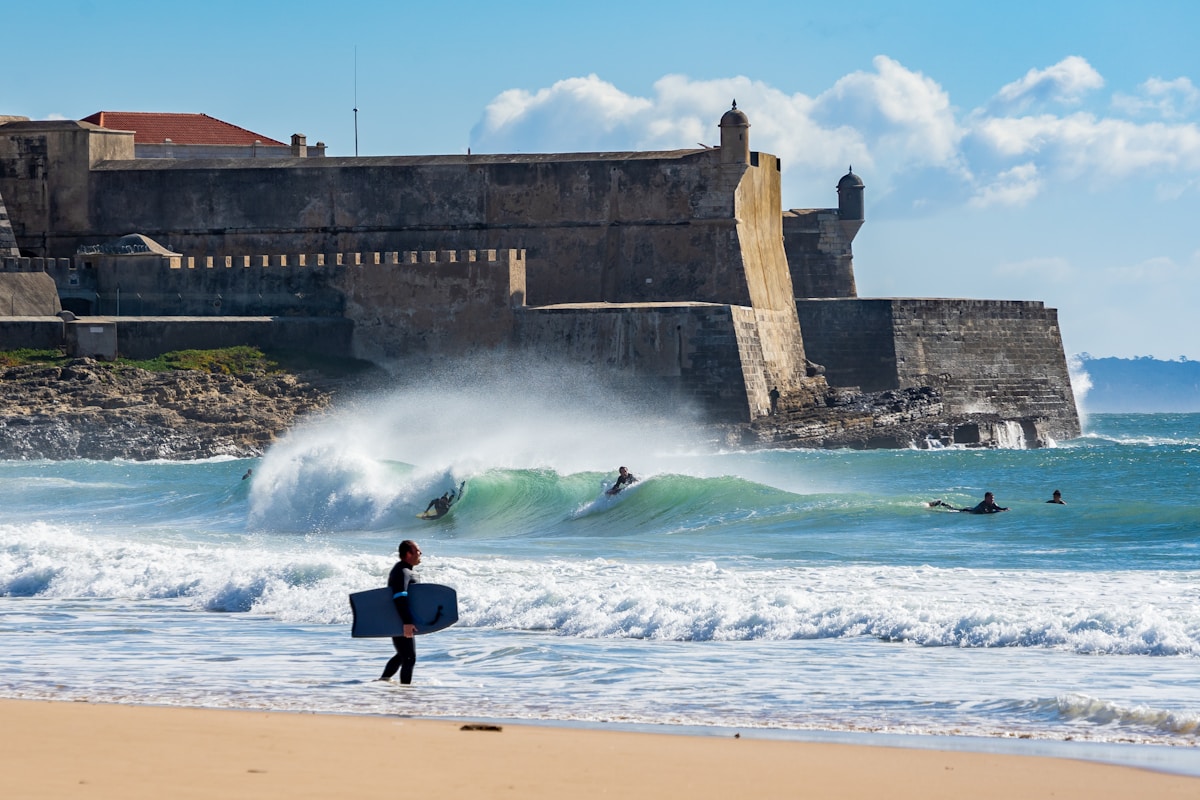
Portugal has one of the longest and most varied surf coastlines in Europe - running more than 800km from the Minho in the north to the Algarve tip at Sagres. The range of breaks is equally varied: punishing reef barrels at Coxos, chest-high learner beach breaks at Baleal, 30-metre monsters at Nazaré. Choosing the wrong destination for your ability level either bores you out or gets you into serious trouble.
This guide places each of the six main surf towns in the right ability bracket, explains what makes each one suit that level, names surf schools and current lesson prices, and suggests the best season to visit. We also flag three additional towns worth knowing about for future trips. For background on the full surf season, see our surfing Portugal overview.
Beginner Surf Towns
Peniche (Baleal) - the clear first choice
For anyone learning to surf in Portugal, Peniche is the right answer - or more precisely, Baleal is. Baleal is a small tidal islet 4km north of Peniche town, connected to the mainland by a causeway. Both sides of the islet have beach breaks with different exposures, meaning one or the other usually offers manageable conditions when the rest of the Portuguese coast is blown out or oversized.
Over 40 surf schools operate from Baleal - more than anywhere else in Portugal. The market is competitive, standards are reasonable, and the infrastructure (board racks, wetsuits in every size, multilingual instructors) is the best in the country.
Why it works for beginners: consistent small-to-medium beach break with sandy bottom, a surf school industry that has refined beginner tuition over decades, and multiple beach sections that reduce crowding. The penalty for falling off is low. The peninsula geography means Peniche almost always has a surfable beach somewhere, regardless of wind direction.
Surf schools and prices (as of 2026):
- Baleal Surf Camp - full-service camp and school, group lessons €40/session (2 hours, board and wetsuit included), week-long surf camp from €450 in dorm accommodation, €750 in private room
- Deep Blue Surf Camp - similar pricing, slightly smaller group sizes, good reputation for progression tracking
- Peniche Surfing House - lessons from €35/session, week packages from €420 including accommodation and daily lessons
- Board and wetsuit hire: €20–30/day at Baleal shops if you prefer to self-guide
Search hotels in Portugal on Booking.com to compare rates and availability. Best season for beginners: April–October. May–June is often ideal - swell is manageable (0.5–1.5m), crowds are below summer peak, and water is warming toward 18°C. July–August is the busiest period with the most school groups; conditions are still beginner-appropriate but lineups are fuller.
For a deeper look at the town and its breaks, see our Peniche surf guide.
Sagres (Beliche and Mareta) - beginner option at the Algarve end
Sagres sits at the southwestern corner of Portugal, 30km west of Lagos. For Algarve-based surfers who don’t want to drive to the Silver Coast, Sagres offers the most beginner-friendly waves in the south.
Praia do Beliche - sheltered at the base of the cliffs between Sagres village and Cabo de São Vicente - works in northerly and westerly swells and gets partial wind protection from the headland. Praia da Mareta, in the main Sagres bay, is typically the smallest and most sheltered of the local breaks.
Why it works for beginners: the headland geography reduces wind exposure, the beach breaks are relatively forgiving, and Sagres surf schools are accustomed to teaching on these spots.
Surf schools and prices (as of 2026):
- Sagres Surf School - group lessons €35–45/session (2 hours, equipment included), week packages from €180
- Wavesensations - well-established, similar pricing, good English-language instruction
- Algarve Surf School - also operates from Lagos, offers pickup from Sagres accommodation
Best season for beginners: May–September. Swell drops to manageable sizes, the Algarve sun is warm, and water temperature reaches 19–21°C. October–April brings more consistent surf but also more power - better for intermediates than true beginners.
Read more in the Sagres surf guide.
Costa Vicentina - scattered beginner spots for the adventurous learner
The Costa Vicentina’s breaks are mostly intermediate-to-advanced, but two spots regularly accommodate beginners: Arrifana beach break and Praia do Amado (2km south of Bordeira, near Carrapateira).
Arrifana bay has cliff protection that buffers the prevailing northwest wind, making the beach break in the centre of the bay the most reliably surfable beginner option on this coast. Praia do Amado has a dedicated surf school presence and slightly more shelter than the exposed Bordeira beach directly north.
This is a beginner option for people who want to experience the wild Atlantic atmosphere of the Vicentina coast rather than a resort surf camp. The infrastructure is thinner - fewer schools, no camp clusters - but the setting is extraordinary.
Surf schools (as of 2026):
- Arrifana Surf Lodge - lessons from €35/hour (group), board hire from €20/day
- Amado Surf Camp - based at Praia do Amado, lessons from €35/day, week packages available
Full details in the Costa Vicentina surf guide.
Intermediate Surf Towns
Ericeira - the World Surfing Reserve for progressing surfers
Ericeira’s reputation is built on advanced breaks, but it is genuinely excellent for intermediate surfers during the right conditions. São Sebastião beach - directly below the village - is the most accessible entry point for intermediates: a beach break with a readable wall and less power than the reserve’s main breaks. On summer swells of 1–1.5m, it is the right level of challenge for someone who can surf green waves confidently but isn’t ready for reef.
The real Ericeira prize for intermediates is Ribeira d’Ilhas on a moderate swell day (1–2m, clean northwest). The classic right-hand point produces a long, predictable wall that allows surfers to work on positioning, turning on the face, and reading the line - all the things a beach break doesn’t easily teach. There’s a reason international surf coaches bring improving clients here.
Surf schools and lessons (as of 2026):
- Ericeira Prime Surf School - intermediate to advanced focus, lessons €40–50/session, can arrange transport to whichever break is working
- Ericeira Surf & Yoga Camp - week packages from €600, intermediate and advanced level, sessions at Ribeira d’Ilhas
- Board hire: €20–30/day (shortboard), €25–35 (longboard) at multiple shops in town
Best season for intermediates: April–June and September–October. Swell is in the 1–2m range, offshore winds are more frequent, and the lineups are less crowded than the peak summer window at São Sebastião. November–March brings bigger waves - 2–3m at Ribeira d’Ilhas - which suits experienced intermediates who are pushing toward advanced.
Full break details in the Ericeira surf guide.
Peniche (Supertubos side) - intermediate on smaller days
While Baleal is the beginner zone, intermediate surfers with a year or more of experience can head to the Peniche town side for Molhe Leste (the jetty break, works on south swells) and the smaller peaks along the south peninsula beaches. These are typically a step up from Baleal without reaching Supertubos intensity.
The Peniche peninsula geography - three open coasts - also makes it unusually easy to find a clean break in most wind conditions. An intermediate surfer working with a Peniche school can often get two surf sessions in per day at different spots depending on the wind.
Guincho - intermediate and up, close to Lisbon
Praia do Guincho, 30km from Lisbon and 8km from Cascais, is not a beginner beach. The Nortada - a persistent north wind that blows along the coast from June through September - typically makes wave quality messy for surfing. But on the good days, typically in autumn and spring, Guincho produces powerful, hollow beach break peaks across a wide sandy bay.
For intermediate surfers based in Lisbon who want a day-trip surf option, Guincho on an offshore-wind day in October or November can produce the best surf conditions they’ll find close to the capital. The northern section takes more direct northwest swell; the south section wraps around the cape and offers slightly smaller and cleaner conditions.
Note: Guincho is also the primary kite and windsurf destination near Lisbon - if the wind is onshore (the common scenario), swap the surfboard for a kite.
Full guide at Praia do Guincho surf.
Advanced and Expert Surf Breaks
Ericeira (Coxos, Ribeira d’Ilhas at size) - advanced reef surfing
When Ericeira’s World Surfing Reserve steps up in the October–March window, it becomes a demanding place. Coxos - a right-hand reef break north of Ribeira d’Ilhas - is the most intense break in the reserve: shallow, fast, and local-heavy. It is not surfable in under 6ft conditions and is not appropriate for anyone who hasn’t extensive experience on heavy reef breaks.
Ribeira d’Ilhas itself at 6ft-plus is a serious wave - fast down the line, requiring precise positioning and the ability to handle late drops. This is the configuration that makes it a WSL Qualification Series venue.
Best season for advanced surfing: October–March, when North Atlantic lows drive regular northwest swells with wave faces of 2–4m at Ribeira d’Ilhas. Water drops to 14–16°C - a 5/4mm wetsuit and boots in December–February.
Peniche (Supertubos) - one of Europe’s best barrels
Supertubos is a left-hand beach break that jacks up from a sandbar to produce thick, powerful barrels. At 6–8ft on a west swell, it is among the most challenging and spectacular beach break waves in Europe. The WSL Championship Tour runs the Rip Curl Pro Peniche here (typically October–November).
Intermediate surfers get washed through. This wave is for experienced surfers who understand heavy beach breaks, can read swell and sandbar, and can handle wipeouts in powerful shorebreak. There is no reef here, which reduces consequence - but the power is real.
Best season for advanced surfing at Peniche: October–March.
Nazaré - expert and professional only
Praia do Norte at Nazaré is not a surfable break for recreational surfers under any circumstances when swells are running. The wave faces of 15–30 metres are surfed exclusively by elite big wave athletes with jet-ski safety teams and tow-in equipment. The shore break is lethal and there is no safe channel.
For everyone else, Nazaré is a spectating destination during big wave season (October–March). The clifftop viewpoint at Sítio above Praia do Norte offers dramatic views at no cost. See the Nazaré surf guide for exactly when to visit and how to watch.
Quick Reference: Surf Towns by Level
| Town | Best Level | Notes |
|---|---|---|
| Peniche / Baleal | Beginner | 40+ schools, camps from €400/week |
| Sagres | Beginner–intermediate | Sheltered breaks, Algarve location |
| Costa Vicentina (Arrifana beach, Amado) | Beginner–intermediate | Wild setting, thinner infrastructure |
| Ericeira (São Sebastião) | Intermediate | Beach break, manageable on small swell |
| Peniche (south peninsula) | Intermediate | Multiple exposures, reliable |
| Ericeira (Ribeira d’Ilhas, moderate) | Intermediate–advanced | Point break, great for progression |
| Guincho | Intermediate–advanced | Powerful, wind-dependent |
| Costa Vicentina (Bordeira, Arrifana point) | Advanced | Exposed, powerful |
| Ericeira (Coxos) | Expert | Heavy reef, local-heavy lineup |
| Peniche (Supertubos) | Advanced–expert | European-class barrel |
| Nazaré | Professional/spectator | Not recreational surfing |
Three More Surf Towns Worth Knowing
These towns don’t yet have dedicated guides on this site but are worth adding to a longer surf itinerary:
Costa da Caparica (30km south of Lisbon): a 30km stretch of Atlantic beach break south of the Tagus with a tram that runs along the coast to different named sections. Some sections are managed as beginner zones; others produce quality peaks in autumn and spring. The closest consistent surf to central Lisbon - accessible by ferry and bus. Intermediate on the better sections, beginner-friendly at the northern end.
Figueira da Foz (170km north of Lisbon): a beach resort with a consistent beach break at Buarcos that suits intermediates. The town has a Portuguese surfing culture going back decades, and the break produces quality waves in autumn and winter with less international crowd pressure than Ericeira or Peniche.
Vila Nova de Milfontes (Costa Vicentina, 80km north of Aljezur): a river mouth beach where the Mira river meets the Atlantic inside a protected bay. The northern section is sheltered and produces smaller, easier conditions - making it one of the friendliest beginner options on the Costa Vicentina. The town is attractive and better-serviced than Aljezur for non-surfers travelling in groups with mixed interests.
car hire in Portugal is the most practical way to move between breaks - most of Portugal’s surf beaches are poorly served by public transport.
an eSIM for Portugal keeps you connected for real-time surf reports and swell forecasts. For guided surf lessons and camp packages, browse tours across Portugal.
How to Book Your Surf Camp or Lessons
The difference between a good surf holiday and a mediocre one is usually the choice of school and the timing of your booking — not the destination.
Booking window: For week-long surf camps at Peniche or Ericeira in July and August, book at least 8–10 weeks ahead. The best-reviewed camps at Baleal (Baleal Surf Camp, Peniche Surfing House) sell their dorm spots by May for the full summer. Single-day lessons can usually be arranged 24–48 hours ahead, even in peak season, because schools operate multiple daily sessions.
What to check before booking:
- Group size: The best beginner schools keep groups at 8–10 students per instructor. Larger groups (15+) reduce water time and feedback significantly. Ask before you book.
- Equipment included: All reputable camps include board and wetsuit in the lesson price. If equipment is listed as extra, look elsewhere.
- Accommodation type: Most Peniche and Ericeira camps offer dorm (4–8 beds, from approximately €400/week all-in) and private room options (from approximately €700/week). Private options are often in converted surf houses rather than hotels — quality varies. Ask for photos.
- Cancellation policy: Atlantic swell is unpredictable. Good schools have a clear reschedule or credit policy for days when conditions are unsafe for beginners. Avoid camps with rigid no-refund policies.
Single lessons vs week camps: A single 2-hour lesson (€35–45 at most schools) is enough to stand up on a wave in good conditions. A week-long camp typically delivers 10–12 sessions and gets beginners to a level where they can rent a board and self-guide on a small day. If you have fewer than 3–4 days, individual lessons are better value. For 5+ days, the all-in camp package usually works out cheaper per session and includes accommodation.
Ericeira vs Peniche for first-time surf holidays: Peniche is larger, more surf-industry oriented, and has more accommodation options at lower prices. Ericeira is more attractive as a town, has better food and café culture, and the breaks are higher quality — but the beginner infrastructure is thinner. If surf school quality is the priority, go to Peniche. If you want a better overall holiday experience around the surf, Ericeira edges it.
For current camps, group lessons, and guided surf experiences, browse surf tours and lessons in Portugal.
Seasonal Overview by Level
Beginners - May to September: smaller swell, warmer water (18–21°C), full surf school programmes running. Peniche and Sagres are the most reliable destinations. Avoid the peak of July–August at Peniche if you dislike crowded lineups.
Intermediates - April to June and September to October: the quality sweet spot. Swell is 1–2m and cleaner, winds are more frequently offshore, and Ericeira is in its best configuration. Water is 16–18°C; a 3/2mm wetsuit is fine.
Advanced - October to March: North Atlantic season. Supertubos runs at its best, Coxos is surfable, Ribeira d’Ilhas hosts competition. Water drops to 14–16°C - invest in a 5/4mm with hood and boots for December–February. The Costa Vicentina also comes into its own: Bordeira and Arrifana point on solid northwest swells are among the best waves in western Europe that most international surfers have never surfed.
For planning around Portuguese weather and events, see the best time to visit Portugal guide and the full surfing Portugal overview.