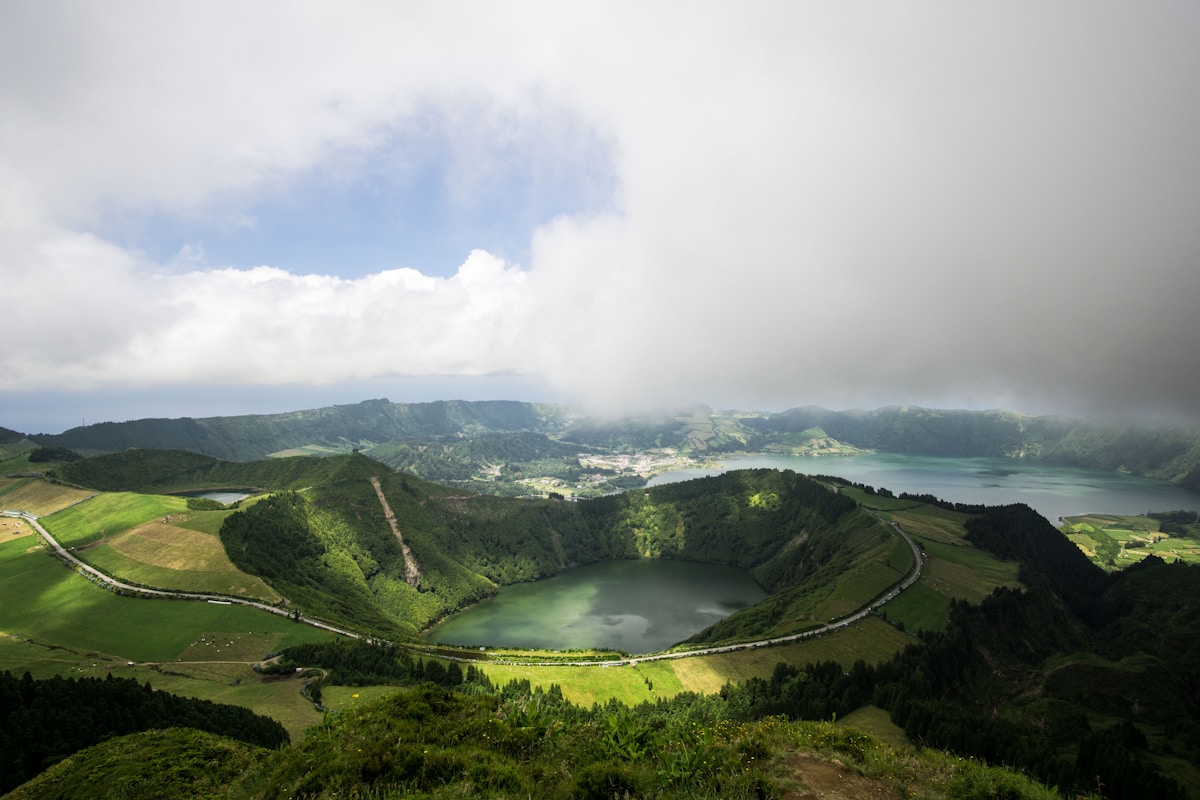
The Azores rewards visitors who rent a car. Spread across nine islands, the archipelago’s standout landscapes — the Sete Cidades twin caldera lakes, the Furnas geothermal valley, Terceira’s UNESCO-listed Angra do Heroísmo, and the black lava coastline of Pico — are all road destinations. Ponta Delgada is the main hub and the most practical entry point; this guide covers what to expect when picking up a car there and how car rental works across the rest of the archipelago.
Book your Azores rental: Compare car hire prices at Ponta Delgada and across the Azores — international and local suppliers, from approximately €25/day in shoulder season (as of 2026).
Why a Car Transforms the Azores Experience
São Miguel is 65 km long and 16 km wide. The main sights are not concentrated in one area — Sete Cidades is in the western caldera, Furnas is in the eastern valley, Lagoa do Fogo is in the central spine, and Nordeste’s viewpoints are at the far eastern tip. On a two-hour bus schedule, seeing more than one area per day is difficult. With a car, you can cross the island in an hour and combine two or three destinations in a day.
The same logic applies to Terceira (30 km long), São Jorge (54 km long), and Flores. All have public transport connections between the main towns but not to viewpoints, crater rims, or coastal fajãs. Car rental on the smaller islands has limited fleets — book before flying if visiting any island beyond São Miguel and Terceira.
Ponta Delgada Airport Car Rental — What to Expect
João Paulo II Airport (PDL) on São Miguel is the Azores’ main international gateway. It handles direct flights from Lisbon (2 hours, TAP and SATA), seasonal routes from the UK and Ireland (Ryanair), and summer transatlantic connections. The airport is about 5 km east of Ponta Delgada city.
Car rental desks are in the arrivals hall. International companies at PDL: Europcar, Hertz, Avis, Budget, Sixt. Local companies: Ilha Verde Rent-a-Car, Auto Atlântico, and Wayzaway are the main Azorean operators. Local companies typically offer rates 15–25% below the international chains for comparable vehicles, and are often recommended by visitors who have used them — service standards are generally good.
Fleet size warning: PDL is not Faro or Lisbon. Fleets at each supplier are small, and in July–August the island’s most popular weeks (especially around Festas do Senhor Santo Cristo, typically late April–early May), popular car classes genuinely do run out. Book 4–6 weeks ahead for any peak-season travel — significantly earlier for the Santo Cristo festival week.
Airport to city centre: The ER1-1A coastal road runs 5 km from PDL into Ponta Delgada; the drive takes about 10 minutes. The city ring road is straightforward to navigate.
Island-by-Island Car Rental Guide
São Miguel
The most accessible and the most essential. Every main attraction requires a car. Distances are manageable — Ponta Delgada to Sete Cidades is 40 minutes west; Ponta Delgada to Furnas is 50 minutes east. The ring road (EN1-1A) encircles the coast and the central roads (ER3) cross the interior.
What to reach:
- Sete Cidades caldera: 40 minutes west. The Vista do Rei viewpoint on the crater rim is the island’s most photographed location. From there, descend into the caldera and walk the 12 km lake circuit or kayak the crater lakes.
- Furnas valley: 50 minutes east. Geothermal mud pools, the underground-cooked cozido stew, and the Terra Nostra botanical garden with thermal swimming pool.
- Lagoa do Fogo: 30 minutes east from Ponta Delgada via the EN3 central road. A pristine crater lake at 590m in a nature reserve — no visitor facilities, no development. A 5 km return hike reaches the lake shore.
- Nordeste: 1 hour 15 minutes northeast. The quietest, greenest part of São Miguel — small farms, hydrangea-lined lanes, and a series of dramatic clifftop viewpoints including Ponta da Madrugada.
- Gorreana Tea Plantation: 1 hour north. Free entry, Victorian tea machinery, tasting cups at the source.
For a full day-by-day plan, see our Azores island-hopping itinerary.
Terceira
Lajes Airport (TER) is 15 km east of Angra do Heroísmo, the UNESCO World Heritage capital. Car rental desks at TER — Hertz and local operators; book ahead as the fleet is smaller than PDL.
What to reach:
- Angra do Heroísmo: 15 minutes west. The best-preserved 16th-century planned city in the Atlantic. The Sé cathedral, the baroque streets, and the Monte Brasil headland above the bay.
- Algar do Carvão: 20 minutes from Angra. A lava tube descending 45m below ground to a subterranean lake — one of the most unusual geological experiences in the Azores (€8 entry; tours on the hour, check schedules at terceiraisland.com).
- Biscoitos: 30 minutes north. Natural volcanic rock pools with the clearest seawater on the island, and Terceira’s small wine-growing area.
- Serra de Santa Bárbara: 30 minutes west. The highest point on Terceira (1,021m) by road and foot — caldera rim views in both directions.
Faial
Faial is small enough (21 km across) that a car is more of a convenience than a necessity for Horta itself — you can walk the marina and the city. But for Capelinhos (the 1957–58 volcanic eruption site on the western tip) and the Caldeira crater rim walk, a car makes the 30 km each way practical. Car rental from Horta airport or in town — Ilha Verde and Hertz are present.
Pico
The Pico Mountain ascent (2,351m, 3–5 hours one way) starts at Casa da Montanha, accessible by car from Madalena (15 km). The UNESCO wine landscape on the south coast, the Museu do Vinho at São Roque, and the whale watching launch points on the north coast all require a car across the island’s 45 km length. Madalena has rental desks (small fleets; book ahead).
Seasonal Prices at Ponta Delgada
Approximate market rates for a compact car with standard CDW on São Miguel:
| Season | Dates | Daily rate (approx.) |
|---|---|---|
| Low season | November–March | €20–35 |
| Shoulder | May–June, September–October | €25–45 |
| Peak summer | July–August | €40–70 |
| Santo Cristo festival | Late April–early May | €55–80 |
Prices on the smaller islands (Terceira, Faial, Pico) are roughly comparable to São Miguel’s shoulder rates year-round — supply is more constrained but the demand is also lower outside the main festival calendar.
Pre-booking saves 30–50% on peak-season rates compared to walk-up desk prices on the same day.
Choosing Your Car for the Azores
Compact (Opel Corsa, VW Polo, Ford Fiesta class): The right choice for São Miguel and Terceira. Handles all paved roads including the caldera rim circuits and the ER3 central roads. Most cost-effective, easiest to park in Ponta Delgada.
5-door vs 3-door: On São Miguel, if travelling with hiking boots, packed meals, and wet weather gear, a 5-door with a proper boot is more practical. Specify when booking.
Automatic vs manual: The Azores roads are gentler than Madeira’s, so the case for an automatic is less pressing. Manual gearboxes are fine throughout.
MPV/minivan: Practical if travelling in a group of four or more — multiple car hire becomes expensive and coordinating on mountain roads is easier with everyone together.
No Toll Roads — A Genuine Difference from Mainland Portugal
Unlike mainland Portugal and Madeira, the Azores has no electronic tolls and no toll roads. The ring road around São Miguel, the cross-island routes on Terceira, and all national roads are free. This removes the Via Verde transponder cost (€2–4/day on the mainland) and the need to track per-section charges.
Insurance on the Azores
Standard CDW at PDL typically reduces your damage excess to €1,000–1,500 for a compact car. Common exclusions: windscreen, tyres, roof, undercarriage, and damage on unsurfaced tracks (including some coastal access roads near the fajãs on São Jorge and Flores).
Super CDW (Full Waiver): Around €8–15/day. Worth considering for multi-day island rentals where you will be driving on unknown roads in changeable Azores weather. Rain and mist are more common here than on the mainland — the islands sit in the middle of the North Atlantic weather track.
Credit card coverage: Check that your card’s rental insurance policy covers Portugal’s autonomous regions specifically. Some US policies cover “Portugal” but have exclusions in Madeira and the Azores — confirm before declining CDW at the desk.
Driving in the Azores — Practical Notes
- Weather: The Azores can change conditions quickly. Carry a waterproof jacket and expect some wet driving, particularly in spring and autumn. Caldera viewpoints like Vista do Rei can be clear at 8am and socked in by 11am.
- Fuel: Petrol and diesel stations are in all main towns on São Miguel and Terceira. On smaller islands, fuel up whenever you see a station — particularly on Flores, Corvo, and Graciosa where options are limited.
- Navigation: Download offline maps before leaving the airport. Google Maps and Maps.me both work well — signal on rural roads is generally adequate but patchy in valleys.
- No toll roads: Confirm with the rental desk that there are no Via Verde charges before driving away — the island’s toll-free status means the transponder activation fee should not appear on your invoice.
- Parking: In Ponta Delgada, paid street parking operates in the city centre (€0.50–1.00/hour). There is a free car park near the waterfront promenade. Outside Ponta Delgada, parking at viewpoints and trailheads is free.
Azores vs Madeira: Car Rental Differences
If you are choosing between the two island groups, Madeira’s mountain roads are more dramatic but significantly steeper and narrower than São Miguel’s. The Azores presents easier driving overall — good roads, no tolls, less gradient, and routes that are shorter in absolute distance than Madeira’s north coast circuit. For a direct comparison of which island group suits your trip, see our Madeira vs Azores guide.
Plan Your Azores Trip
🚗 Compare car hire prices at Ponta Delgada and across the Azores 🗺️ São Miguel island guide — calderas, Furnas, and whale watching 📅 10-day Azores island-hopping itinerary 🏨 Search hotels in São Miguel on Booking.com ✈️ Book flights to the Azores 🛡️ Travel insurance for the Azores 📱 Azores eSIM