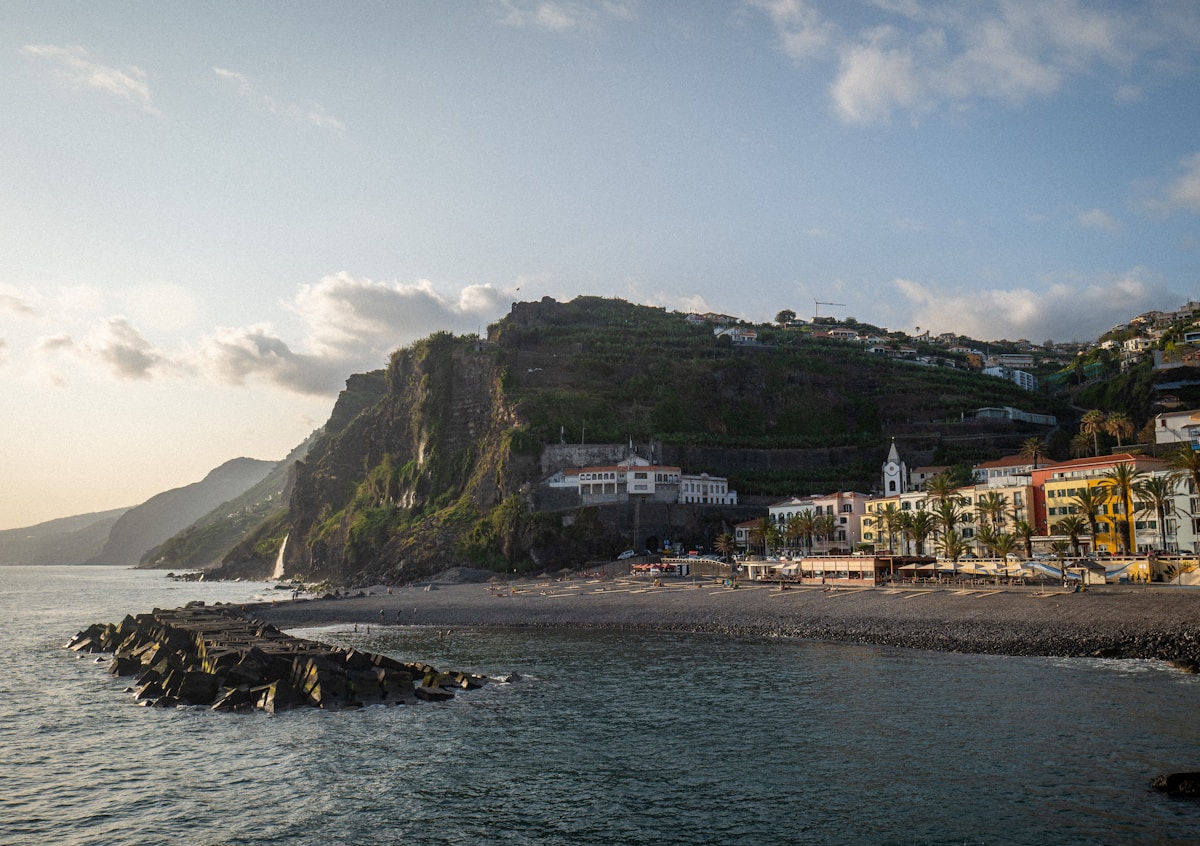
Madeira is an island where a hire car makes a fundamental difference to your trip. The most dramatic parts of the island — the north coast with its sea cliffs and natural pools, the mountain trailheads for the levada walks, the panoramic summit roads, and the small fishing villages strung along the coast — are either impossible or deeply impractical to reach without one. Funchal Airport is well organised for car pickups, and the island’s expressway system makes getting around easier than the terrain might suggest.
Book your Madeira rental: Compare car hire prices at Funchal Airport — international chains and local Madeiran companies, from approximately €30/day in shoulder season (as of 2026).
Why Madeira Requires a Car
Madeira’s road network is one of the most spectacular in Portugal — and one of the most necessary. The island rises sharply from the coast to over 1,800 metres in the interior. Most of the levada trailheads that make Madeira famous for walking are accessible only by car. The bus network connects Funchal with towns like Santana and Ribeira Brava, but runs slowly and on limited schedules; it does not serve the mountain roads to Achada do Teixeira, the Queimadas park, or the Rabaçal plateau where Levada das 25 Fontes begins.
With a car, the full island opens up. The north coast — dramatically wetter and greener than the south — is a 45-minute drive from Funchal through the VR1 tunnel. The west coast (Porto Moniz, Seixal) is another 30 minutes beyond that. The mountain peak road to Pico do Arieiro summit (1,818m) is a 30-minute drive from Funchal. All of this sits behind a Funchal base.
Funchal Airport Car Rental — What to Expect
Madeira Airport (FNC) is on the east coast, approximately 20 km from Funchal. The runway extension over the sea on concrete columns is one of the most unusual in Europe and worth a look. Domestic and international flights land here; there is no other commercial airport on the main island.
Car rental desks are in the arrivals hall, with international companies (Sixt, Europcar, Avis, Budget, Hertz) alongside local Madeiran operators. The drive from FNC to Funchal on the VR1 expressway takes about 20 minutes.
Local companies at FNC: AutoClassic, Rodavante, Moinho, and 6rent are among the local Madeiran rental suppliers. They typically offer lower rates than the international chains for the same vehicle class — the trade-off is usually slightly older fleet, and support is less consistent if something goes wrong in a remote area. For short, straightforward rentals, local companies are usually fine.
Desk queues in peak season: December to January (New Year fireworks) and May (Flower Festival) are the two busiest periods. Desk queues can run 20–30 minutes at peak arrival times regardless of pre-booking. Pre-booking does not skip the queue but does guarantee a car — walk-up availability at FNC in late December is frequently nil for compact cars. Pre-book if travelling at any busy window.
Return: The car return area is adjacent to the terminal — a short drive. Allow 15 minutes for the check-in in peak season.
Madeira’s Road System
Understanding which roads Madeira has is important before you drive.
VR1 (Via Rápida): The main east–west expressway running along the south coast from Canical in the east to near Calheta in the west. Fast and modern, with the central section between Funchal and Santa Cruz being the most used stretch. Most tunnel tolls on the VR1 are free — some short-distance sections have small electronic tolls of €0.30–0.70. Speed limit 100 km/h.
VR2: The ring road connecting Funchal with the north coast via an 8 km tunnel under the central mountain ridge. The tunnel itself is free. This is the key artery for reaching the north — without it, driving from Funchal to the north coast would take over an hour on mountain roads; with it, it’s 25 minutes.
Mountain roads (EN101, EN105, EN103): The old national roads through the mountain interior. These are narrow, steep, and winding — some sections have had traditional cobblestone surfaces replaced with asphalt, others have not. They are the most scenic routes on the island and worth using when you have time. Do not attempt them in fog without familiarity with the roads — cloud drops quickly on Madeira’s peaks.
North coast road (EN101 via Ribeira Brava–São Vicente–Porto Moniz): One of the most spectacular coastal road sections in all of Portugal. Some tunnels, some exposed clifftop sections, and the dramatic sea cliffs of the north coast throughout. Distance from Funchal to Porto Moniz: approximately 95 km, allow 2 hours minimum (and more if stopping).
Choosing Your Car
Compact (VW Polo, Ford Fiesta, Opel Corsa class): Sufficient for all standard Madeira roads including the VR expressways and the main mountain roads. Fits in all the standard parking areas in Funchal and at trailheads. The right choice for most visitors.
Automatic transmission: Madeira’s steep road inclines make automatic gearboxes a genuine convenience, particularly in Funchal’s hilly streets. Available at most rental desks but often at a 15–30% premium. Worth it if you are not comfortable with manual gearboxes on steep hills.
SUV: Only worth it for the Pico do Arieiro summit road or other extreme mountain ascents. Standard mountain roads are fine in a compact. SUVs are more expensive, harder to park in Funchal’s narrow streets, and unnecessary for most itineraries.
Electric car: Available from some suppliers at FNC. The range anxiety concern on Madeira is minimal — the island is 57 km long and 22 km wide. Charging is available in Funchal. Quiet, clean, and suited to the island’s speed limits.
Seasonal Prices at Funchal
Approximate market rates for a compact car with standard CDW:
| Season | Dates | Daily rate (approx.) |
|---|---|---|
| Low season | February–March | €20–30 |
| Shoulder | April–June, September–October | €30–50 |
| Peak summer | July–August | €45–70 |
| New Year peak | Late December–early January | €60–90 |
The New Year fireworks period (roughly 27 December–4 January) is the most expensive window for Madeira car rental — higher demand than summer in some years. Book early if travelling over New Year.
Best value window: February and early March. Prices are at their annual low, the weather is mild (16–18°C in Funchal), and the island is quiet. Levada walks are uncrowded. The main downside is that mountain peaks have more cloud cover in winter.
Key Destinations by Car
Pico do Arieiro (1,818m summit car park): 30 minutes from Funchal. The easiest high-altitude viewpoint in Madeira — drive directly to the summit, no hiking required. At clear sunrise, the peaks emerge from a sea of cloud.
Levada das 25 Fontes (PR6) trailhead at Rabaçal: 45 minutes from Funchal via the VR1 and mountain road. The most popular levada walk in western Madeira — impossible to reach by public transport. Park at the viewpoint and follow the signs down to the Rabaçal plateau.
Porto Moniz natural rock pools: 2 hours from Funchal via the north coast road. Atlantic rock pools enclosed by lava formations, with excellent swimming. Entry €2. The drive there is half the point.
Santana A-frame houses and Parque Temático: 1 hour 15 minutes from Funchal via the VR2 tunnel and north coast. Madeira’s most-photographed traditional buildings — palheiro houses with straw roofs reaching to the ground.
Cabo Girão sea cliff: 25 minutes from Funchal west. Europe’s second-highest sea cliff at 580m. Glass viewing platform cantilevered over the vertical drop. Free entry.
Paul da Serra plateau: A high moorland plateau at around 1,300m in the western interior. Entirely flat — unusual for Madeira — with wind turbines and a wide-open landscape unlike the rest of the island. Accessible via the ER209 or the EN110. Drive-through; no entry fee.
Insurance in Madeira
Standard CDW is included in most quoted Madeira prices, reducing your damage liability to an excess of approximately €1,000–1,500. This covers the car body for most incidents but typically excludes:
- Windscreen and glass damage
- Tyre punctures
- Roof damage (low branches in forested areas)
- Undercarriage damage (relevant on rougher north coast tracks)
- Damage from entering any road marked “passagem não autorizada” (unauthorised passage)
Super CDW (Full Waiver): Reduces your excess to zero for approximately €10–18/day. Worth considering given Madeira’s narrow roads — the risk of a slow-speed wing mirror clip on a mountain road or a scratch while parking in Funchal’s old town is genuine.
Credit card coverage: Some US and UK premium cards provide primary rental collision coverage abroad. Verify your card’s territory coverage — not all policies apply in Portugal’s autonomous regions specifically. Check the exact terms before declining CDW at the desk.
Fuel policy: Most operators in Madeira use a full-to-full policy. Take a photo of the fuel gauge level at pickup. Fuel stations are in all main towns; do not let the tank drop below a quarter on mountain roads where stations are sparse.
Practical Driving Notes
- GPS or offline maps: Download Madeira offline maps before driving — mobile signal drops in tunnels and some mountain areas.
- Expressway tolls: The VR1 and VR2 have electronic tolls on some sections paid via the Via Verde system built into most rental cars. Typically €0.30–0.70 per tunnel section; your rental company invoices at drop-off plus a daily activation fee (€2–4/day). Confirm the fee structure at pickup.
- Narrow roads: Standard practice on single-track mountain roads is to reverse to the nearest passing place when another car approaches. Take it slowly — locals are used to tourists; a polite acknowledgement goes a long way.
- Parking in Funchal: Paid parking throughout the centre. The Marina car park and the Mota car park near the market are most central. Budget approximately €1–2/hour. Outside peak hours, roadside spaces near the old town do become available.
Plan Your Madeira Trip
🚗 Compare car hire prices at Funchal Airport 🗺️ Madeira island guide — levadas, hiking, and Funchal 📅 1-week Madeira itinerary 🏨 Search hotels in Madeira on Booking.com ✈️ Book flights to Madeira 🛡️ Travel insurance for Madeira 📱 Madeira eSIM