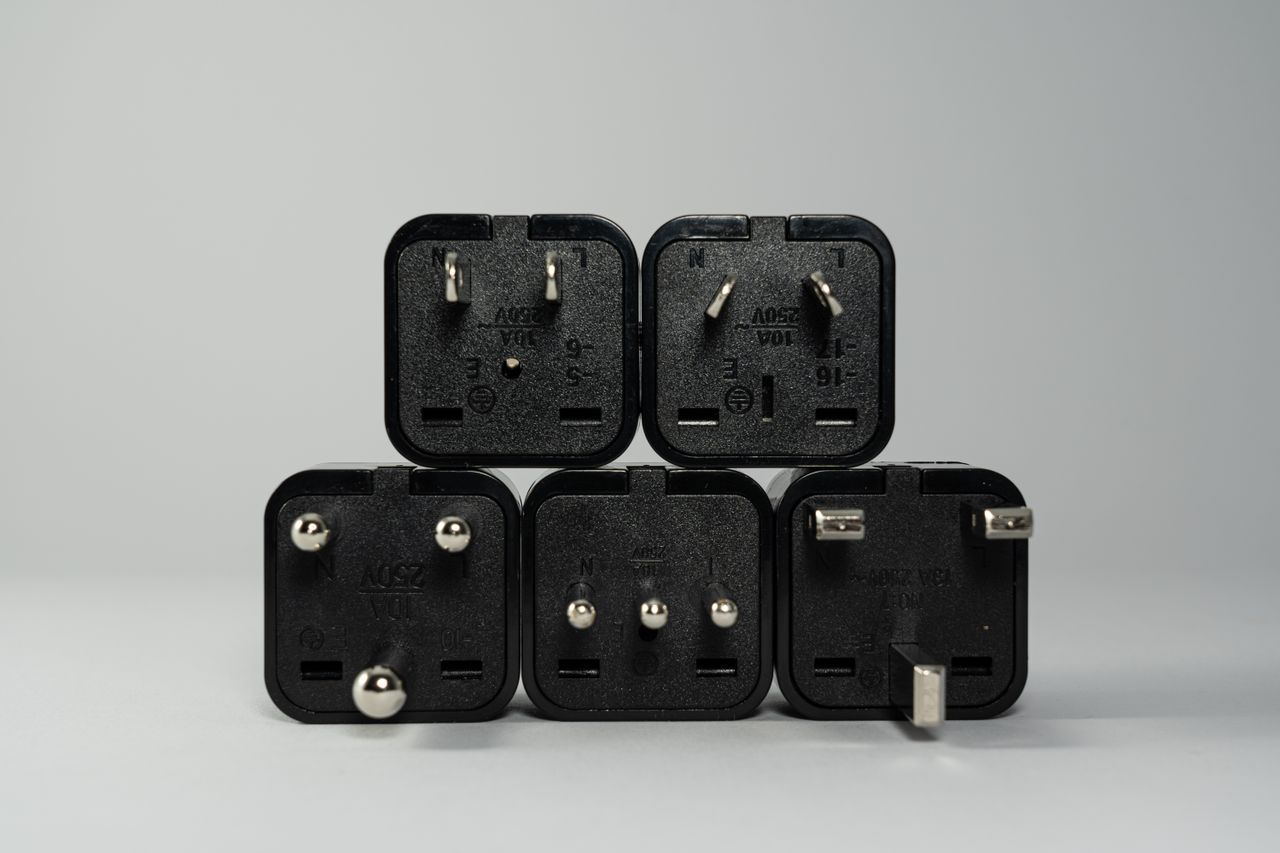
Portugal runs on the same electrical standard as most of continental Europe: 230 volts at 50 hertz, with type C and type F sockets. If your devices come from Spain, France, Germany or Italy, you need nothing extra. If they come from the UK, the US, Canada, Australia or Brazil, you will need an adapter, and in some cases a closer look at the voltage rating. This guide covers what we pack for Portugal and the checks that stop a charger or hair dryer from failing on the first night.
Plug types used in Portugal
| Type | Description | Where you will see it |
|---|---|---|
| C | Two round pins, 4mm, no earth. Also called the Europlug, rated for about 2.5A | Phone chargers, shavers, small devices |
| F | Two round pins plus earthing clips on the top and bottom edges of the plug, also called Schuko | Laptops, kettles, hair dryers, most sockets |
Most Portuguese wall sockets are the round recessed type that accepts either plug. A type C plug slides in without the earth connection, which is fine for low-power devices. Higher-power appliances should use a type F plug so the earth clips make contact.
You will sometimes find older sockets in older guesthouses and rural properties, particularly in the Alentejo and Douro. They still take the same round pins, but they can be loose or sit deep in the wall, so a plug with a thick body may not seat fully. A slim adapter or a short extension lead solves this.
Voltage and frequency
The standard supply is 230V at 50Hz. For visitors this breaks down three ways:
- From the UK and Ireland: the voltage is the same (230V). You only need a plug adapter.
- From the US, Canada and Mexico (120V, 60Hz): you need an adapter, and each device has to be rated for 230V. Look for “Input: 100-240V, 50/60Hz” on the charger. Almost all modern phones, tablets, laptops, cameras and power banks carry this.
- From Australia and New Zealand (230V, 50Hz): same voltage, so a plug adapter is enough.
Brazil is a special case. Many Brazilian cities run on 127V or 220V and use type N plugs, so travellers should check the label on each device and not assume anything.
Which adapter to bring
- UK visitors: a UK to EU adapter (type G to type C/F). Buy one with a type F-compatible output, which also covers Spain, France and the rest of the trip if you continue overseas.
- US and Canadian visitors: a US to EU adapter. Pair it with a dual-voltage hair dryer or buy a cheap one at a Portuguese electronics shop.
- Travelling through several countries: a compact universal adapter works but is bulkier. A multi-port USB charger with a single EU plug, plus a couple of short USB-C cables, lets you charge everything from one socket.
Hair dryers, straighteners and kettles
This is where most plug problems happen. A 120V hair dryer plugged into 230V through an adapter does not convert anything. It simply receives twice the voltage and can fail in seconds, sometimes with smoke. The adapter changes the pin shape only.
If your device is single voltage, leave it at home. Most hotels in Lisbon, Porto, Faro and Funchal supply a hair dryer in the room, and many apartments have one. Check the listing before you pack. Travel hair dryers marked 100-240V work anywhere with the right adapter.
Charging in practice
- USB-C is the norm. The EU has required a common USB-C charging port on new phones, and European brands follow it, so cables are easy to replace locally. Check our Portugal packing list for the rest of the essentials.
- Socket placement: hotel rooms often have limited sockets by the bed. A short extension lead with a built-in surge protector is useful, and cheap to buy at a supermarket or hardware shop.
- Trains and airports: Comboios de Portugal intercity services and Lisbon and Porto airports have charging points in places, but they are not guaranteed to work or to be free. Carry a power bank.
- Power cuts: the Iberian blackout of 28 April 2025 showed that outages can last hours. Keep a charged power bank and offline maps for any long journey, especially in the interior and on the islands.
- Cars: if you are renting, most cars have a USB port or a 12V socket, but the cable you need may not be included. Our car hire in Portugal guide explains what to check at pick-up.
Staying connected abroad
A charged phone only helps if it has data. Our Portugal eSIM guide and SIM card guide compare the options, and you can get a Portugal eSIM before you arrive. Cover for lost or damaged electronics sits in your travel insurance, so check the gadget limits on the policy.
Where to buy an adapter in Portugal
If you forget one, you can buy one on arrival at Worten and FNAC (both in major shopping centres in Lisbon, Porto and the Algarve), at El Corte Inglés in Lisbon and Vila Nova de Gaia, and at airport convenience shops. Expect a few euros in a regular store and more at the airport. Supermarkets such as Continente and Pingo Doce often stock basic travel adapters near the electrical aisle, though stock varies by store.
Quick checklist
- Check each charger label for 100-240V.
- Pack one adapter per person, or one multi-port USB charger.
- Leave single-voltage heat appliances at home.
- Bring a power bank and short USB-C cables.
- Confirm your accommodation has a hair dryer.
Heading out once everything is charged? See what is on offer with Lisbon tours.
Electrical details are correct as of 2026. Retailer stock and prices change, so confirm before you travel.