Terceira is the most visited of the central Azores islands and one of the easiest to explore independently — the road network is good, distances are short, and the island has a broader range of geological and historical sites than many first-time visitors expect. Most day trips from Angra do Heroísmo return by early evening, leaving evenings free in the UNESCO city.
Angra do Heroísmo — Historical Centre Walk
Before heading out, walk the city itself. Angra do Heroísmo was designated a UNESCO World Heritage Site in 1983 — one of the few entire urban centres in Portugal to hold the designation — for its intact 16th–17th century layout and architecture.
Key stops:
Sé Cathedral (Igreja da Sé): the largest church in the Azores. Free entry. The sacristy has a notable collection of silver liturgical objects.
Jardim Duque da Terceira: a formal garden in the historic centre, built on the site of a former Franciscan convent. The garden’s iron gazebo dates to the 19th century.
Monte Brasil: the volcanic headland immediately west of the city, accessible by car or a 45-minute walk from the centre. The São João Baptista Fort at the base (one of the best-preserved 16th-century military fortifications in the Atlantic) has free access to the outer walls. The summit of Monte Brasil gives a 360-degree view of Angra and the bay.
Rua Direita and the side streets: the pedestrianised main street and its parallel lanes have a mix of 18th-century merchants’ houses, azulejo-tiled facades, and the island’s best cafés. The Bolo Levedo — a sweet bread traditional to Terceira — is sold in most bakeries.
Allow 2–3 hours for the full walk; a full half-day if you include Monte Brasil.
Algar do Carvão
Distance from Angra: approximately 16km north, around 20 minutes by car.
A lava tube formed around 3,200 years ago — one of the most accessible active volcanic tubes in the world and one of Terceira’s top-ranked natural attractions. Visitors descend through a narrow tunnel entrance and spiral staircase into a chamber 90m deep, where a lake of crystal-clear groundwater sits at the bottom. The cave is actively hydrothermal: the walls are encrusted with white silica minerals, and stalactites of volcanic origin hang from the ceiling.
Entry: approximately €8 as of 2026. Book in advance — timed slots fill quickly in summer. The descent involves steep steps and some low-clearance sections; not suitable for those with serious mobility limitations. The temperature inside is approximately 12°C year-round — bring a layer even in summer.
The cave is managed by the Azores regional government. Current booking information is available at the visitor centre in Angra or online via the Azores tourism portal.
Furnas do Enxofre
Distance from Angra: approximately 18km north, around 25 minutes by car, adjacent to Algar do Carvão.
A network of sulphur caves and fumaroles in the volcanic highlands near the centre of the island. Less dramatically deep than Algar do Carvão but set in open ground, with boardwalk paths through steaming vents and sulphur pools. The landscape — yellow mineral deposits against grey volcanic rock, steam rising through low vegetation — is visually striking. Entry: approximately €4 as of 2026.
Combine Furnas do Enxofre with Algar do Carvão in the same morning (they are 2km apart) and allow an hour for each.
Serra do Cume Viewpoint
Distance from Angra: approximately 15km east, around 20 minutes by car.
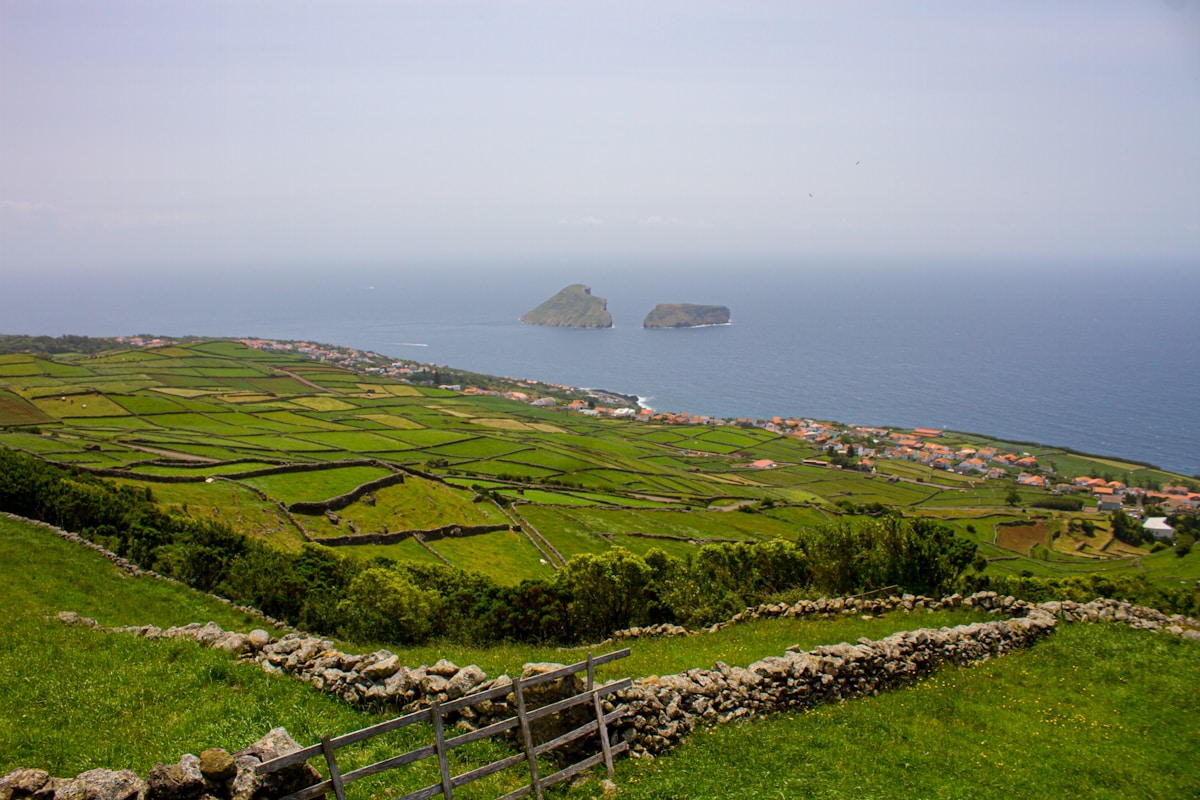
The viewpoint at Serra do Cume sits at 547m above sea level and looks east across the most distinctive landscape on Terceira — a patchwork of small fields divided by thousands of kilometres of dry stone walls, stretching to the coast and the two small offshore islets (the Ilhéus das Cabras). The pattern is the result of land subdivision over centuries of agricultural settlement; from above it looks almost like a drawn map of the island.
The viewpoint has a car park and a small café. On clear days, Graciosa island is visible on the horizon to the north. Free.
Biscoitos Lava Pools
Distance from Angra: approximately 20km north, around 25 minutes by car.
The lava field on Terceira’s north coast created a series of natural rock pools where the volcanic plateau meets the sea — one of the best swimming spots in the central Azores. The pools at Biscoitos are enclosed enough to be calm when the Atlantic swell is moderate, with deeper sections for swimming and shallower ones for wading. The water is clear, cold (18–20°C in summer), and unpolluted.
A small café operates at the pools in summer. Free access; a car park is available nearby. Arrive early on summer weekends — local families fill the pools by 11am. Note that rough winter swell makes the pools impractical October–April.
The Museu do Vinho (Wine Museum) is adjacent to the pools in the village of Biscoitos — Terceira’s lava vineyards produce a distinctive style of wine; the museum charges a small entry fee and includes a tasting.
Getting Around
Terceira requires a car for comfortable day trips — public transport serves Angra and the main villages but not the volcanic interior or the lava pools. Rental cars are available at Lajes Airport (approximately 15km from Angra) and from agencies in the city centre, from approximately €40–50 per day as of 2026.
Most day trips listed above can be combined in pairs: Algar do Carvão + Furnas do Enxofre in the morning, Serra do Cume on the way back. Biscoitos pairs well with the north coast road or an afternoon in Angra.
For guided tours covering Algar do Carvão, Angra walking tours, and whale watching from Terceira, browse options on GetYourGuide — most run half-day and suit a morning slot before an independent afternoon.
Before travelling to the Azores, travel insurance that covers outdoor activities is worth arranging — Algar do Carvão’s descent involves steep steps and the caves reach 12°C year-round regardless of season.
For accommodation in Angra, see the best hotels on Terceira guide. The full Terceira island guide covers arrival and practical logistics.
Search hotels in Terceira Azores on Booking.com to compare rates and availability.