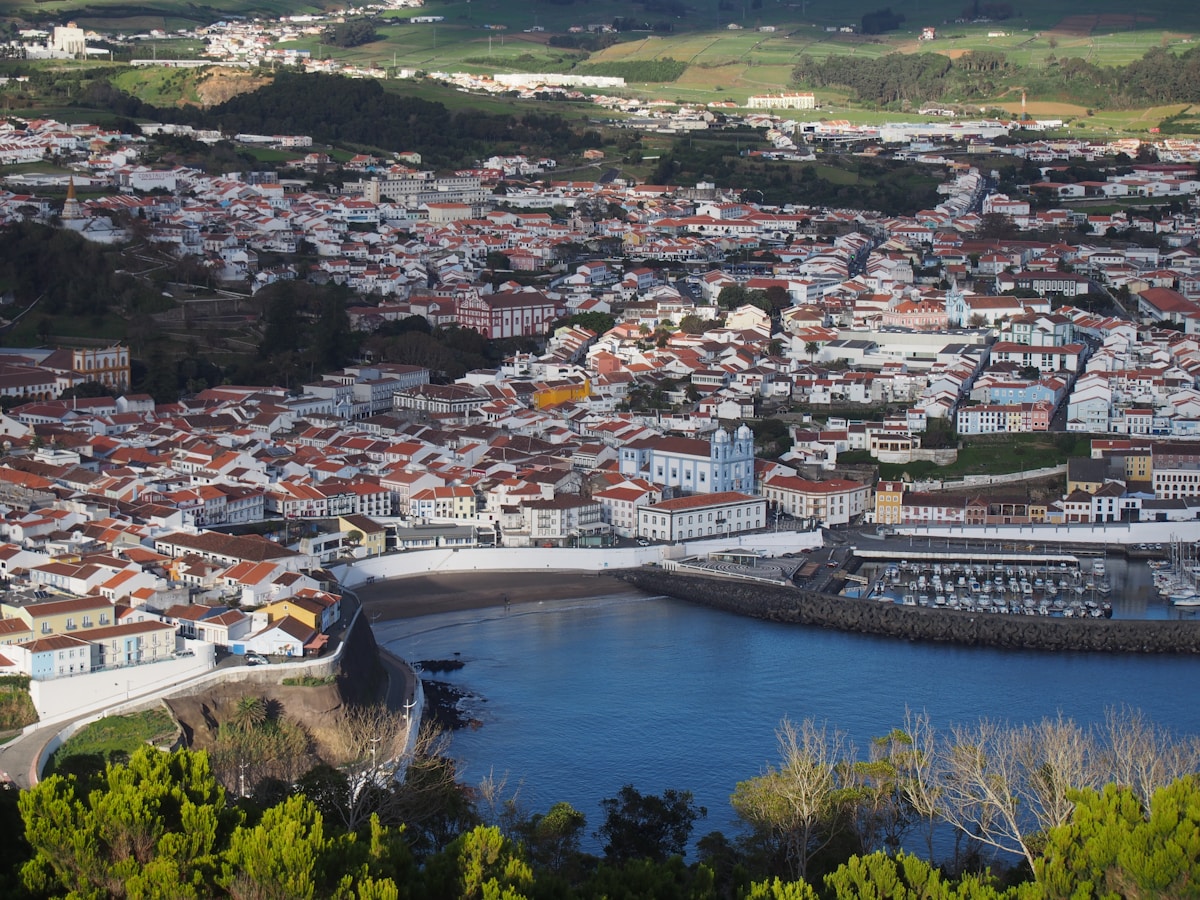
Terceira is the second most visited island in the Azores after São Miguel, and the most historically significant. Its capital, Angra do Heroísmo, is the only UNESCO World Heritage city in the Azores - a preserved 16th-century Portuguese colonial town of baroque churches, painted merchant houses, and 17th-century fortifications. Beyond the city, the island offers one of the few accessible volcanic caves in the world, a unique bullfighting tradition, and the best beach in the central Azores.
Angra do Heroísmo
The city was founded in 1534 and served as a critical stop on the Atlantic trade routes between Portugal, Brazil, and Africa. Much of the colonial architecture survived the 1980 earthquake (which damaged much of the island) through extensive restoration, and the city was inscribed as a UNESCO World Heritage site in 1983.
Sé Cathedral - the oldest cathedral in the Azores, built between 1570 and 1618. The interior is largely Manueline in style, with ornate stonework and a notable collection of Flemish paintings. Free entry, open daily. The cathedral square is the social centre of the city.
Monte Brasil - the volcanic headland protecting Angra’s harbour is a natural reserve with a 16th-century fortress (Fortaleza de São João Baptista) still occupied by the Portuguese military. The circular walk around the top of Monte Brasil takes 2 hours; views across the city, harbour, and the central Azores caldera chain are exceptional on clear days.
Museu de Angra do Heroísmo - installed in the former Convento de São Francisco. Strong collection covering the history of the Azores trade routes, the 1980 earthquake, and island ethnography. Entry €3. Closed Mondays.
Jardim Duque da Terceira - the city’s formal garden, laid out in the 19th century. Peacocks, fountains, and a decorative bandstand. Pleasant for an hour in the afternoon; the surrounding streets have the best café options in the city.
Algar do Carvão
One of the few volcanic tube caves in the world open to the public. Visitors descend 45m through a circular lava chimney into a chamber of stalactites formed from silica and iron deposits - white, black, and yellow mineral formations covering walls and ceiling. A pool of freshwater sits at the base of the chamber.
The cave formed approximately 3,200 years ago during a volcanic eruption. It is 100m deep in total; the accessible section is about 300m. The temperature inside is a constant 16°C - bring a layer.
Open April–October. Entry €6. Maximum 80 visitors per session; book in advance or arrive at opening. The site also includes the Gruta do Natal (Christmas Cave), a shorter lava tube nearby, sometimes included in the same ticket.
Caldeira de Guilherme Moniz
The most accessible caldera on Terceira - a flat-floored volcanic crater covering 15km². You can walk around the rim or descend into the caldera floor via marked trails. The interior grows subtropical vegetation; the crater walls are steep and green. Combined with the nearby Caldeira do Pico Alto, this is worth a half-day for anyone interested in volcanic landscapes.
Touradas à Corda
Terceira’s bullfighting tradition differs from mainland Portugal and Spain in one important respect - the bull is not killed. Eight men (pastores) dressed in traditional dress hold the bull on a single rope (corda) while a cavaleiro works in front. The bull charges; the pastores manage the rope. Audiences stand along the streets of Angra and nearby villages.
Touradas run from late June through September, primarily on summer evenings. The main events happen in Angra’s Praça Velha and in village streets across the island. Entry to street-side touradas is free. Check the local tourism office schedule on arrival - dates shift each year.
Praia da Vitória
The island’s best beach, on the east coast, 20km from Angra. A long stretch of dark sand (typical of the Azores) with protected swimming in a sheltered bay. The town of Praia da Vitória itself is smaller and quieter than Angra with a straightforward marina waterfront. The beach gets busy in July and August; out of peak season, it is one of the better Atlantic island beaches.
Bay swimming: the bay at Praia da Vitória is one of the few places in the Azores where the sea is consistently calm enough for family swimming. Protected from Atlantic swell by the headland.
Biscoitos
A village on the north coast with natural lava rock pools - dark basalt channels and pools filled by the Atlantic. Different in character from Praia da Vitória’s beach swimming; the pools are exposed and dramatic. Biscoitos also produces a distinctive white wine from vineyards grown in black volcanic soil, sold by the local cooperative. Entry to the pools area costs €3 in summer.
Tours in Terceira cover Algar do Carvão cave tours, full-day island circuits, and Angra do Heroísmo walking tours - a guide is especially useful for the lava tube system.
Pick up an eSIM for Portugal for reliable navigation across the islands.
Getting Around
Terceira has a reliable bus network connecting Angra with the main villages, but a hire car is practical for the volcanic interior and the north coast. Hire from Angra airport (3km from the city) on arrival; budget for €30–45/day from local companies. The island is small enough that no drive takes more than 40 minutes. Terceira is a key island on the Azores island hopping itinerary. For accommodation, see best hotels in Terceira and the Terceira island guide.
Search hotels in Terceira Azores on Booking.com to compare rates and availability.