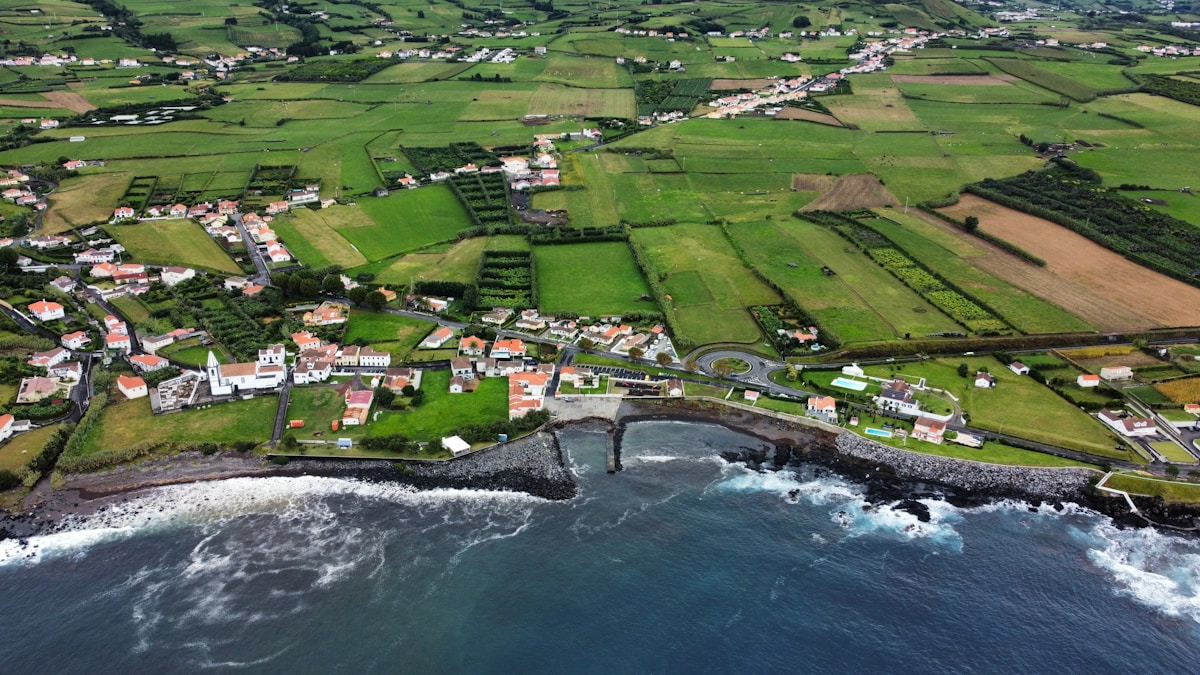
Faial is the smallest of the central group islands and compact enough that most day trips from Horta return you in time for dinner. The island divides neatly into three zones: the caldera highlands, the western Capelinhos peninsula, and the Horta waterfront itself. Allow at least two full days to cover all three properly.
Horta Marina and the Mural Tradition
Before leaving the city, walk the marina walls. Horta sits at the centre of the Atlantic crossing routes — it lies almost equidistant between Europe and the Americas — and has been a waypoint for ocean sailors since the 16th century. Since the 1980s, crews completing Atlantic passages have painted a mural on the marina walls before departing: boat name, crew names, home port, and date. The superstition holds that boats skipping the ritual suffer bad luck at sea.
The result is one of the most unusual public art installations anywhere: hundreds of murals covering every available surface, layered over decades, with newer paintings applied directly over old ones. Walking the full length takes about 20 minutes. Free.
Capelinhos Volcano and Interpretation Centre
Distance from Horta: approximately 18km west, around 25 minutes by car.
In 1957–58, a volcanic eruption off the western tip of Faial produced a new landmass — the Capelinhos peninsula — and buried the Ponta dos Capelinhos lighthouse in ash and lava. The lighthouse still stands, partially submerged in volcanic debris, and the surrounding landscape of grey ash fields and hardened lava flows looks unlike anywhere else in the Azores.
The Capelinhos Interpretation Centre (entry €8 as of 2026, open Tuesday–Sunday) is built into the hillside below the old lighthouse and tells the story of the eruption through film, geological exhibits, and an underground passage that surfaces directly onto the ash fields. The views from the lighthouse platform — looking west over the open Atlantic from the newly created land — are among the most dramatic on the island.
Allow 2 hours for the site. Combine with the Caldeira walk (returning east past the caldera summit road) for a full day in the western half of the island.
Caldeira Rim Walk
Distance from Horta: approximately 10km west, around 15 minutes to the car park above Cabeço Verde.
Faial’s caldera is 2km wide and nearly 400m deep, with a flat forested floor. The rim walk circles the top of the caldera on a marked trail — 8km in total, 4–5 hours, with views down into the crater on one side and across to Pico on clear days on the other. The path is well-maintained and largely flat along the rim itself with a short steep descent to the car park.
Important: the walk is officially closed when fog reduces visibility at the rim. This happens regularly — the caldera collects cloud even on otherwise clear days. Check with the ranger at the car park before starting. Admission: free. No guide required when conditions are clear.
The caldera floor is a nature reserve and is not accessible without a permit.
Monte da Guia
Distance from Horta: 3km south, around 5 minutes by car or 30 minutes on foot.
The Guia promontory south of Horta is a small volcanic cone that gives a panoramic view back over the harbour, the town, and across to Pico on clear days. The Chapel of Nossa Senhora da Guia sits at the top — a pilgrimage site that has been in continuous use since the 17th century. The surrounding area is a nature reserve with nesting seabirds, including Cory’s shearwaters. Free.
Walk up from the marina via the coastal path (3km, 45 minutes) or drive to the car park at the top and walk the short loop trail around the headland.
Ferry to Pico Island
Pico is 30 minutes by ferry from Horta — close enough for a straightforward day trip. Atlanticoline operates the Horta–Madalena crossing; fares run approximately €6 each way as of 2026 (confirm current schedules and fares at atlanticoline.pt as services vary by season and day). Ferries run multiple times daily in summer; fewer in winter.
From Madalena on Pico, the main day-trip options are:
Pico Mountain ascent: at 2,351m, Pico is the highest point in Portugal. A permit (€26 as of 2026, booked online via IFCN Açores) is required to ascend above the volcanic cone’s base. The summit hike takes 3–4 hours up and 2–3 hours down; start no later than 7am to make the last ferry back.
Pico wine region: the UNESCO-listed lava field vineyards along Pico’s southern coast produce the island’s distinctive Verdelho wines. Several quintas offer tastings — Cooperativa Vitivinícola da Ilha do Pico in Madalena is the easiest starting point.
Lava pools at Cachorro: natural volcanic sea pools on Pico’s north coast, free, accessible by car from Madalena in 20 minutes.
A day on Pico is easier with a rental car on the island — pick one up at the Madalena ferry terminal. Allow at least 8 hours for a comfortable Pico day trip from Faial.
Practical Notes
Getting around Faial: most day trips require a car. Rental companies operate in Horta from approximately €40–50 per day as of 2026. The island is compact — driving from Horta to Capelinhos and back with stops fits comfortably in a day.
Ferry booking: Atlanticoline ferries can be booked online or at the Horta terminal. In peak summer (July–August), book ahead for the inter-island routes.
Guided options: for boat trips, Capelinhos volcano tours, and whale watching excursions, compare guided tours on Faial — several operators run small-group day trips covering multiple sites.
Travel insurance: Faial’s volcanic hikes and open-ocean ferry crossings make it worth arranging travel insurance before you fly — EKTA covers adventure activities including hiking.
For accommodation in Horta, see the best hotels on Faial guide. The full Faial island guide covers arrival, orientation, and what to eat.
Search hotels in Faial Azores on Booking.com to compare rates and availability.