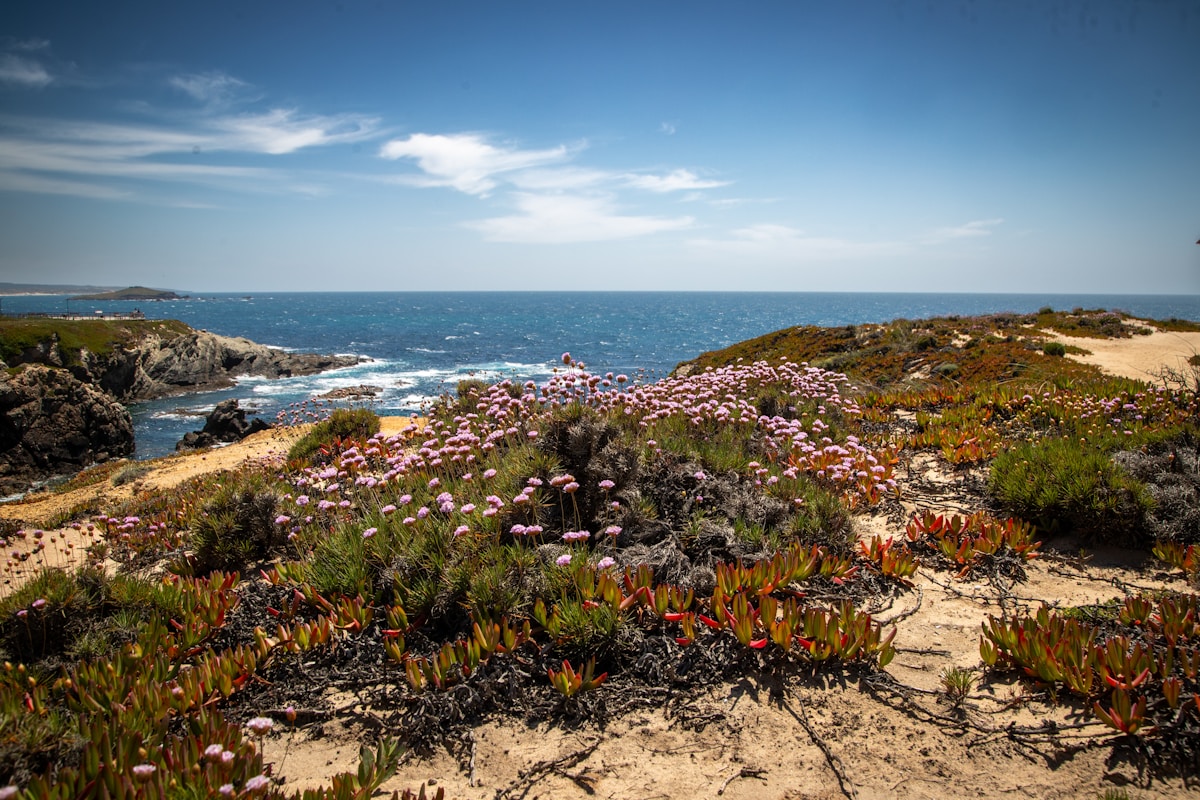
The Costa Vicentina is what most of Portugal’s coastline used to look like before the 1960s. Development restrictions within the Parque Natural do Sudoeste Alentejano e Costa Vicentina have kept the 120 km between Sines and Burgau largely free of the hotels, beach bars, and permanent infrastructure that line the Algarve. The result is a coast of empty beaches, crumbling cliffs, Atlantic dune systems, and fishing villages that still smell of sardines rather than sunscreen.
What Makes It Different
Two things protect the Costa Vicentina: the nature park status (established 1988) which prohibits large-scale construction, and the weather. The prevailing northwest wind blows cold air off the open Atlantic, keeping sea temperatures below 18°C even in midsummer and making the beaches genuinely uncomfortable without a wetsuit for swimming. Surfers love this; sunbathers go to the Algarve instead. The self-selecting effect keeps the coast from being overrun.
The coastline is geologically varied - from the limestone sea stacks south of Sagres (technically at the border of the Wild Coast and the west Algarve) to the long sand beaches and river mouths of the Alentejo north, the dramatic cliff sections near Arrifana, and the dunes north of Porto Covo.
The Rota Vicentina - Walking the Wild Coast
The Rota Vicentina connects Santiago do Cacém (inland) to Cabo de São Vicente at the far southwest tip of Portugal, with two main routes:
The Fishermen’s Trail (Trilho dos Pescadores): 226 km along the clifftops and beaches from Porto Covo to Cabo de São Vicente. The trail uses paths that fishermen historically used to reach the cliff-edge fishing spots. It is genuinely spectacular - long sections have no roads or buildings visible in any direction.
The Historical Way (Caminho Histórico): An inland route of similar length, passing through cork oak forests, farms, and villages.
Both routes are well waymarked and maintained. The Rota Vicentina association (rotavicentina.com) publishes up-to-date trail notes and accommodation lists along the route. Stage lengths are typically 15–25 km, with villages positioned to provide overnight stops. Most walkers complete the full Fishermen’s Trail in 10–12 days.
For shorter walks, individual sections from Zambujeira do Mar to Odeceixe (approximately 17 km), or Arrifana to Aljezur (12 km) are among the best day walks in Portugal.
The Towns and Villages
Vila Nova de Milfontes is the largest and most accessible town on the Alentejo coast - a small fishing town at the mouth of the Mira river, with a castle (now a private residence), a pedestrianised centre, and good fish restaurants. The beaches north and south of the town mouth are extensive and backed by dunes. Ferries cross the river mouth to quieter beaches on the north bank.
Zambujeira do Mar is a small village at the bottom of a cliff path, known mainly for the Sudoeste Primavera Sound festival (held in August, capacity 40,000 - the village of 200 inhabitants briefly becomes one of Portugal’s larger “cities”). Outside festival week, it is very quiet, with one excellent beach and minimal facilities.
Odeceixe sits on the Alentejo-Algarve border, where the Seixe river meets the sea. The village is on a hill above the valley; the beach is 2 km down a road that ends at the river mouth. At low tide, the river is crossable on foot and the beach extends north. The village has a weekly market on Tuesdays and a handful of cafés.
Aljezur is the main town of the northern Algarve’s wild coast section - two neighbourhoods (old Moorish hill, new town in the valley) with a covered market, independent cafés, and easy access to the beaches at Arrifana, Monte Clérigo, and Amoreira.
Arrifana is a surf village below the cliffs, with consistent beach and reef breaks and two surf schools. The ruins of a Moorish fort sit on the headland above the beach. It is the most active surf spot on the coast and can get crowded in summer.
Carrapateira is a small village known for Praia da Bordeira - a vast beach inside a dune system with a river that curves across the sand. The dunes here are among the tallest on the Portuguese coast and the beach’s northern exposure picks up powerful Atlantic swells.
Surfing
The Costa Vicentina is the most consistent surfing coastline in Portugal. The northwest-facing beaches pick up North Atlantic swell from September to May; summer is calmer but waves still run. Key breaks:
- Arrifana - beach and reef break; good for intermediate surfers; surf schools available
- Praia do Amado - wide beach near Carrapateira; powerful beach break; beginner-friendly sections
- Odeceixe - sheltered from north winds; good for beginners
- Praia da Bordeira (Carrapateira) - powerful beach break, best for experienced surfers
- Sagres - multiple breaks including Tonel and Mareta; year-round consistency
Water temperature runs 14–18°C year-round. A 4/3mm wetsuit is appropriate for most of the year; a 3/2mm is usable from June to September for those who tolerate cold water.
Practical Notes
Getting there: A car is essential for exploring the coast flexibly - hire a car at Faro airport and drive north, or pick up from Lisbon. The nearest airport is Faro (Algarve), 2 hours from Vila Nova de Milfontes. Lagos (Algarve) is the best base if arriving by train. Bus connections from Lisbon reach Odemira and Sines; local buses to beach villages are infrequent. Our 7-day Algarve road trip devotes Days 4 and 5 to the Costa Vicentina section, with a structured route from Sagres north to Vila Nova de Milfontes and Porto Covo.
Accommodation: Book well in advance for July and August. The Rota Vicentina website lists accommodation along the walking routes including rural guesthouses and surf camps. Wild camping is not permitted within the nature park.
Water: Sea temperatures are cold year-round by Mediterranean standards. What feels cold to most swimmers feels excellent to surfers. Even in August the water rarely exceeds 18°C at Arrifana.
Facilities: Do not expect beach bars, lifeguards, or phone signal at the more remote beaches. Bring water and food; the coast is raw by design.
Related Guides
For detailed surf reports by break - Arrifana, Bordeira, Odeceixe, and Monte Clérigo - see our Costa Vicentina surf guide. The southern end of the coast connects directly to the Algarve region via Sagres; the Sagres surf guide covers the peninsula’s breaks. Heading north, the Alentejo interior is covered in our Alentejo region guide - useful for those combining the coast with Évora, Monsaraz, and the wine estates. For dolphin watching boat trips that operate along this coast, see our dolphin watching Algarve guide.
Search hotels in Costa Vicentina Portugal on Booking.com to compare rates and availability.