Sagres Travel Guide - Cabo de São Vicente, Surf
Sagres guide: Fortaleza de Sagres, Cabo de Sao Vicente lighthouse, world-class surf, wild beaches, and a quieter base for exploring the Costa Vicentina.
Guides for Sagres
Sagres is a small fishing town at the southwestern tip of continental Europe, where the Atlantic Ocean meets the edge of the Algarve’s wild coast. The village itself has fewer than 2,000 permanent residents, but the landscape around it — vertical cliff faces, open ocean horizons, gale-force winds that flatten the coastal scrub — makes it one of the most dramatic settings in Portugal.
The two headline draws are the Fortaleza de Sagres, the 15th-century promontory fortress linked to Henry the Navigator, and Cabo de São Vicente, the lighthouse-topped headland 6km to the northwest that marks the extreme southwestern corner of continental Europe. Beyond these, Sagres has world-class surf breaks, excellent beaches across a range of exposure levels, and a relaxed year-round scene built around surfers, walkers, and travellers who want the Algarve without the resort infrastructure.
Fortaleza de Sagres
The Sagres Fortress sits on a flat headland (Ponta de Sagres) with cliffs dropping to the sea on three sides. The walls date to the 16th century, though a fortification of some kind has existed here since the early 1400s when Portuguese navigators used Sagres as a base for Atlantic expeditions.
The interior is largely open ground — the most striking feature is the giant compass rose (Rosa dos Ventos) laid out in stone on the fortress floor, measuring 43 metres in diameter and attributed to Henry the Navigator’s era, though its exact dating is contested. A small chapel (Nossa Senhora da Graça) and the entrance fortifications are the main structures standing.
Entry is €3 (as of 2026), and the circuit of the headland walls takes about 45 minutes. The cliff edges are unfenced in places — relevant if you are visiting with children. Come in the morning before the tour buses; afternoon light on the cliffs is better for photography but the site is busier.
Cabo de São Vicente
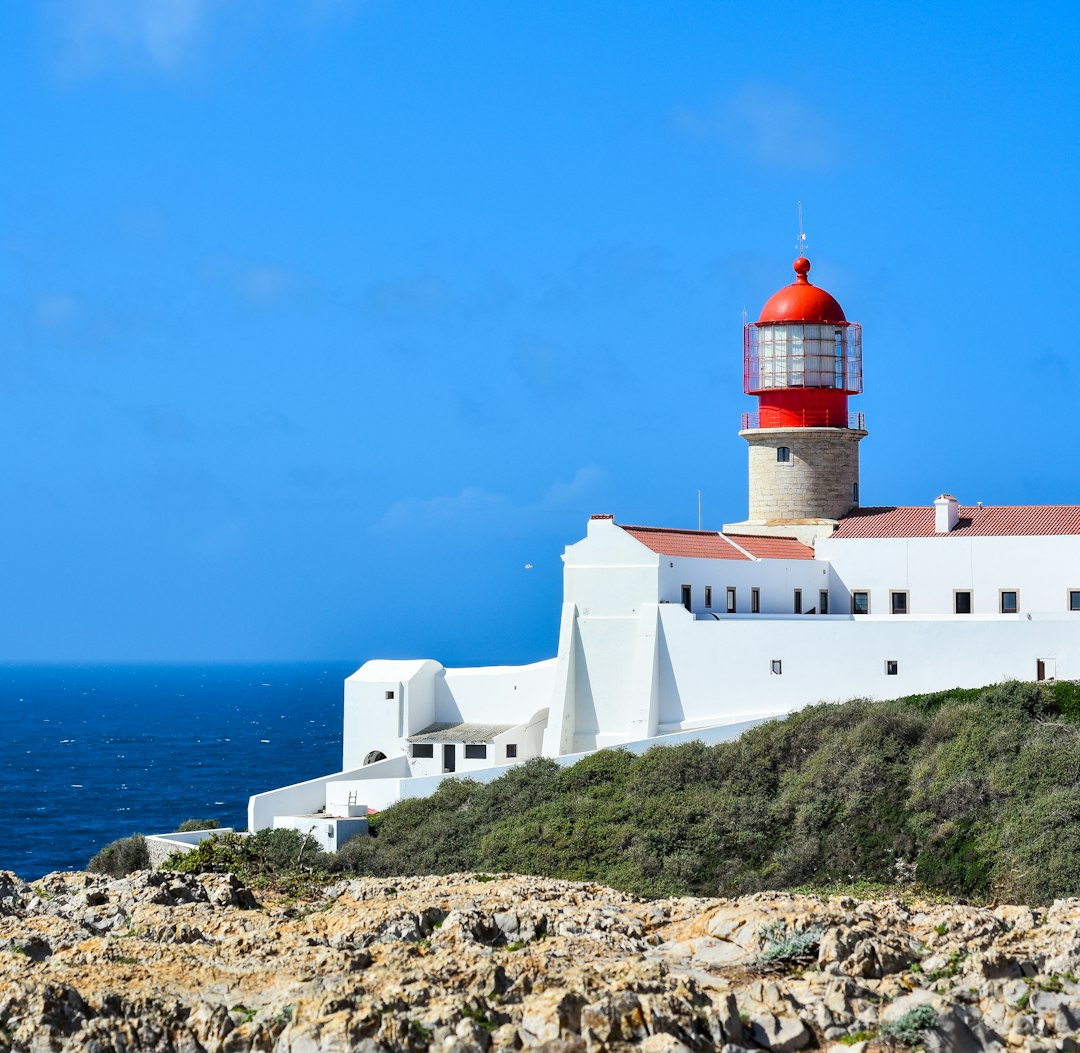
Six kilometres northwest of Sagres along a clifftop road, Cabo de São Vicente is the most southwestern point in continental Europe. The lighthouse (Farol de Cabo de São Vicente) stands 77 metres above sea level on the headland and has been guiding Atlantic shipping since 1846; the current structure is one of the most powerful in Europe with a range of 32 nautical miles.
The approach is open to visitors during daylight hours. There is a small car park, a cluster of souvenir stalls, and the lighthouse building itself (exterior only; the lighthouse is operational and not generally open for interior tours). The cliff edges here are dramatic and the views on clear days extend south toward Morocco.
The best time to visit Cabo de São Vicente is late afternoon — the southwestern orientation means the final hour before sunset produces exceptional light on the cliffs. It’s worth timing the drive out accordingly.
Beaches
Sagres has four main beaches covering very different conditions. Our Sagres beaches guide covers all of them in detail.
Praia da Mareta: the town beach, 300m walk south of the village square. South-facing, sheltered from the prevailing westerly winds, calm enough for swimming most of the year. Small, sand, with a beach bar in summer.
Praia do Martinhal: 3km east of Sagres, inside a partially sheltered bay. The calmest beach in the area — a long stretch of pale sand popular with families, and the site of the Martinhal resort complex. Good snorkelling around the rocks at the eastern end.
Praia do Tonel: the main surf beach, 1km northwest of the village. Consistent Atlantic swell, beach break, and the most popular spot for lessons and longboarding. Backed by dunes, with a seasonal beach bar.
Praia do Beliche: 4km toward Cabo de São Vicente on the N268, accessed via a steep path down the cliff. A sheltered cove with good waves and a dramatic cliff backdrop. Exposed to strong currents — check flags.
Surf
Sagres is one of the best surf bases in Portugal, with breaks suited to all levels within a short drive. Praia do Tonel is the beginner and intermediate go-to. Praia do Beliche handles bigger swells and is better for more experienced surfers. The wider Costa Vicentina — accessed by heading north on the N268 through Aljezur — opens up a run of world-class breaks including Arrifana and Monte Clérigo.
See our full Sagres surf guide for break-by-break conditions, seasonal swell data, and the best local surf schools.
Things to Do
Beyond the fortress and lighthouse, Sagres offers coasteering, sea kayaking, birdwatching (the headland is a major raptor migration watchpoint in autumn), and walking the cliffs along the Rota Vicentina. Our Sagres things to do guide covers all activities including half-day tours, sunset kayak sessions around the fortress headland, and dolphin watching trips that depart from the small harbour.
Where to Stay
Sagres has accommodation for most budgets, though the selection is smaller than in Lagos or Albufeira. See the full Sagres accommodation guide for all options.
Martinhal Sagres Beach Family Resort: the area’s premium option, a self-contained resort complex on Praia do Martinhal with villas, hotel rooms, pools, and a kids’ club. From approximately €200–380/night in high season as of 2026. Well-suited to families; less so for solo travellers or couples wanting proximity to the village.
Memmo Baleeira: a contemporary boutique hotel overlooking the harbour, 500m from the village centre. Pool, terrace bar, clean modern design. From approximately €120–230/night depending on season.
Orquídea Residencial: a simple guesthouse in the village with double rooms and a communal terrace, consistently well-reviewed for value. From approximately €55–90/night.
Sagres surf camps: several surf schools operate camp accommodation — typically a mix of dorms and private rooms, breakfast included, surf lessons optional. The budget option for younger travellers or those combining lessons with accommodation.
Where to Eat
The village square (Praça da República) is the hub for cafés and casual dining.
Restaurante O Telheiro do Infante: reliable for fresh Atlantic fish and seafood — grilled bream, razor clams, percebes (barnacles). The terrace has partial views toward the fortress. Mains approximately €14–22.
A Tasca: a small, informal spot near the square for cataplana, grilled tuna, and the local speciality of carob bean soup. No views, but solid cooking at reasonable prices (mains approximately €10–16).
Dromedário: the main café-bar on the square, best for morning coffee, light lunches, and watching the world go by. Nothing elaborate but the pastel de nata is worth stopping for.
Mum’s: a popular laid-back bar that functions as a surf crowd meeting point in the evenings, with burgers, boards on the wall, and a reliable beer selection.
Getting to Sagres
Sagres has no train station. The Eva Transportes bus from Lagos takes about 1 hour and costs approximately €5. By car from Lagos, it’s 30km via the N125 and N268 — about 35 minutes. From Faro airport, allow 1h15–1h30 by car.
Our Sagres getting there guide covers all transport options in detail, including car hire logistics, the bus timetable from Lagos, and the closest car rental pick-up points.
Best Time to Visit
May–June and September–October are the optimal months. Temperatures are in the mid-20s, the Atlantic swell is manageable for most surfers, and the cliff walks are comfortable. July and August bring the largest crowds to Cabo de São Vicente and the fortress, though Sagres remains quieter than the eastern Algarve. Winters are mild (12–16°C), very windy, and quiet — the surf is at its biggest from November to February, and some restaurants reduce hours.
For guided experiences in the Sagres area, browse tours in Sagres — covering cliff walks, kayak sessions around the fortress headland, and dolphin watching from the harbour. Getting here from the airport? Airport transfers cover the Faro–Sagres route. Pick up an eSIM for Portugal before you land.
How Sagres Compares
Sagres vs Lagos: Lagos is 30km east — a larger town with more restaurants, a train station, and a historic centre. Sagres is a small village at the tip of the Algarve with the Cabo de São Vicente lighthouse and a very different atmosphere: windswept, quiet, surf-focused. Lagos is the stronger base for most visitors wanting Algarve variety; Sagres is the right choice for surfers, hikers, and those who specifically want the end-of-Europe feeling with minimal resort infrastructure. Costs in Sagres are lower than Lagos overall.
Sagres vs Ericeira: Both are surf destinations on Portugal’s Atlantic coast, but they are very different in character. Ericeira is a World Surfing Reserve 45 minutes north of Lisbon — accessible, busy in summer, with a developed café and restaurant scene. Sagres is remote, 100km from the nearest major city, and significantly wilder. Sagres suits intermediate to advanced surfers who want swell consistency and solitude; Ericeira suits those combining surf with city access. Families will find Ericeira more convenient. Best months at Sagres: May–June for manageable swell; November–February for the largest, most consistent waves.
Frequently Asked Questions
- How do I get from Faro airport to Sagres?
- Sagres is about 115km from Faro airport — roughly 1h20 by car on the A22 and N268. By public transport, take the train from Faro to Lagos (about 1h45, €7–9), then the Eva bus from Lagos to Sagres (about 1h, €5). There is no direct bus from Faro airport to Sagres. Private transfers from Faro to Sagres cost approximately €90–120 as of 2026.
- Is Sagres worth visiting without a car?
- Yes, but it requires planning. Eva buses run from Lagos to Sagres several times daily. The fortress, Cabo de São Vicente, and the town beach (Praia da Mareta) are walkable from the village centre. Praia do Tonel and Praia do Beliche are harder to reach without wheels — a bicycle or taxi covers these. For day trips, Sagres makes more sense as a base with a hire car than as a car-free destination.
- What is the best time to visit Sagres?
- May, June, September, and October give the best balance — warm enough for beaches, Atlantic swell for surfers, and far fewer visitors than July–August. Sagres is less crowded than the eastern Algarve year-round, but summer still brings significant footfall to the fortress and Cabo de São Vicente. Winters are mild but windy; the surf is biggest from October to March.
- Are the beaches at Sagres good for swimming?
- It depends on the beach. Praia da Mareta (in the village) and Praia do Martinhal (east of town) are sheltered and calm — both good for swimming and families. Praia do Tonel and Praia do Beliche face the open Atlantic and have consistent surf, strong rip currents, and beach flags that should always be observed. Always swim at flagged beaches in Sagres.
Book an experience
Top experiences in Sagres
Explore the best tours and activities in Sagres, with instant confirmation and free cancellation on most bookings.
Where to stay in Sagres: Find hotels in Sagres →