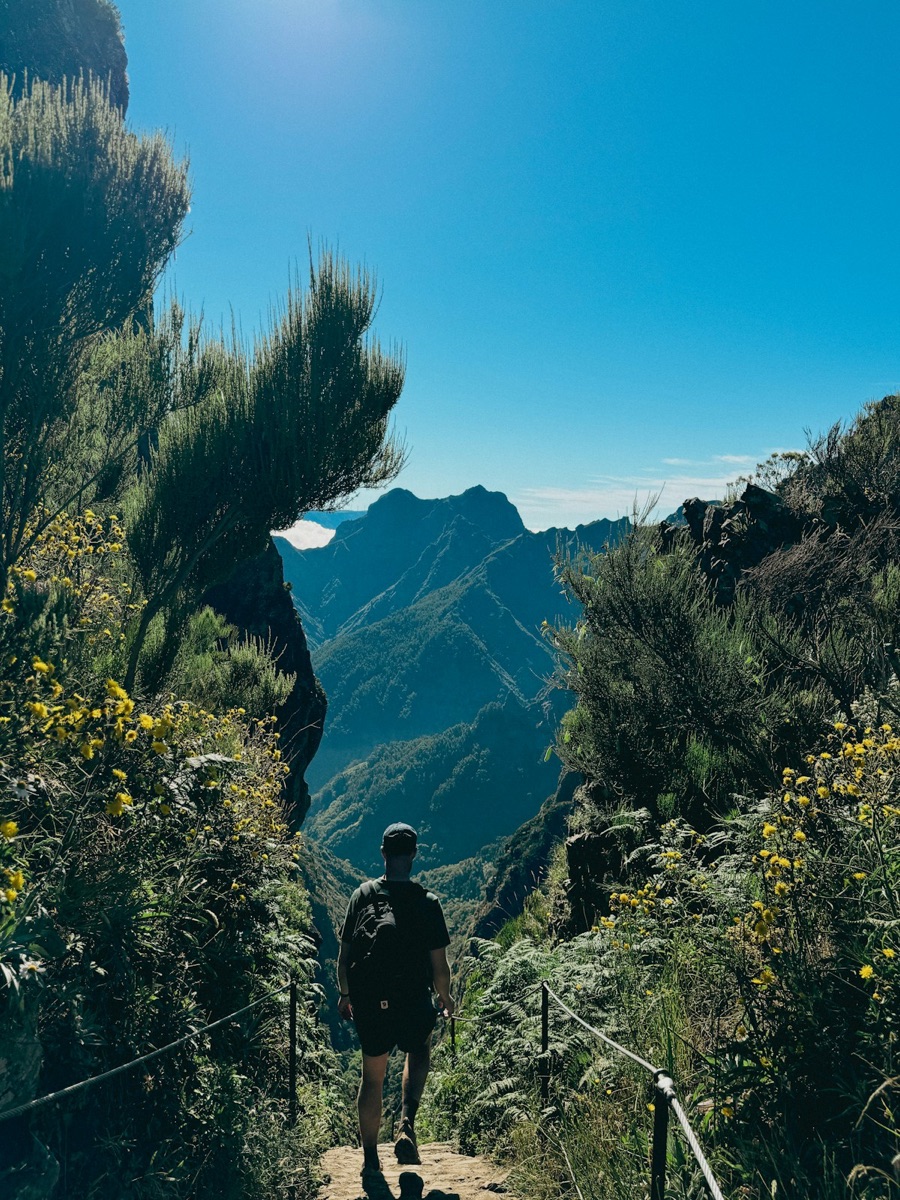
Pico do Arieiro to Pico Ruivo is the walk that defines Madeira hiking. The PR1 connects the island’s two highest accessible peaks across a knife-edge ridge at over 1,700m, with sheer drops on both sides, cloud formations below the path, and views on clear days that extend to both coastlines and sometimes to the island of Porto Santo 40km to the northeast.
This is not a levada walk. There is no canal to follow and no forest canopy overhead. The PR1 is an exposed high-mountain traverse, re-opened in spring 2026 after winter maintenance with a revised permit fee of €10.50 - the highest charged for any classified PR trail on the island. It is also the walk most likely to be the most memorable thing you do in Portugal.
At a Glance
| Trail code | PR1 |
| Distance | 9.6km one way (Arieiro to Ruivo) |
| Duration | 5–6 hours one way |
| Difficulty | Strenuous |
| Start | Pico do Arieiro summit car park, 1,818m |
| End | Pico Ruivo car park / Achada do Teixeira, 1,780m |
| High point | Pico Ruivo, 1,861m (Madeira’s highest point) |
| Permit fee | €10.50 per person (2026) |
| Headtorch | Required (tunnel sections) |
The 2026 Permit System
The PR1 requires an advance booking through SIMplifica, Madeira’s official trail management platform. The €10.50 fee was set when the trail reopened in spring 2026 following an extended closure over winter 2025–2026 for path and safety infrastructure maintenance.
How to book:
- Go to simplifica.madeira.gov.pt
- Register with your passport or ID card number
- Select Percurso PR1 - Pico do Arieiro - Pico Ruivo
- Choose your date and start time slot
- Pay €10.50 per person (children under 12 free; Madeira residents free but must reserve)
- Save your QR code confirmation - checked at the Arieiro gate before the trail starts
Booking lead time: Summer weekends (mid-June through September) sell out two to three weeks ahead. This is the single most in-demand trail in Madeira. Midweek in October or early November, five to seven days is usually enough. If you have a fixed travel date, book the PR1 permit before you book anything else.
Guided tour participants pay approximately €3.00 for the permit as part of the tour price. If you are new to mountain walking or unfamiliar with Madeira, a guided PR1 is worth considering - guides manage the transport logistics, carry emergency equipment, and know the weather patterns.
Getting to Pico do Arieiro
By taxi from Funchal: The standard approach. Pico do Arieiro is 28km from Funchal via the ER202 - about 40–50 minutes by car. A taxi from central Funchal costs approximately €35–45 each way as of 2026. Most PR1 walkers arrange a pre-dawn taxi to arrive at the summit for sunrise (around 06:00–07:00 in summer, 07:00–08:00 in winter).
By hire car: Hire a car to drive up to the summit car park, but note the one-way logistics problem: your car stays at Arieiro while you walk to Ruivo. You either need a second car waiting at Ruivo, a return taxi, or you walk back the same way.
By guided tour: Tour operators collect from Funchal hotels, drive to the summit, walk the PR1 with you, and arrange return transport. This solves the logistics problem entirely. Browse guided PR1 sunrise tours from Funchal — guided tours handle the end-point taxi logistics automatically.
Book Guided PR1 Hikes on GetYourGuide
All tours below include transport from Funchal and end-point return logistics — the key advantage over self-guided. Prices are per-person “from” rates as of 2026.
| Tour | Duration | From price | What it is |
|---|---|---|---|
| Pico Arieiro to Pico Ruivo Guided Hike | 8 hours | From €55 | The full guided PR1 traverse — transport from Funchal, English/French/German guides, return from Ruivo included |
| Sunrise Hike Transfers (Self-Guided) | Transfer only | From €25 | Pre-dawn pickup from Funchal to the Arieiro summit, with a return pickup from Achada do Teixeira — solves the one-way logistics without a guide |
| PR1 Guided Hiking Tour from Funchal | 8 hours | From €60 | Small-group guided traverse with permit assistance, packed lunch, and certified mountain guide |
| Pico do Arieiro Sunrise Transfer | Transfer only | From €20 | Earliest available pre-sunrise pickup from Funchal — for experienced walkers handling their own permit and return logistics |
There is no bus service to the summit. A few operators run dedicated shuttle services on summer mornings for early departures - ask when booking tours.
The Sunrise Strategy
The PR1 sunrise start is one of Madeira’s most reliable bucket-list experiences. At 1,818m, Pico do Arieiro is frequently above the cloud layer that settles around 1,200–1,500m during the night. From the summit, you watch the sun rise over a sea of clouds with only the highest ridges - including Pico Ruivo ahead of you - breaking the surface.
Practical sunrise timing:
- Summer (June–August): Sunrise is around 06:20–06:40. Aim to be at the summit by 06:00.
- Spring/Autumn (March–May, September–November): Sunrise is between 07:00 and 07:30. Aim to arrive by 06:30–07:00.
- Winter (December–February): Sunrise is between 07:40 and 08:00. Arrive by 07:15.
Check the SIMplifica first available slot for your date - the platform manages entry numbers, and a pre-sunrise first slot may or may not be bookable depending on operational hours. A torch is essential for the approach to the first summit viewpoint in pre-dawn darkness.
Weather caveat: Clear mornings at the summit are common from May through October. In November through February, cloud can sit at summit level for days at a time, producing spectacular mist but no sunrise views. Check the Madeira Meteorological Institute forecast for the mountain zones specifically - coastal forecasts don’t reflect summit conditions.
The Trail: Section by Section
Pico do Arieiro to Ninho da Manta (2.5km, ~1.5hrs)
The first section descends from the Arieiro summit (1,818m) sharply on a good path with metal handrails on the steepest sections. The ridge narrows to a spine with drops on both sides - these are the most exposed stretches of the entire walk. On a clear morning this section is extraordinary: the path runs between clouds and the ocean, with both the north and south coasts of Madeira occasionally visible simultaneously.
After approximately 2.5km you reach Ninho da Manta (“Eagle’s Nest”), a balcony viewpoint with a rest bench. This is a good place to pause and check the weather building to the east.
Through the Tunnels (2.5km–4.5km, ~1.5hrs)
The middle section passes through a series of tunnels bored through the ridge. Unlike the levada tunnels of the PR9, these are higher and wider, carved for trail use rather than maintenance access. Each tunnel bypasses a particularly exposed ridge section.
Key tunnels:
- The first main tunnel is approximately 1.2km from Ninho da Manta, running about 80 metres. Headtorch on before entering.
- The second tunnel follows within 500 metres - slightly longer and with a sharp bend inside.
- Several shorter passages punctuate the ridge between here and the final descent to Ruivo.
The path between tunnels traverses the true ridge crest - a spine of fractured basalt with handrails and wire cable on the sharpest sections. The drop on the north side falls to the Metade valley (over 600m below); the south side falls towards the Ribeiro Frio area.
Pico Ruivo Refuge to the Summit (4.5km–5.5km, ~1hr)
From around the 4.5km mark you begin the final push to Pico Ruivo. The Casa de Abrigo do Pico Ruivo - a mountain hut - appears at around 1,780m and makes a natural rest stop. Water and basic refreshments are available when the hut is staffed (not guaranteed off-season).
From the hut, the trail continues upward to the Pico Ruivo summit at 1,861m - the highest point in Madeira and the highest point in the Portuguese Atlantic islands. On clear days the summit view is extraordinary: the full length of Madeira visible to east and west, the Atlantic on both sides, and Porto Santo to the northeast.
Allow 30 minutes at the summit before beginning your descent.
The Final Descent to Achada do Teixeira (1.5km, ~45min)
The standard one-way PR1 exits via the marked descent to Achada do Teixeira at 1,590m, where the paved car park and road access are located. This descent is shorter and gentler than the Arieiro side. The PR1 waymarkers guide you clearly.
One-Way Logistics: Getting Back
Walking one-way from Arieiro to Ruivo means your return transport must be pre-arranged from Achada do Teixeira, accessed via the ER218 from Santana on the north coast (not the same road as the Arieiro approach from the south).
Pre-booked taxi: The recommended option. Book a Madeira taxi company the evening before, confirming the pickup at Achada do Teixeira car park. Specify the approximate time you expect to arrive (add 30–60 minutes buffer for walking pace variation). Fare to Funchal is approximately €45–55 as of 2026; to Santana town approximately €15.
Arranged group pickup: If your group has two cars, one stays at Arieiro and one is driven by a non-walker to Achada do Teixeira at the expected arrival time. This requires someone willing to miss the walk.
Guided tour transport: All organised PR1 tours handle end-point logistics - this is the biggest practical advantage of guided over self-guided on this trail.
Walking back: Returning the same way from Ruivo to Arieiro adds roughly 4–5 hours and demands a total day of 9–11 hours of strenuous mountain walking. Possible in good conditions for experienced walkers; not recommended for first-timers.
What to Wear and Bring
At 1,800m, summit conditions in Madeira can be 8–10°C cooler than Funchal even in summer, and wind can be significant on the exposed ridge. Pack for this regardless of the forecast at sea level.
- Walking boots: This is the one Madeira trail where trail runners are risky. The basalt is sharp and the ridge sections are unforgiving on tired ankles.
- Wind and rain shell: Essential. Even on clear days, cloud can form rapidly on the ridge.
- Warm mid-layer: A fleece or down jacket for the summit - temperatures below 10°C are normal.
- Headtorch with fresh batteries: For the tunnels and any early start before dawn.
- 3 litres of water: The hut at Ruivo may or may not be open. Don’t count on it.
- High-energy food: Lunch at the summit is one of Madeira’s best experiences - pack something worth eating at 1,861m.
- Sun protection: At altitude and above the cloud layer, UV exposure is higher than at sea level.
Connecting with the Madeira Levada Network
The PR1 is the highest and most demanding walk in Madeira. For contrast, the island’s classic levada trails run at much lower elevations through forest. Our Madeira levada walks guide covers the full PR network, from the easy PR17 Levada dos Balcões (4km, 1.5hrs) to the PR6 at Rabaçal’s 25 Fontes and the tunnel-heavy PR9 Caldeirão Verde on the north coast.
For wider island trip planning - where to stay, how to get around Madeira, and what else the island offers beyond walking - see the Madeira island guide.