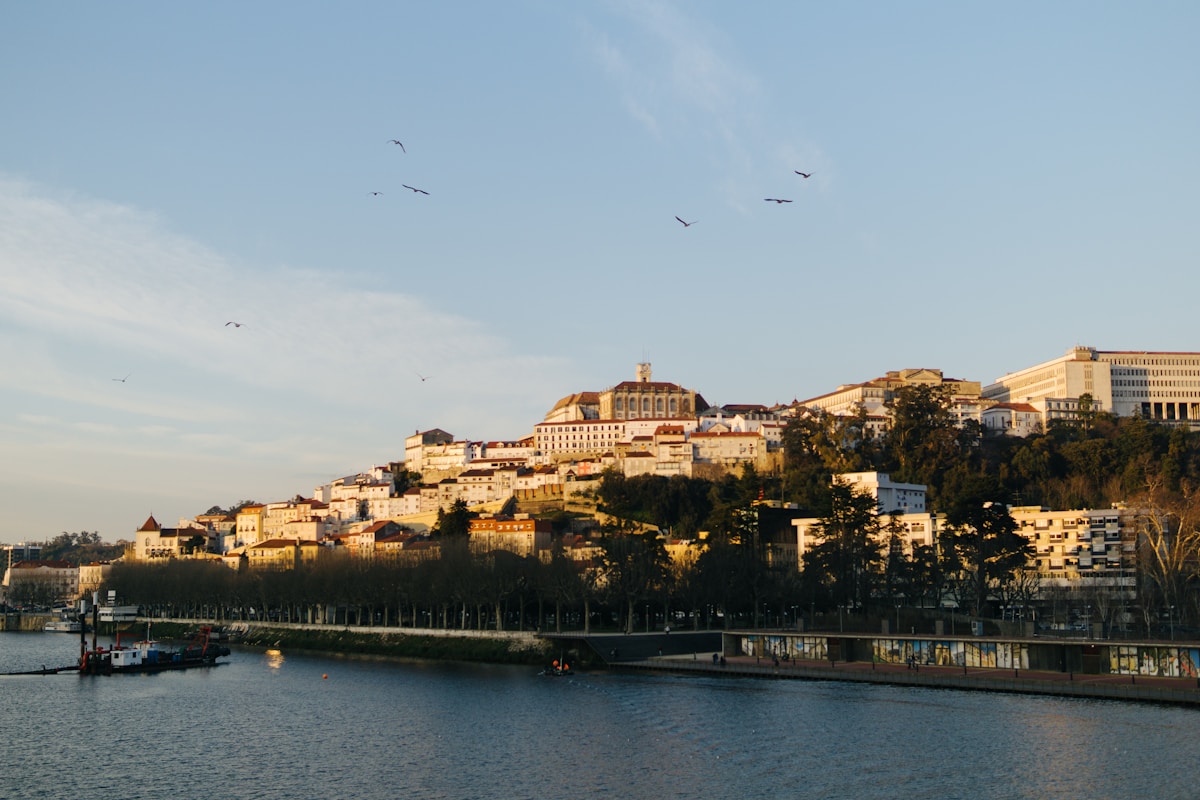
Coimbra is Portugal’s university city — a place where Baroque libraries sit alongside student bars, and where Portugal’s distinctive Coimbra fado (a style distinct from Lisbon’s fado) has its home. The city sits on the Mondego River midway between Lisbon and Porto, making it a natural stopover on any north-south Portugal journey. See our Coimbra guide for the full overview.
Accommodation is split naturally between the upper town (Alta) near the university and the lower town (Baixa) by the river. Both work as bases; the choice depends on how much you mind hills.
Coimbra Neighbourhoods: Where to Stay
Alta (Upper Town) — near the university
The Alta is where the university’s main buildings sit: the Joanina Library, the old cathedral, the Science Museum, and the student quarter around Praça da República. Hotels here are walking distance from the main sights but involve a significant climb from the train station and the river. Most suited to visitors prioritising proximity to the university.
Baixa (Lower Town) — by the river
The Baixa runs along the Mondego, with the pedestrianised shopping streets (Rua Ferreira Borges) and the main market. Hotels here are more varied and tend to offer slightly better value than equivalent properties in the upper town. The central train station (Coimbra-A) is in the Baixa, making arrivals and departures straightforward. The funicular connects uphill easily.
Residencial Districts (Santa Cruz / Solum)
Beyond the historic centre, residential neighbourhoods have apartment rentals and smaller guesthouses at lower prices. Worth considering for longer stays with self-catering needs.
Coimbra Hotels by Budget
Budget — approximately €60–€100 per night
Pensão Residencial Larbelo (Baixa) — a traditional guesthouse with clean rooms in a well-located building near Largo da Portagem, Coimbra’s main riverside square. Frequently praised for value. Approximately €60–€80 per night as of 2026.
Hotel Oslo (Baixa) — a no-frills three-star with consistent reviews and a riverside location. Good for travellers who want a private room at a budget price without sacrificing location. Approximately €70–€90 per night.
Student-Era Hostel (Alta) — a hostel near the university with private rooms available. The university atmosphere and location are genuine plusses. Approximately €55–€75 per night.
Mid-range — approximately €100–€160 per night
Hotel Astória (Baixa) — a 1927 art deco hotel on Avenida Emídio Navarro by the river. The building is genuinely handsome and the rooms have been modernised without losing the period character. A Coimbra landmark. Approximately €110–€150 per night.
Hotel Quinta das Lágrimas (Santa Clara) — a romantic hotel in a 15th-century palace across the river from the centre, on the grounds where the tragic love story of Pedro and Inês de Castro is said to have taken place. There is a pool, a spa, and gardens. It requires a taxi to the historic centre but the setting is distinctive. Approximately €130–€180 per night.
Vila Galé Coimbra (Baixa) — a larger hotel in a converted 19th-century palace building with rooftop views, a spa, and good facilities. Part of a reliable Portuguese chain. Approximately €110–€160 per night.
Luxury — approximately €160–€200 per night
Bela Vista Hotel & Spa (Coimbra outskirts) — a spa hotel with a pool and contemporary rooms, set slightly outside the centre. Better for visitors with a car than those relying on walking or public transport. Approximately €160–€220 per night.
Hotel Quinta das Lágrimas (full suites) — the same property in its suite configurations, with private garden access and larger rooms. From approximately €180 per night.
Practical Advice for Coimbra
The Joanina Library requires advance booking. Timed entry slots sell out weeks ahead in summer. Book online before you arrive — walk-in entry is rarely possible in high season.
Coimbra fado is different from Lisbon fado. The Coimbra style is traditionally sung by male students in academic dress — the music is more formal and the performances are often in the university settings rather than dedicated restaurants. Ask at your hotel for recommendations; the better performances are not always the most visible ones.
The university is an active institution, not a museum. Much of it is open to visitors, but some buildings and lecture halls are closed when exams or events are running. The Joanina Library has restricted entry because of the famous bats that are allowed to live there to protect the historic books from insects.
Conimbriga Roman ruins are 16 km south of Coimbra and have exceptional mosaics. The local bus takes approximately 30 minutes; a taxi costs approximately €20 each way. Well worth a half-day if you are spending two nights.
From Coimbra, the road north to Porto passes through Aveiro — Portugal’s ‘Venice’ with its moliceiro canal boats, which makes a natural lunch stop on a driving route.