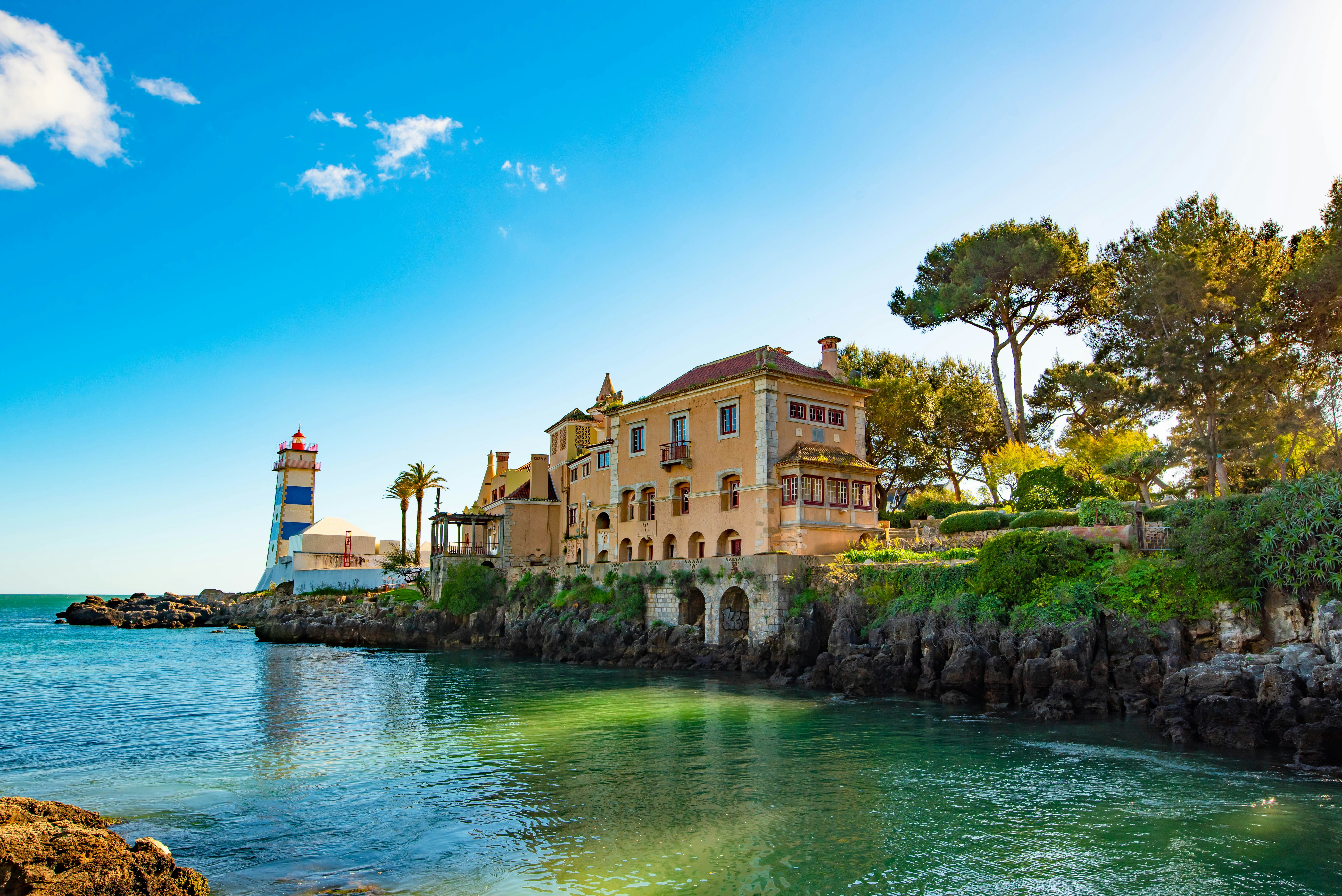
Cascais occupies a genuinely unusual position in the Portuguese property market. It is close enough to Lisbon — 30 km west, 40 minutes by train — to commute in either direction, yet distinctly different from the capital: lower-density, directly on the Atlantic coast, with more space per euro and a pace that rewards slower living. The town has been an aristocratic seaside resort since the 19th century; the infrastructure reflects that history — wide promenades, maintained parks, a compact but properly equipped historic centre, and a marina that remains active year-round.
The expat presence is significant and long-established. Around 20% of Cascais municipality residents hold non-Portuguese nationality — British, American, Brazilian, and French nationals have communities here going back decades. This makes the practical elements of extended stays — English-language services, international schools if relevant, expat social infrastructure — easier than in smaller Portuguese towns.
For an overview of what to do in the area, see our Cascais guide. For the full visa and tax picture relevant to long stays, our Portugal digital nomad visa guide covers the D8 and D7 options.
How Much Does Extended-Stay Accommodation Cost in Cascais?
Prices below are for furnished accommodation as of 2026. Summer rates (July–August) sit 15–25% above the annual average; October–May represents the best value.
| Type | Budget | Mid-Range | Upper |
|---|---|---|---|
| Furnished apartment (monthly) | €900 | €1,200–1,800 | €2,500+ |
| Serviced apartment (monthly) | €1,100 | €1,500–2,200 | €3,200+ |
| Extended-stay hotel (monthly) | €1,300 | €2,000–3,000 | €4,500+ |
The Cascais municipality covers a wide area — the town centre and beachfront sit at the upper end of each range; São João do Estoril, Alcabideche, and Malveira da Serra are progressively cheaper further from the coast and the train line.
Best Neighbourhoods for an Extended Stay
Cascais Town Centre
The historic core around Praça 5 de Outubro and the pedestrianised streets leading down to Cascais beach is the most convenient long-stay base. The town market, the best restaurants, the library, and the main commercial services are all within 10 minutes’ walk. The train station — which connects directly to Lisbon — is at the edge of the centre, approximately a 5-minute walk from most central apartments.
Monthly furnished apartments in the centre run approximately €1,100–1,900 as of 2026. Older buildings (pre-1970s) tend to be larger for the price; newer builds closer to the Marina offer more modern finishes but smaller floor plans. The centre is the right choice if you want to be able to walk to the beach, the market, restaurants, and the train station from the same apartment. The main downside is summer tourist foot traffic on the pedestrianised streets, which calms substantially outside June–September.
Monte Estoril and Estoril
East of Cascais, Monte Estoril and Estoril sit on the train line between Cascais and Lisbon. Both are quieter than Cascais centre — more residential in character, with leafy streets, larger villas, and a pace closer to suburb than resort. Estoril’s casino and its famous promenade are the main landmarks; the beach (Praia de Estoril) is directly adjacent to the train station.
Monthly furnished apartments in Monte Estoril run approximately €950–1,700 as of 2026. Properties here tend to be older (many dates from the 1950s–1970s) and often occupy villas split into apartments, which can mean larger rooms and gardens at the cost of older kitchens and bathrooms. For long-stay visitors who want a quieter, more residential context while retaining easy Lisbon access, this area is frequently the best price-to-space ratio in the Cascais–Estoril stretch.
Birre and Alapraia
North of Cascais centre, the residential quarter of Birre attracts families and expats who prefer a quieter, more suburban context — wider streets, newer apartment blocks, and more parking. Alapraia, towards the Guincho beach direction, is slightly more upscale. Both are car-helpful rather than walkable for daily errands, though buses connect to Cascais centre in approximately 10–15 minutes.
Monthly furnished apartments in Birre and Alapraia run approximately €900–1,600 as of 2026. This area suits long-stay visitors who drive, who prioritise space over walking proximity to the centre, and who plan to explore the broader Sintra–Cascais Natural Park on foot or by bike.
São João do Estoril
The quietest and most affordable stretch on the Cascais line, São João do Estoril is a small residential station village between Estoril and Parede. It has a beach directly below the cliff (Praia de São João do Estoril), a handful of local restaurants, and the train to Lisbon taking approximately 35 minutes from the station. Furnished apartments here run approximately €800–1,400 as of 2026.
It is the right choice for those who prioritise cost and coastal access over facilities — the village has enough for daily needs (café, small grocery, pharmacy) but little beyond that. The upside is that the beach is directly accessible without a car and the local character is entirely Portuguese rather than tourist-facing.
Serviced Apartments and Extended-Stay Hotels
Hotel Albatroz (Cascais centre, seafront) — The most iconic hotel in Cascais, occupying a 19th-century royal villa directly on the Cascais coast. Rooms and suites are individually styled with period furniture; several have private terraces with Atlantic views. Extended-stay rates for a double room run from approximately €2,500/month in shoulder season as of 2026. The Albatroz suits long-stay guests for whom atmosphere and historical setting outweigh budget — it is one of the most characterful hotel bases on the entire Portuguese Riviera.
Cascais Miragem Health & Spa (Monte Estoril) — A large modern hotel on the seafront between Estoril and Cascais, with full spa facilities, pool, and sea-view rooms. Extended-stay rates for a superior room run from approximately €2,200/month in shoulder season as of 2026. The spa access and pool make it a practical long-stay base for those who want hotel structure — breakfast included, daily housekeeping, fitness facilities — rather than self-catering independence.
For a wider range of self-catering apartments and serviced flats across the Cascais municipality, Booking.com’s Cascais entire-place listings include furnished apartments and aparthotels accepting 7, 14, and 30-day stays, with prices automatically adjusted for length of stay.
Direct Rentals in Cascais
For monthly furnished rentals outside the hotel system:
- Idealista (idealista.pt) — filter by furnished and set minimum stay to 30 days; Cascais has consistent furnished inventory, particularly in the centre and Monte Estoril
- Flatio — medium-term furnished lets from one to twelve months; useful for verified Wi-Fi speeds and straightforward no-admin contracts, and growing inventory in Cascais
- ERA Imobiliária and Century 21 — the main Portuguese estate agent chains have offices in Cascais and list monthly furnished rentals; calling directly rather than using online forms often surfaces off-market listings
Facebook group “Expats in Cascais” has active rental listings from owners and landlords bypassing platforms, and the English-language community means direct communication is rarely a language barrier.
Digital Nomad Infrastructure
Cascais has a smaller co-working scene than Lisbon but sufficient options for regular remote workers:
- Cowork Cascais (centre) — the main co-working space in town, with hot-desk access from approximately €120/month; dedicated desks from €200/month; fibre internet consistently fast
- Cascais library (Biblioteca Municipal de Cascais) — a well-maintained public space with reliable Wi-Fi and work-appropriate seating; open Monday to Saturday; free to use
- Café working — a number of cafés in the centre and along the Cascais promenade maintain reliable Wi-Fi year-round; the tourist off-season (October–April) makes finding a seat and sustaining a working session significantly easier
Internet speeds in Cascais furnished apartments are generally good — most modern builds have NOS or MEO fibre connections delivering 100–300 Mbps. Older buildings may have slower ADSL connections; asking for a speed test result before signing any monthly agreement is worth the 2 minutes.
The Lisbon commute works well as a supplement. For days when co-working space or meetings are needed in the capital, the 40-minute train connection is reliable enough to make a Cascais base practical for business travel within Portugal.
Practical Details
Transport: The Linha de Cascais train runs every 20 minutes during peak hours, connecting Cascais to Lisbon Cais do Sodré in approximately 40 minutes. A monthly Cascais–Lisbon rail pass costs approximately €45 as of 2026. Within Cascais, the town centre and waterfront are walkable; outlying areas (Guincho beach, Malveira da Serra, Sintra) require a car or the infrequent bus services. Car rental from Cascais or Lisbon Airport starts from approximately €400/month for a small car.
Healthcare: Cascais has a private hospital (Hospital de Cascais — Grupo HPA Saúde) and the CUF Cascais clinic, both offering English-speaking consultants. The main public hospital for the area is Hospital de Cascais — Dr. José de Almeida. EU citizens are covered for public health treatment with the EHIC; non-EU long-stay visitors should carry valid travel or expat health insurance.
Groceries: Pingo Doce and Continente have branches in the Cascais centre and along the main road toward Estoril. El Corte Inglés in Cascais offers a broader supermarket range including imported goods. The Cascais market (Mercado de Cascais) runs on Wednesday and Saturday mornings, with fresh produce, fish, and local vendors.
Day trips and exploration: Cascais is the gateway to the Sintra–Cascais Natural Park, with Sintra 12 km to the north (bus or taxi, 20–30 minutes). Guincho beach — one of the best Atlantic surf beaches near Lisbon — is 9 km west of Cascais centre. Cabo da Roca, the westernmost point of mainland Europe, is 16 km from Cascais. For a month-long stay, the combination of Cascais town life, Sintra’s palaces, and the park hiking trails covers most weekends without repetition.
Visa: EU nationals face no restrictions. Non-EU visitors on tourist entry have 90 days in any 180-day Schengen window — a one-month Cascais stay fits comfortably within this. For longer stays, see our Portugal digital nomad visa guide for current D8 and D7 visa requirements and the NHR tax regime for qualifying new residents.