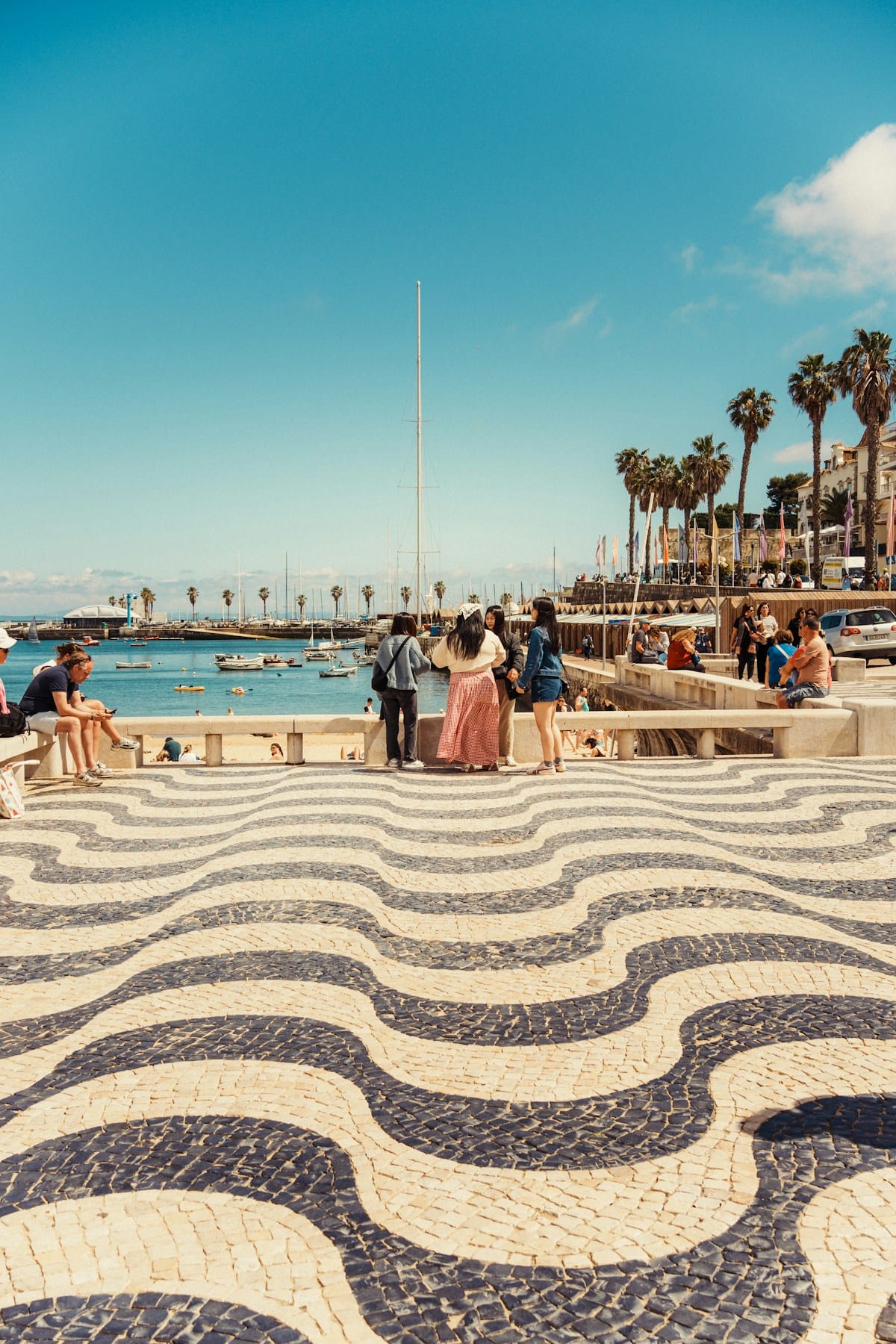
Cascais punches above its weight for a town of 35,000 people. It has a genuine old town, a working marina, good beaches within walking distance, and the clifftop walk to Boca do Inferno — all within 40 minutes of Lisbon by train. It’s popular enough to have strong accommodation supply at every price point, without being so overrun that booking becomes an ordeal outside peak weeks. See our Cascais city guide for the wider picture.
Planning a longer visit? See our Cascais long-stay guide for monthly rental costs, best neighbourhoods for extended stays, and digital nomad tips.
The key decision is town centre versus the more spread-out seafront zone between Cascais and Estoril. For most visitors, town centre wins.
Town Centre and Old Town
The historic centre runs between the main square, Largo Luís de Camões, and the marina. It’s compact — you can walk across the core in under fifteen minutes — and has the highest concentration of restaurants, pastelarias, and shops. The promenade connecting Cascais marina to Estoril runs along the seafront from here.
Budget — approximately €60–90 per night (as of 2026):
Guesthouses and smaller B&Bs in the old town streets start in this range. The options here are typically family-run with between six and fifteen rooms — variable quality but often excellent value compared to larger hotels. Air conditioning is standard in summer; parking is not provided, so budget approximately €10–15 per day for the nearest car park.
Mid-range — approximately €100–200 per night (as of 2026):
Hotel Cascais Miragem is the most prominent hotel in this bracket — directly on the seafront with sea views, a pool, and a spa. The location is slightly west of the town centre towards Estoril, which means a 10-minute walk into the main restaurant area. Casa da Pergola (guesthouse style, small pool, garden) offers more character at similar prices closer to the old town.
Upscale — approximately €200–400 per night (as of 2026):
Bairro Arts Hotel brings a design-focused approach to a converted manor house near the town centre — twelve rooms with individual character, a garden, and strong restaurant. Farol Hotel sits directly on the seafront with a famous clifftop pool; it is the most photographed hotel in Cascais and books up well in advance for summer weekends. The Albatroz Hotel occupies a similar clifftop position with a longer history and similar pricing.
Estoril and the Train Line
Estoril sits three minutes by train east of Cascais — close enough that the two towns effectively function as a strip. Estoril has the casino (Casino Estoril), a famous grand hotel facing the casino gardens (Hotel Palácio Estoril, approximately €250–450 per night as of 2026), and a quieter feel than Cascais itself.
If you find a significantly better rate in Estoril, the train makes moving between the two effortless. For visitors focused on Cascais itself, however, the extra train journey in and out adds up quickly on a short stay.
Beaches Near Cascais
Praia da Rainha and Praia da Ribeira are the two town beaches, both small and right in the centre — convenient but busy in summer. Good for a morning swim; expect to share the sand with a crowd by late morning in July.
Praia do Guincho is 9 kilometres west of Cascais — wide, exposed, windswept, and one of the most dramatic Atlantic beaches in the Estoril area. It’s popular with windsurfers and surfers; swimming conditions can be rough. Buses run from Cascais in summer, or hire a bike (rental available at the marina, approximately €15–20 per day as of 2026).
Praia de São João do Estoril and the other beaches along the Estoril line are calmer and well-suited to families — protected from the Atlantic swell by the slight curvature of the coast.
Getting to Cascais
By train: Linha de Cascais from Cais do Sodré station in Lisbon takes approximately 40 minutes end-to-end. Services run every 20–30 minutes. The train station in Cascais is 5 minutes on foot from the town centre.
By car: Approximately 30–40 minutes from Lisbon centre on the A5 motorway, depending on traffic. Parking in the town centre is metered and competitive in summer — most hotels advise using the municipal car park near the market. Expect approximately €10–15 per day as of 2026.
By bus: Scotturb buses connect Cascais to Sintra and Estoril. The Sintra–Cascais connection via the Guincho coast (bus 403) passes the famous Boca do Inferno and Guincho beach.
Best Time to Book
Cascais is genuinely seasonal. Summer weekends (June–September) fill fast, particularly for the character hotels and boutique guesthouses. Midweek summer stays are easier to find. The best value-weather combination is May–June or September–October — fewer crowds, full restaurant openings, and prices closer to shoulder-season rates. November through February is quieter than you’d expect: the seafront stays attractive for walks even without swimming, and accommodation prices drop significantly.
Summary
Cascais is one of the more effortless bases on the Lisbon coast — well-connected, attractive, and varied enough to hold attention for two or three nights. It works as a day trip from Lisbon but it works better as a stay. The accommodation range from budget guesthouses to cliff-top design hotels means there’s a sensible option at most budgets.