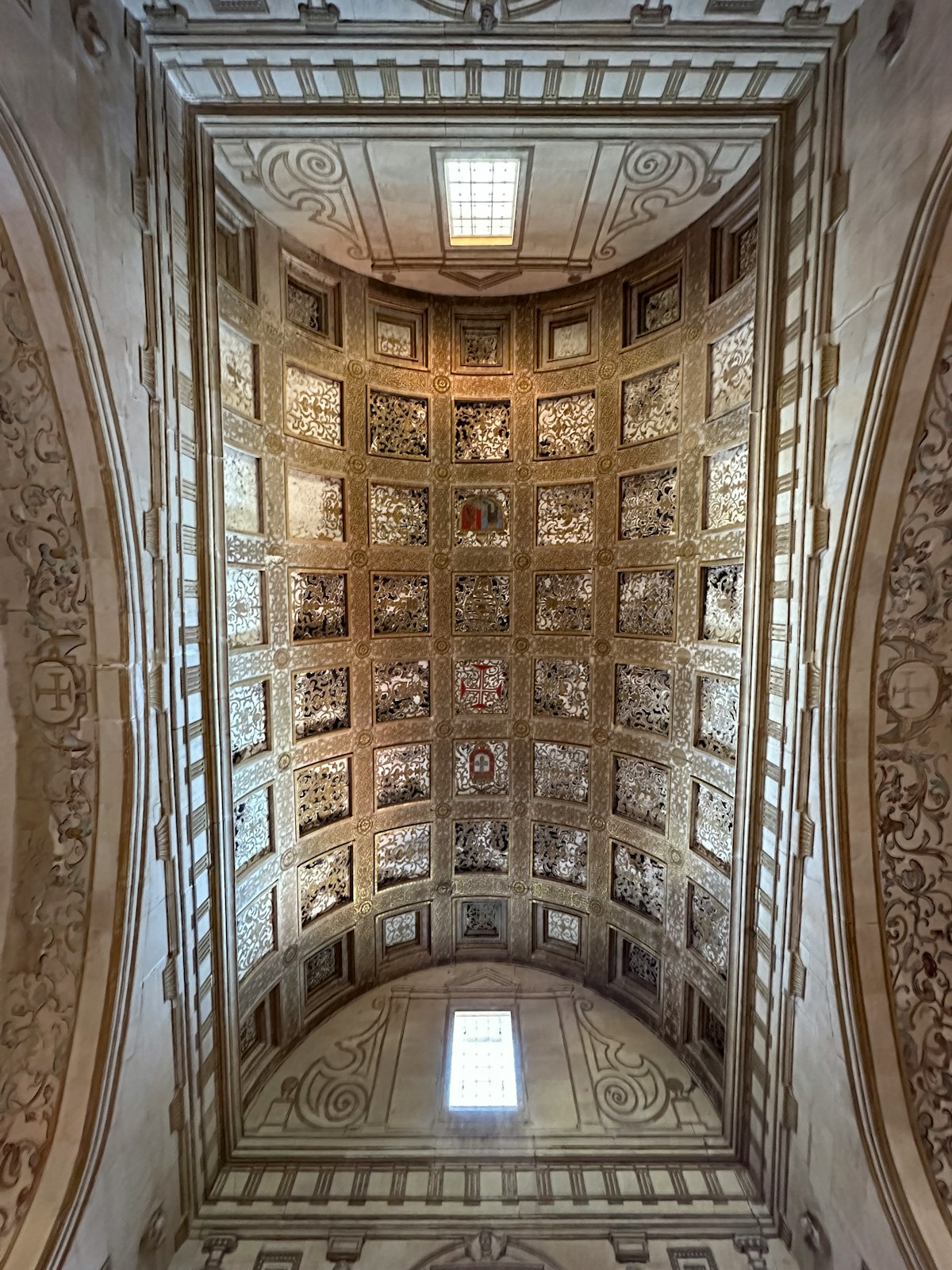
Tomar Travel Guide - Convento de Cristo, Knights
Tomar guide - the UNESCO Convento de Cristo, Portugal's greatest Templar monument, the Charola rotunda, Pegões aqueduct, and the Festa dos Tabuleiros.
Guides for Tomar
Tomar is a city of around 40,000 people in central Portugal’s Ribatejo region, on the Nabão River, 140km north of Lisbon. It is best known for the Convento de Cristo - a medieval Templar castle and monastery that sits on a wooded hill above the town and was listed as UNESCO World Heritage in 1983. The convent is one of the most significant monuments in Portugal and among the finest surviving examples of Templar and Manueline architecture in Europe. Tomar makes a natural stop on the route between Lisbon and Coimbra or Porto. Our 10-day Portugal coast-to-coast itinerary passes through the Silver Coast and Nazaré north of Tomar on the same Lisbon–Porto route.
The town below the hill is calm, pleasantly proportioned, and easy to navigate. The Praça da República - Tomar’s main square - has a 15th-century church on one side and restaurants on the other. The Nabão River divides the old town from the newer quarters, and the Parque do Mouchão (a river island park) sits at the centre.
Getting There
By train from Lisbon: approximately 1 hour 45 minutes to 2 hours from Oriente or Santa Apolónia on CP regional services, from around €10–15. Change at Entroncamento if travelling on an Intercidades service (Tomar is on a branch line, not the main Alfa Pendular route). The train station is at the bottom of the hill, a 10-minute walk from the town centre and 20–25 minutes on foot from the Convento.
By car from Lisbon: 140km via the A1 motorway to Entroncamento and then the IC3 - about 1 hour 30 minutes. From Coimbra: 90km via the A13, approximately 1 hour. Tomar has free parking near the Parque do Mouchão.
The Convento de Cristo
The Convento de Cristo is the defining reason to visit Tomar. Its history spans from the Templar castle built in 1160 by Gualdim Pais, Grand Master of the Knights Templar in Portugal, through to its transformation into the headquarters of the Order of Christ in the 14th and 15th centuries - the successor order that funded Portugal’s Age of Discovery.
The complex is extensive. The main elements:
The Charola (Templar Oratory): The 12-sided rotunda at the heart of the convent, built around 1160, modelled on the Church of the Holy Sepulchre in Jerusalem. It was the private chapel of the Templars - knights would attend mass from horseback, and the circular design allowed them to remain mounted. The interior is covered in gilded painted panels and carved stonework; the central altar structure is itself a smaller octagonal tower. This is the most powerful room in the building and one of the most unusual ecclesiastical spaces in Portugal.
The Manueline Chapter Window (Janela do Capítulo): The west facade of the chapter house bears Portugal’s most celebrated example of Manueline decoration - a window frame that accumulates maritime imagery (ropes, anchors, coral, armillary spheres, the Cross of Christ) into a dense carved composition unlike anything else in Portuguese architecture. Commissioned in the early 16th century during the reign of Manuel I. The window is visible from the pathway that circles the convent - allow time to study it.
The Cloisters: The convent has eight cloisters of different periods and styles. The Great Cloister (Claustro Principal) is the largest and most formal - two-storey Renaissance architecture commissioned by João III in the 1550s, with carved balustrades. The Cloister of Santa Bárbara is the best vantage point for the chapter window.
The Castle and Walls: The 12th-century Templar castle encircles the convent’s highest point. Walking the ramparts gives views over the Nabão valley and the Mata Nacional dos Sete Montes forest below. The keep is original Templar construction.
Entry approximately €6 per adult, open approximately 9am–6:30pm in summer (shorter hours in winter). Allow 2–3 hours minimum.
The Pegões Aqueduct
The Aqueduto dos Pegões, built between 1593 and 1619 to supply water to the convent, stretches approximately 6km with 180 arches rising up to 30 metres. The main visible section - two tiers of stone arches crossing a valley - is reached by walking about 1km from the convent car park or from the Mata Nacional dos Sete Montes. Free to visit and rarely crowded. The scale is striking given how little it features in Portugal’s standard tourist itinerary.
The Town and Synagogue
The Praça da República is Tomar’s social centre - a large rectangular square with the 15th-century Igreja de São João Baptista on one side (Manueline door, carved interior) and the Town Hall occupying the former Dominican monastery adjacent. Cafés and restaurants occupy the lower end.
On Rua Dr. Joaquim Jacinto, the Tomar Synagogue is one of the best-preserved medieval synagogues on the Iberian Peninsula. Built in the early 15th century and used until the expulsion of Portuguese Jews in 1496, the single vaulted hall still retains its four original columns. Entry approximately €1.50. The small museum on site documents the Jewish community that once lived in Tomar’s medieval juderia.
The Parque do Mouchão - a river island park with a watermill, weeping willows, and a small café - is the best place in Tomar to spend an afternoon hour. Flat, green, and free; popular with local families.
Festa dos Tabuleiros
The Festa dos Tabuleiros (Festival of the Trays) is held every four years in July and is Tomar’s defining cultural event. Hundreds of young women walk in procession through the town’s streets wearing headdresses of stacked bread loaves decorated with paper flowers and topped with a crown - each assemblage reaching up to 2 metres in height and weighing approximately 15kg. The bread is later distributed to local families. The festival fills every hotel in a wide radius and transforms the usually quiet town completely. If your visit coincides with a festival year, book accommodation months in advance.
Best Time to Visit
Spring (April–June) and early autumn (September–October) are the most pleasant times - warm without the summer heat, and the Mata Nacional dos Sete Montes around the convent is at its greenest. July is the festival month in festival years. August can be hot (temperatures reaching 35°C+) and the town has fewer visitors than Portugal’s coastal destinations - the convent is rarely crowded even in peak summer.
For guided experiences, browse tours in tomar - covering walking tours, food tours, and day trips from the city.
Getting here by air? airport transfers take the stress out of the journey from the airport to your hotel. Pick up an eSIM for Portugal before you land to stay connected on arrival.
Where to Stay and Eat
See our Tomar hotel guide for specific accommodation options by budget. The Tomar food guide covers Ribatejo regional dishes, river fish, and where to eat around the Praça da República.
Search hotels in Tomar on Booking.com to compare rates and availability.
How Tomar Compares
Tomar vs Évora: Both are day trips from Lisbon with a single dominant monument (Convento de Cristo vs the Roman temple and chapel of bones), but they suit different interests. Évora is better for food, wine, and a broader Alentejo immersion. Tomar is more focused — the convent alone is one of the most architecturally complex buildings in Portugal, with Manueline detail that rewards sustained attention. Évora is more developed for tourism and costs slightly more; Tomar is cheaper and less crowded. Couples and history travellers can do both in a two-day Lisbon day-trip circuit.
Tomar vs Fátima: Tomar is 35km from Fátima — many visitors combine both in a single day. The appeal is entirely different: Fátima is a pilgrimage site with religious significance; Tomar is a secular sightseeing destination. Back-to-back, they give a good picture of Portugal’s medieval Christian heritage in contrasting forms. Tomar suits couples, solo travellers, and history enthusiasts. Families with young children generally prefer the open esplanade and clear structure of Fátima. Best months: April–June and September–October. Tomar is comfortable in summer — the convent is never crowded.
Frequently Asked Questions
- How much does it cost to visit the Convento de Cristo?
- The combined ticket for the Templar Castle and Convento de Cristo costs approximately €6 per adult as of 2026, with reductions for students and seniors. The Charola rotunda, cloisters, Manueline chapter window, and castle walls are all included. Opening hours run approximately 9am–6:30pm in summer and 9am–5:30pm in winter - check the national monuments website (patrimoniocultural.gov.pt) for exact current times before visiting.
- How do I get to Tomar from Lisbon?
- CP trains run from Lisbon's Oriente or Santa Apolónia stations to Tomar via Entroncamento. Journey time is approximately 1 hour 45 minutes to 2 hours on regional services, from around €10–15. There is no Alfa Pendular stop at Tomar - you take an Intercidades or regional train to Entroncamento and change onto the Tomar branch line, or take a direct regional service. By car the A1 motorway to Entroncamento then the IC3 covers roughly 140km in about 1 hour 30 minutes.
- When is the Festa dos Tabuleiros held?
- The Festa dos Tabuleiros is held every four years in July. The festival involves hundreds of young women processing through Tomar's streets with elaborate headdresses - stacked trays (tabuleiros) of bread decorated with paper flowers, reaching up to two metres tall. The headdresses are supported on the participant's head, weighing roughly 15kg. It is one of Portugal's largest and most distinctive folk celebrations. Check current scheduling before planning a visit around it, as dates shift by a day or two each cycle.
- Is Tomar worth a full day or just a half day?
- A full day is worthwhile if you plan to explore the Convento de Cristo thoroughly, walk the Mata Nacional dos Sete Montes woodland, and spend time in the town centre around the Praça da República. The convent alone takes 2–3 hours at a decent pace - rushing it means missing the upper terraces, outer cloisters, and castle walls. A half-day visit from Lisbon or Coimbra is feasible but pressured; an overnight stay is much more comfortable.
Book an experience
Top experiences in Tomar
Explore the best tours and activities in Tomar, with instant confirmation and free cancellation on most bookings.
Where to stay in Tomar: Find hotels in Tomar →