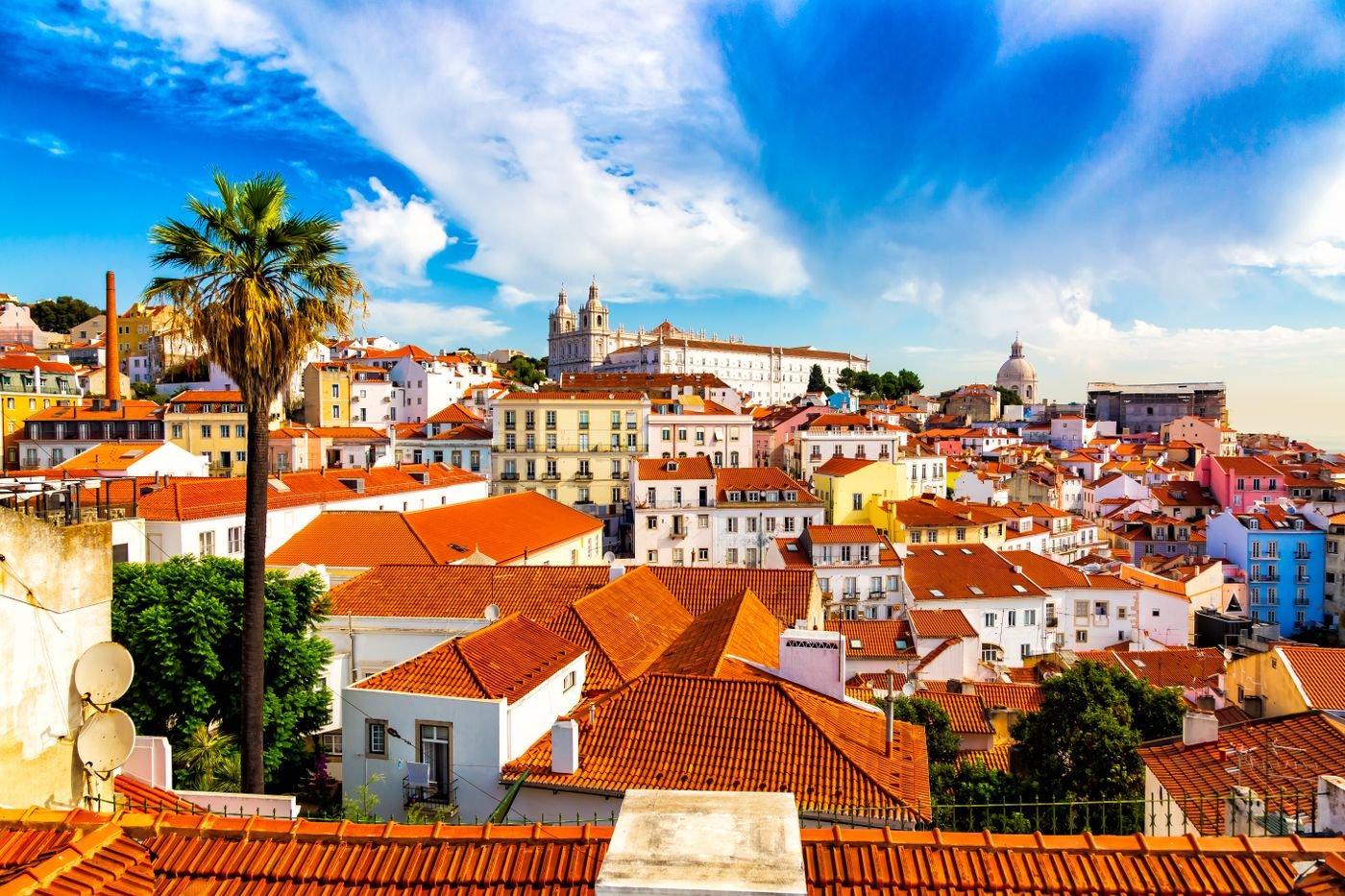
Graça is the hill east of Baixa and north of Alfama, and Mouraria is the district that slopes down from it toward Martim Moniz. Together they make up a part of Lisbon that most visitors only brush against on tram 28, even though it has some of the best views in the city, one of its most-visited flea markets and a food scene shaped by decades of immigration. It is the neighbourhood we point people to when they want somewhere lived-in, slightly rougher around the edges than the postcard areas and cheaper to eat and sleep in. It pairs well with Alfama, which borders it to the south.
Miradouros
The Miradouro da Graça (also named after the poet Sophia de Mello Breyner Andresen) is a pine-shaded terrace beside the Igreja da Graça with a kiosk, benches and a sweeping view over Baixa, the castle and the 25 de Abril Bridge in the distance. It gets busy at sunset, and the kiosk is where locals and visitors share the evening.
A ten-minute uphill walk takes you to the Miradouro da Senhora do Monte, the highest of the central viewpoints. The view takes in the castle, the river and the roofs of Mouraria. Fewer tour groups arrive, so it is the better choice if the Graça terrace is crowded. Bring a layer: the hilltop is windier than the streets below.
São Vicente de Fora and the Panteão
The Mosteiro de São Vicente de Fora is a 17th-century church and monastery with a cloister lined in blue-and-white 18th-century azulejos and the royal pantheon of the Braganza dynasty. The roof terrace gives a view across Alfama. Entry is a few euros; the Museus e Monumentos de Portugal site lists current prices and opening hours at museusemonumentos.pt. A short walk away, the white-domed Panteão Nacional (the former church of Santa Engrácia) is the burial place of Portuguese presidents and figures such as Amália Rodrigues, with another roof terrace.
Feira da Ladra
The Feira da Ladra at Campo de Santa Clara, just below São Vicente de Fora, is Lisbon’s flea market, running on Tuesdays and Saturdays. Expect second-hand books, records, azulejo fragments, vintage cameras, bric-a-brac and some tourist goods. Haggle politely, bring cash, and keep a hand on your bag in the crowd. Start before 11:00 for the best selection.
Mouraria and Fado
Mouraria was the quarter where Lisbon’s Muslim population was allowed to live after the Christian conquest of 1147, and it later became the birthplace of fado, the city’s song form. The Largo da Severa is named after Maria Severa, often described as the first great fado singer. Small casas de fado survive in the lanes, and some run informal evenings where locals sing. For how to choose between tourist and local venues, see our fado music guide.
The lower streets around Martim Moniz and Intendente are among Lisbon’s most multicultural, with Indian, Nepali, Bangladeshi, Chinese and African restaurants alongside traditional tascas. It is good for cheap, filling meals and a break from tourist pricing. For pastries, coffee and traditional dishes elsewhere, our Lisbon restaurants guide lists options by area.
Getting Here
- Tram 28: passes through Graça on the climb from Martim Moniz; queues at the start are long, so board mid-route or at a later stop.
- Metro: Martim Moniz and Intendente (Green Line) are the closest stations, and both involve a climb to reach Graça itself.
- On foot: from Alfama’s Sé Cathedral it is a 15 to 20 minute uphill walk. Wear shoes with grip, as the cobblestones are steep and slippery after rain.
For the tram, see our tram 28 guide.
Where to Stay
Graça and Mouraria suit visitors who want a budget-friendly base with local character and are comfortable with hills. Options are mostly small guesthouses, apartments and hostels, with fewer large hotels than in Baixa. The streets near Martim Moniz have more transport links but more noise, and the upper streets around the miradouros are quieter but steeper. As of 2026, prices run lower than in Chiado or Príncipe Real. See Graça hotels on Booking.com for current rates, or compare areas in our Lisbon hotels guide.
Suggested Route
Start at Martim Moniz and walk uphill through Mouraria to Largo da Severa, continue to the Graça miradouro, visit São Vicente de Fora, and finish with the flea market if it is a Tuesday or Saturday. Allow half a day. For a guided look at the old quarters with local context, Lisbon walking tours often combine Alfama, Graça and Mouraria.
Official city information is at Visit Lisboa.