Lisbon’s location near the Atlantic coast and surrounded by mountains, vineyards, and medieval towns makes it one of Europe’s most day-trip-rich capitals. Most of the best destinations are reachable in under 90 minutes by train or bus - many without a car. This guide covers eight day trips worth making, with specific transport details, costs, and what to do when you get there.
Browse day tours from Lisbon if you’d rather book a guided excursion with transport included.
Quick Comparison
| Destination | Transport | Approx. Cost (return) | Journey Time | Best For |
|---|---|---|---|---|
| Sintra | CP train from Rossio | ~€5 as of 2026 | 40 min | Palaces, forests |
| Cascais | CP train from Cais do Sodré | ~€5 as of 2026 | 40 min | Beaches, seafront |
| Óbidos | Bus from Campo Grande | ~€9 as of 2026 | 1 hr | Medieval town |
| Évora | Bus from Sete Rios | ~€24 as of 2026 | 1h30 | Roman ruins, history |
| Setúbal & Arrábida | Bus or car | ~€10–14 as of 2026 | 45–60 min | Turquoise beaches |
| Peniche & Berlengas | Bus + ferry | ~€45–55 as of 2026 | 1h30 + 45 min | Islands, snorkelling |
| Palmela wine region | Car or tour | varies | 40 min | Wine tasting |
| Alcácer do Sal | Bus | ~€16 as of 2026 | 1h15 | Flamingos, history |
All costs approximate as of 2026.
Sintra (40 min by train)
Sintra is the most visited day trip from Lisbon and the one most likely to disappoint if you get it wrong. Get it right, and it’s exceptional.
Getting there: CP regional train from Rossio station, approximately €2.55 each way as of 2026. Trains run every 20–30 minutes. The journey takes 40 minutes. Exit at Sintra station - the historic centre is a 10-minute walk uphill, or take the 434 tourisTrain bus (€7–9 circuit) to the palaces.
Pena Palace is the headline: a 19th-century Romanticist palace built for King Ferdinand II on the ruins of a medieval monastery, painted in ochre, terracotta, and cyan, rising above forested hills. Entry approximately €14–16 as of 2026 (palace + park; park only is cheaper). Book online at least 2–3 days ahead in summer - walk-up queues can reach 2 hours. The views from the battlements across the Sintra mountains and down to the coast are among the best in Portugal.
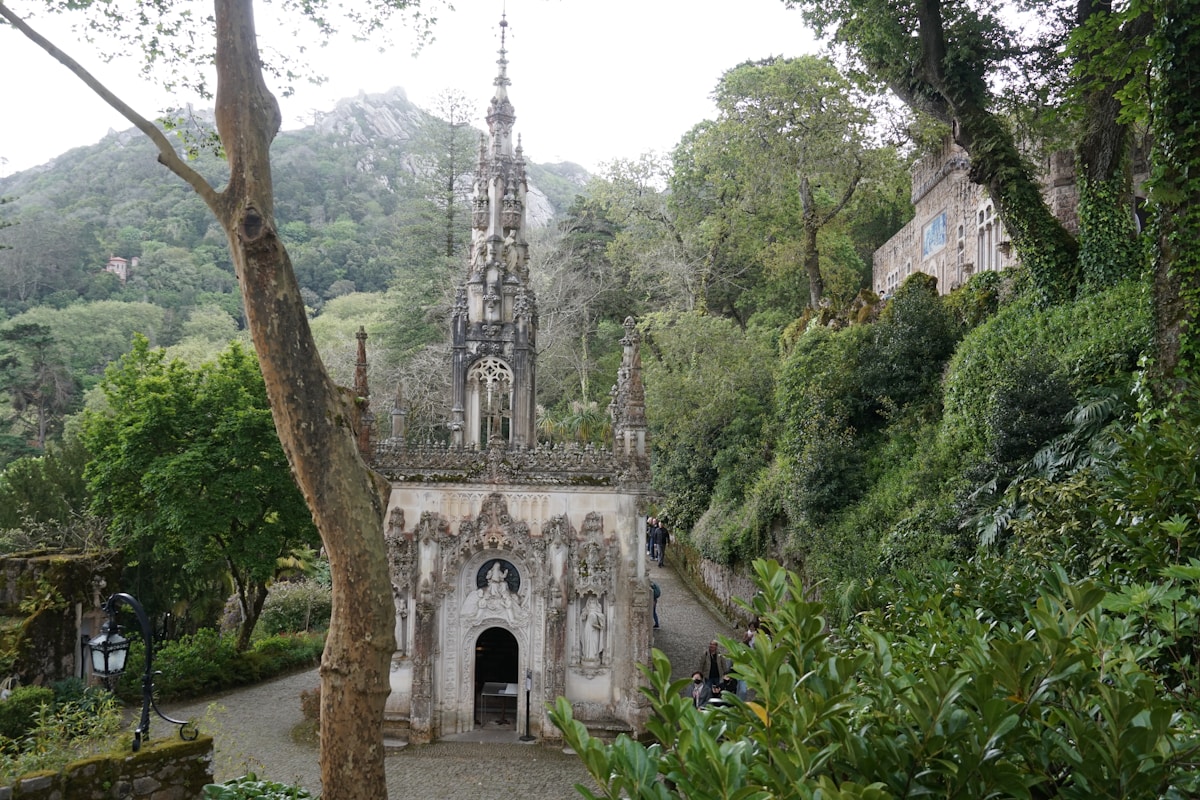
Quinta da Regaleira is a 10-minute downhill walk from the palace. A Gothic estate with elaborate gardens, grottoes, towers, and underground wells (called the Initiation Well) connected by tunnels. Entry approximately €10 as of 2026. Book ahead in peak season.
Moorish Castle (Castelo dos Mouros) sits between Pena Palace and the town and makes for a good stopping point between the two. Crenellated walls, views over Sintra, and atmospheric ruins. Entry approximately €8 as of 2026.
Palácio Nacional de Sintra (the town palace, with distinctive twin chimneys visible from everywhere) is in the village centre and good for a quick visit. Entry approximately €10 as of 2026.
Crowds: July and August are extremely busy. Arrive at 9 am, before the tour buses from Lisbon arrive at 10:30–11 am. Midweek is significantly quieter than weekends. The Sintra things to do guide has further detail on the palaces.
Cascais (40 min by train)
Cascais is the easier, more relaxed alternative to Sintra - a 19th-century fishing village that became a royal resort, with a good beach, a pretty marina, and a seafront esplanade.
Getting there: Linha de Cascais from Cais do Sodré station in Lisbon, approximately €2.55 each way as of 2026. Runs every 20–30 minutes. Journey 40 minutes. Exit at Cascais - the town centre is directly outside.
What to do: The main draw is the Cascais seafront and old town. Boca do Inferno (Hell’s Mouth) is a sea cave with dramatic wave action 2km west of Cascais - easy 25-minute walk along the coastal path. Cascais Marina is good for lunch. Guincho Beach is 10km further west - wide, exposed, and popular with windsurfers. Bus 405 from Cascais (approximately €2.50 as of 2026) or bike hire from town (~€10–15 per hour as of 2026).
Estoril is one stop before Cascais on the same train line. The Estoril Casino is Europe’s largest casino, reportedly the inspiration for Ian Fleming’s Casino Royale. You can visit for the spectacle even without gambling.
Combining with Sintra: Bus 403 runs from Sintra to Cascais (approximately €4 as of 2026, 1h15 journey through the Serra de Sintra hills). Taking the train out to Sintra and the bus to Cascais then the train back to Lisbon makes an efficient full day with two destinations. The scenery on the 403 is worth the journey in itself.
Óbidos (1 hr by bus)
A complete medieval walled town sitting on a hillside, ringed by crenellated walls you can walk along, with a castle at one end and white-painted houses with yellow and blue trim throughout. Genuinely photogenic rather than theme-park-ish - the village inside the walls is still inhabited.
Getting there: Bus from Campo Grande bus terminal (Metro station nearby). Rede Expressos or Rodoviária Oeste services, approximately €4–5 each way as of 2026. Journey approximately 1 hour. Check timetables in advance - services run several times daily but not very frequently.
What to do: Walk the full circuit of the castle walls (30–40 minutes, free). Visit the 12th-century castle, now converted into a pousada (you can have a drink in the bar without staying). The main street, Rua Direita, is where most shops and restaurants sit. Ginjinha (cherry brandy, spelled ginjinha or ginja) is the local speciality - served in a small chocolate cup for approximately €1.50 as of 2026. Try it at one of the small kiosks near the main gate.
Timing: Arrive early. Tour groups from Lisbon arrive from 10 am onwards and the narrow streets fill up quickly. Before 9:30 am or after 4 pm in summer the town is considerably quieter.
Óbidos Chocolate Festival (usually March) and the Medieval Market (July–August) are the main annual events, when the town gets particularly busy.
Évora (1h30 by bus or train)
Évora is the capital of the Alentejo region and a UNESCO World Heritage city - two millennia of continuous habitation have left a dense layering of Roman, Moorish, medieval, and 18th-century architecture in a compact hilltop town.
Getting there: Bus from Sete Rios terminal (approximately €12–14 return as of 2026) or Rede Expressos. Journey 1h30–1h45. Alternatively, trains run from Oriente station (1h30, approximately €12–15 as of 2026). Both options are viable.
Roman Temple of Diana (it’s actually a 1st-century temple to unknown Roman deities - the Diana attribution is a later naming) stands in the town centre: 14 Corinthian columns supporting a partial entablature, in remarkable condition. Free to view from the surrounding square; evening illumination is particularly good.
Évora Cathedral (Sé): The largest medieval cathedral in Portugal, begun in 1186. The rooftop walkway (approximately €4 as of 2026) gives views over the Alentejo plains stretching to the horizon.
Chapel of Bones (Capella dos Ossos): Built in the 16th century by Franciscan monks using bones from approximately 5,000 bodies. The interior walls and columns are literally lined with skulls and bones. Entry approximately €5 as of 2026. More visceral than Faro’s version; the inscription above the entrance translates as “We bones, lying here, await yours.” An unusual but genuinely memorable visit.
Medieval Aqueduct (Prata): The 16th-century aqueduct runs through the city and into the historic centre, with arches incorporated into houses and streets.
Budget 4–5 hours in Évora to see the main sights at a comfortable pace. Lunch at one of the restaurants around Praça do Giraldo - the central square - is a worthwhile stop. The Évora things to do guide covers the sights in more detail. For day tours from Lisbon including Évora, browse our Lisbon tours page.
Setúbal & Arrábida Natural Park (45–60 min)
Arrábida is the best coastal scenery within easy reach of Lisbon - limestone hills dropping directly into clear turquoise water, with beaches accessible by car or boat that rival anything in the Algarve.
Getting there: Bus from Praça de Espanha (approximately €5–7 each way to Setúbal as of 2026, 45 minutes) or by car (45 minutes on the A2/A12 motorway). From Setúbal, local buses or a taxi get you to the beaches. By car, the drive along the N379 through Arrábida park to Portinho da Arrábida takes about 25 minutes from Setúbal. If you plan to combine Arrábida with Palmela or the Alentejo coast, hiring a car for the day is the most flexible option.
Portinho da Arrábida is the main Arrábida beach - a sheltered cove with transparent water and fine sand. Arrive early in summer; the car park fills quickly and a vehicle access cap applies on busy weekends. The water temperature reaches 22–24°C in August.
Dolphin watching tours depart from Setúbal harbour, approximately €35–50 per person as of 2026. Common bottlenose dolphins are present year-round; sightings are high probability on most trips. Book ahead in July and August.
Sesimbra is a fishing village 20km west of Setúbal with a long beach, a castle on the headland, and a good fish restaurant scene. Less visited than Arrábida beaches.
Peniche & Berlengas Islands (1h30 by bus + 45 min ferry)
The Berlengas are a small granite archipelago 12km offshore from Peniche, protected as a nature reserve. The largest island, Berlenga Grande, has a 17th-century fortress, seabird colonies, and some of the clearest water on the Portuguese coast.
Getting there: Bus from Lisbon Campo Grande to Peniche (approximately €8–10 each way as of 2026, 1h30). From Peniche harbour, ferries to Berlenga Grande run between June and September (approximately €22–25 return as of 2026, 45 minutes). Ferry services are weather-dependent - check in advance.
On Berlenga Grande: The Forte de São João Baptista on the connecting causeway is photogenic and worth exploring. Snorkelling around the island is excellent - the water is cold (18–20°C even in summer) but visibility is outstanding. Day trips allow about 4 hours on the island before the return ferry. Overnight camping is possible with a permit from Peniche town hall, booked well ahead.
Peniche town is a working fishing port and surfing hub - the Rip Curl Pro surf competition typically takes place here in October (when the Supertubos wave breaks at its best). Worth a walk around the fortress walls and the harbour.
Palmela & Setúbal Wine Region (40 min by car)
The Setúbal Peninsula produces some of Portugal’s most interesting wines, particularly the Moscatel de Setúbal - a fortified amber dessert wine made from Muscat grapes, often aged for decades. The region is accessible from Lisbon in well under an hour.
Wine tasting tours from Lisbon cover the main quintas and cellars, approximately €45–80 per person as of 2026 including transport. Palmela Castle (partially preserved medieval castle, free to visit) overlooks the vineyards from a hilltop. The José Maria da Fonseca winery in Azeitão is one of the oldest in Portugal and offers guided tours with tastings (book ahead).
Alcácer do Sal (1h15 by bus)
A quieter, less-visited option - a medieval rice town on the River Sado, with a Moorish castle, a well-preserved old quarter, and the Sado estuary providing excellent birdwatching. Greater flamingos can be spotted in the estuary year-round.
Getting there: Bus from Lisbon’s Praça de Espanha, approximately €8 each way as of 2026. Journey about 1h15.
The castle (now converted into a pousada) dominates the hillside. The riverside walk is pleasant for an hour. The town is most interesting on Wednesday when the weekly market runs.
Practical Notes
- Train tickets: Buy at the Rossio or Cais do Sodré ticket machines. The Zapping card (loaded credit card) gives a small discount over single tickets.
- Sintra passes: A combined Sintra Card covers Pena Palace, Quinta da Regaleira, and two others - useful if you’re visiting multiple sites. Check current pricing at the ticket offices.
- High season: July and August see the most visitors. For Sintra especially, midweek mornings are significantly better than weekend afternoons.
- Guided day tours: For destinations like Évora or Arrábida where logistics are complex, a guided tour is often good value. Browse day tours from Lisbon for the full selection.
For more on Lisbon itself, see our complete Lisbon city guide and things to do in Lisbon.
Search hotels in Lisbon on Booking.com to compare rates and availability.