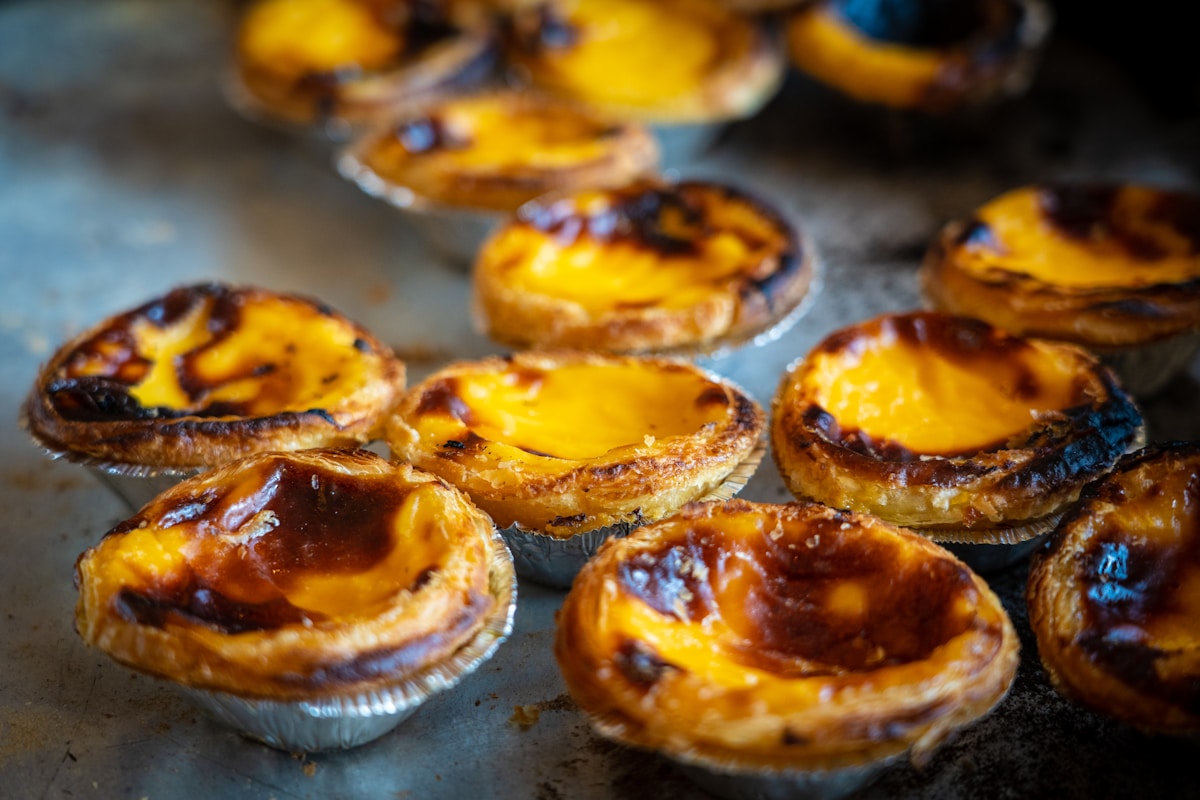
Portuguese pastry is one of the most developed traditions in Europe - and one of the least known outside Portugal. It grew from a specific historical circumstance: centuries of convent cooking, where surplus egg yolks (whites were used industrially) were transformed into an elaborate repertoire of egg-based sweets. The results are rich, sweet, and often intensely flavoured - not subtle, but technically sophisticated. For a hands-on pastry experience, our pastel de nata workshop guide covers Lisbon cooking classes where you can learn the technique.
Understanding the pastry map helps. Some sweets are national (pastéis de nata, bolo de arroz); others are strictly regional and barely leave the town that makes them (queijadas de Sintra, ovos moles de Aveiro). Finding the regional ones requires going to the source.
The National Staples
Pastéis de Nata
The custard tart is Portugal’s most exported food. Inside a flaky, slightly charred pastry shell sits a baked egg custard - egg yolks, sugar, milk or cream, cornflour - caramelised on top during baking at high temperature. The correct serving temperature is warm (straight from the oven is best; not cold). Served with powdered sugar and cinnamon, both of which you apply yourself at the counter.
Where to find the best:
Antiga Confeitaria de Belém (Rua de Belém 84, Lisbon) - the original, the benchmark. The secret Jerónimos recipe produces a tart with a distinctively thin and shattery pastry and a slightly firmer, less sweet custard than competitors. The queue is usually 15–30 minutes but moves fast. €1.30 each at the counter (eat in the tiled rooms for the experience).
Manteigaria (Rua do Loreto, Chiado, Lisbon) - open plan kitchen, tarts baked every 15 minutes, visible from the counter. More transparent than Belém and very close in quality. Slightly more custard than Belém, slightly less pastry crunch. €1.30 each.
Garret (Rua Garrett, Chiado, Lisbon) - older pastelaria format with full café service. Good pastéis de nata alongside travesseiros and other pastries. Worth combining with a coffee and a short lunch.
Outside Lisbon, quality varies enormously. The best pastelarias tend to be family-run operations in smaller towns rather than national chains. In Porto, Madureira (Rua de Santo Ildefonso) and Fábrica dos Segredos (Rua da Boavista) are reliable.
Bolo de Arroz
The rice flour muffin - a dome-shaped individual cake in a fluted paper case. Dry exterior, slightly moist interior, faint vanilla and lemon zest flavour. Found at every pastelaria in Portugal. Eaten with coffee (the bolo de arroz and bica combination is the default Portuguese mid-morning break). Costs €0.80–1.20.
Bola de Berlim
The Portuguese doughnut - a round fried dough filled with yellow custard cream (the quantity varies dramatically between producers). The beach version, sold from vendors along the Algarve and Lisbon coast beaches, is a summer institution. The proper version from a good pastelaria is better - the cream should be generous and properly made. €1.50–2.50.
Sintra Specialities
Queijadas de Sintra
Small tarts made from fresh cheese (requeijão), sugar, eggs, and cinnamon, baked in a thin pastry shell. From Sintra, 28km from Lisbon, where several pastelarias make them using recipes from the 15th century. The cheese gives them a slightly grainy texture - dense and sweet without being cloying. Best from Fábrica das Verdadeiras Queijadas da Sapa on Volta do Duche in Sintra town. About €2 each.
Travesseiros de Sintra
Travesseiro means “pillow” - the shape of this almond and egg cream pastry, rectangular and puffed. From the same Sintra pastelaria tradition. The Piriquita pastelaria on Rua das Padarias is the most famous address for travesseiros - the pastry is shatteringly thin and flaky, the filling intensely almond and egg. €2–3 each.
Aveiro Specialities
Ovos Moles
The most unusual Portuguese sweet - a paste of egg yolks and sugar, very soft (hence “moles”), enclosed in thin wafer shells pressed into shapes of fish, shells, and barrels. Aveiro’s signature product, made by the Convento de Jesus since the 16th century. The white wafer shell is almost tasteless; the interior is intensely egg and sweet. Available in every Aveiro shop (the town sells them everywhere) and from specialty shops in Lisbon. Buy from a confeitaria that makes them fresh rather than supermarket packaging.
Coimbra Area
Pastel de Tentúgal
Filo pastry tubes filled with egg custard cream - extremely delicate, both texturally and structurally. From the village of Tentúgal, 15km from Coimbra, where the recipe was developed by nuns in the Convento de São João de Evangelista. They are difficult to transport (they shatter easily) and are best eaten at the source. A handful of confeitarias in Coimbra and nearby towns sell them fresh; they are available in specialty shops in Lisbon but less fresh. €2–3 each.
Pão de Ló
A sponge cake made with eggs, sugar, and flour, deliberately under-baked so the centre remains liquid. The Ovar version (pão de ló de Ovar) is the most famous - the centre is gooey and intense, the edges fully cooked. Served at room temperature, eaten by the spoonful from the centre out. Found in pastelarias across the north and centre of Portugal; the best versions require going to Ovar (between Aveiro and Porto) or Alfeizerão in the Oeste region.
Algarve Specialities
Morgadinho de Amêndoa
Almond marzipan shaped into fruit forms - a Moorish inheritance from eight centuries of Arab presence in southern Portugal. Small (one bite each), with colour applied to represent strawberries, oranges, and figs. Made commercially in the Algarve, particularly in Loule and Silves. Sold in boxes as gifts; €8–15 for a box of 12. Better from small producers than supermarket versions.
Dom Rodrigo
A Faro specialty - egg yolk threads (fios de ovos) wrapped around almond filling in a twist of silver foil. Intensely sweet, the fios de ovos technique is a Portuguese-Japan connection (Portuguese missionaries introduced it to Japan in the 16th century, where it became kanamono). Available in Algarve confeitarias; the best are from artisanal producers in Faro and Loule.
Convent Sweets
Toucinho do Céu
The name translates as “bacon from heaven” - the original recipe used lard, which has since been replaced by ground almonds in most versions. An almond tart, egg-rich, dense, intensely sweet. Associated with convents in Braga, Portalegre, and the Alentejo. Found in pastelarias across northern and central Portugal. Sliced and served in portions; €2–3 per slice.
Broinhas de Mel
Small honey cakes with anise, cinnamon, and sometimes pine nuts. Associated with Beja in the Alentejo and traditionally made at Christmas, though now available year-round. Dense, spiced, long shelf life - characteristic of convent baking designed to sustain through fasting periods.
Where to Buy Pastry in Portugal
In Lisbon: the best pastelaria concentration is in Chiado (Manteigaria, Garret, Versailles) and Belém (Antiga Confeitaria de Belém). The Mercado da Ribeira (Time Out Market) has several pastelaria stalls but at higher tourist prices than the street equivalents.
In Porto: Madureira (Santo Ildefonso), Confeitaria do Bolhão (Rua Formosa - the oldest confeitaria in Porto, operating since 1896), and the Bolhão market for region-specific sweets from northern Portugal.
Regional specialities: always buy at source. Queijadas from Sintra, ovos moles from Aveiro, pastéis de tentúgal from Tentúgal near Coimbra. Airport shops sell packaged versions but quality drops significantly with packaging and transit time. To learn how to make pastéis de nata yourself, our pastel de nata baking workshop guide covers the best Lisbon classes and what to expect.
Coffee to Drink With Pastry
Bica (Lisbon) / Cimbalino (Porto) - the standard espresso. Short, strong, served in a pre-warmed cup. €0.70–1.20 at a standing counter (more at sit-down tables).
Galão - espresso in a tall glass with hot milk, approximately a quarter coffee to three quarters milk. Weaker than a bica but the right call with a sweet pastel de nata.
Meia de leite - like a flat white, served in a medium cup. Northern Portugal preference over the galão.
tours in Lisbon include food-focused walking tours that visit local tasca restaurants, markets, and artisan food producers across Lisbon’s neighbourhoods - many include a stop at a pastelaria for pastéis de nata fresh from the oven. To make them yourself, see our pastel de nata workshop guide.
Take a Guided Pastry Tour of Portugal
A guided pastry tour in Lisbon is one of the most practical ways to understand the depth of Portugal’s convent sweet tradition. Good tours visit Manteigaria in Chiado (where you can watch pastéis de nata go into the oven), the historic Pastéis de Belém bakery, and often include a stop at a specialist pastelaria for queijadas or travesseiros alongside the custard tart circuit. Knowing the history of each pastry — why convents produced egg-heavy sweets, which orders invented what — adds real texture to what otherwise looks like a straightforward bakery visit.
Browse food and pastry tours in Portugal on GetYourGuide.
City Food Guides
For where to eat pastry alongside other foods in each city:
- Lisbon restaurants guide - includes the best pastelarias and the Pastéis de Belém experience
- Porto restaurants guide - Confeitaria do Bolhão and northern pastry traditions
- Sintra - for queijadas and travesseiros at source (Piriquita bakery is the standard reference)
- Aveiro - for ovos moles, best bought at the traditional shops near the central canal
- Coimbra - for pastéis de tentúgal and chanfana
The Portuguese food guide covers the full range of Portuguese dishes beyond pastry.