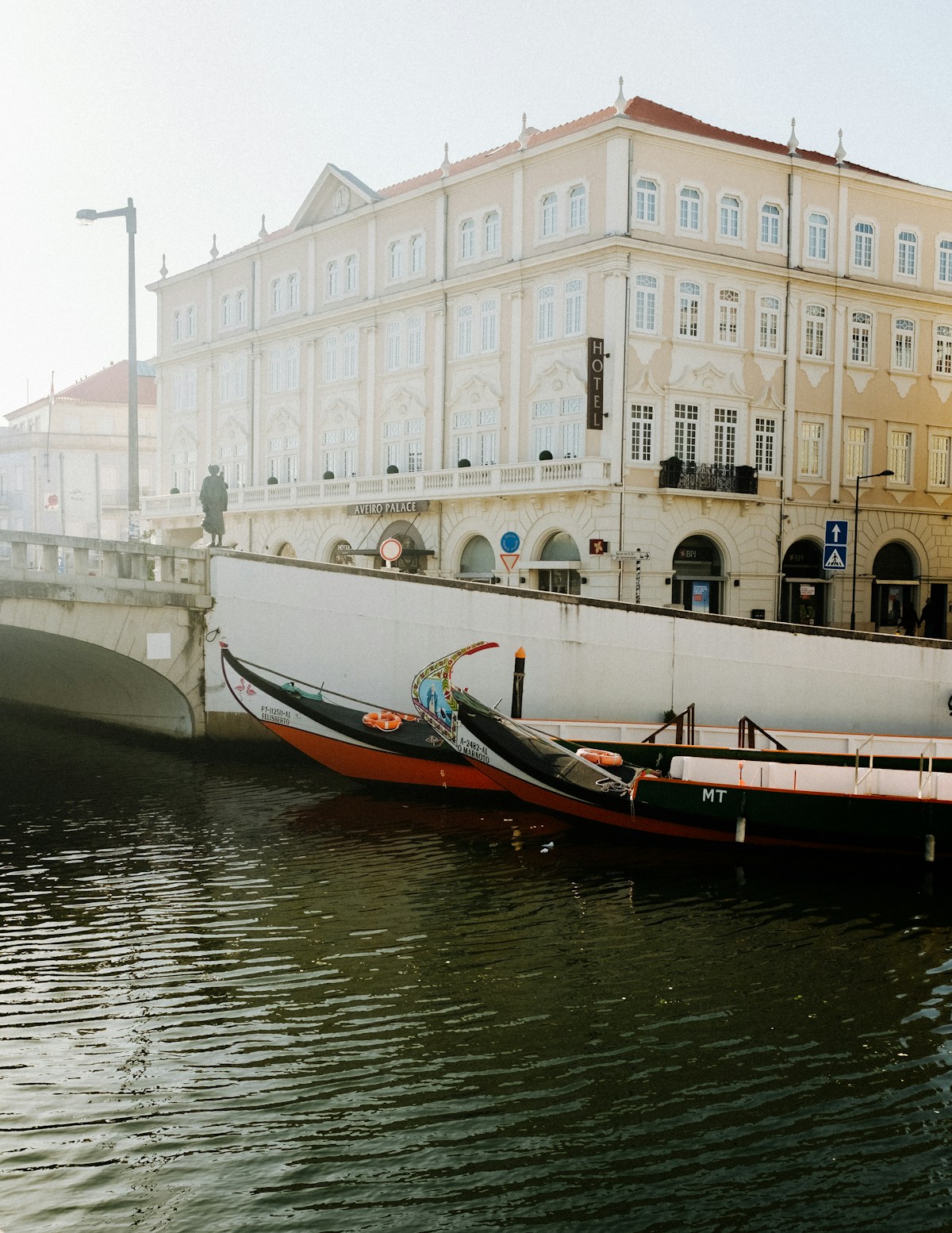
Aveiro sits at the edge of the Ria de Aveiro, a large coastal lagoon 70km south of Porto. Its comparison to Venice - common in Portuguese tourism writing - is exaggerated; the canals are attractive but modest, and the city is navigable and unpretentious rather than grand. What it offers is a well-preserved Art Nouveau town centre, a genuine craft tradition (ovos moles and salt production), an interesting lagoon ecosystem, and good connections to Porto that make it viable as a day trip without feeling rushed. For overnight planning, see our Aveiro city guide.
The Central Canal and Moliceiro Boats
The main canal (Canal Central) runs through the centre of the old town, flanked by 19th- and early 20th-century Art Nouveau buildings. Moliceiro boats - the painted flat-bottomed craft traditionally used to harvest lagoon seaweed - are now tourist vessels, operating 45-minute guided tours along the canal. Prices are €12–15 per person. The tours cover the main canal and branch into the smaller waterways, giving views of the back facades of the old buildings that aren’t visible from the streets.
The painted prow panels on moliceiro boats are the cultural detail most worth looking at. Traditionally they depicted folk scenes, religious images, and occasionally satirical or bawdy illustrations. The older panels, now in the museum, are more interesting than the tourist-friendly versions on modern boats, but even the commercial versions retain the general tradition.
Art Nouveau Architecture
Aveiro’s main contribution to Portuguese architectural heritage is its Art Nouveau buildings, concentrated around the Canal Central and the central streets. The best examples are the Casa Major Pessoa (now a small museum, entry €2), the Câmara Municipal (town hall), and the buildings along Rua João Mendonça. The Casa Major Pessoa is the most intact example - its façade and interior give a clear sense of the style’s ambition.
The Aveiro train station is also worth a quick stop regardless of whether you arrive by train - it has a large-scale azulejo tile panel depicting scenes from regional life and history, completed in 1916.
Ovos Moles
Ovos moles are Aveiro’s most famous food product and have DOP (protected designation of origin) status within Portugal. The confection is a thin rice-starch shell, crisped and formed into shapes (fish, shells, barrels), filled with a sweet paste of egg yolk cooked with sugar. The texture contrast - crisp shell, yielding paste - is the point.
They are sold in dedicated pastry shops throughout the city. Fábrica Artesanal de Ovos Moles near the canal and several shops on Rua Combatentes are reliable sources. Expect to pay €1–2 per piece, or €8–15 for a small gift box. The fish-shaped versions are the most photographed; the flavour is the same across all shapes.
The Salt Pans (Salinas)
The Ria de Aveiro has been a salt-producing area since Roman times. The saltworks (salinas) on the edge of the lagoon are still active - flor de sal (the top layer of crystalised salt, harvested by hand) from Aveiro is considered among the best in Portugal. Several salt producers offer tours of the pans between June and September, when harvesting is underway. The pink colour of some pans is caused by halophilic algae - a natural indicator of salinity. Tours cost €5–10 and can be arranged through the tourist office.
The lagoon around the salt pans is also a good area for bird-watching - flamingos, herons, and other waders are present year-round.
tours in Aveiro cover guided day trips, themed walks, and activity bookings so you can skip the logistics.
Costa Nova
Costa Nova is 8km west of Aveiro and is famous for its striped houses - wooden structures painted in vivid vertical stripes (red, blue, green, yellow) that were originally fishermen’s storehouses and later adapted as holiday homes. The village is on a narrow strip of land between the lagoon and the Atlantic beach, which gives it an unusual geography. The beach itself is a long Atlantic strand with moderate surf. In summer it’s busy with day visitors from Aveiro and Porto. Getting there requires a bus (Linha 12 from Aveiro, €2, 20 minutes) or a car.
Search hotels in Aveiro on Booking.com to compare rates and availability.