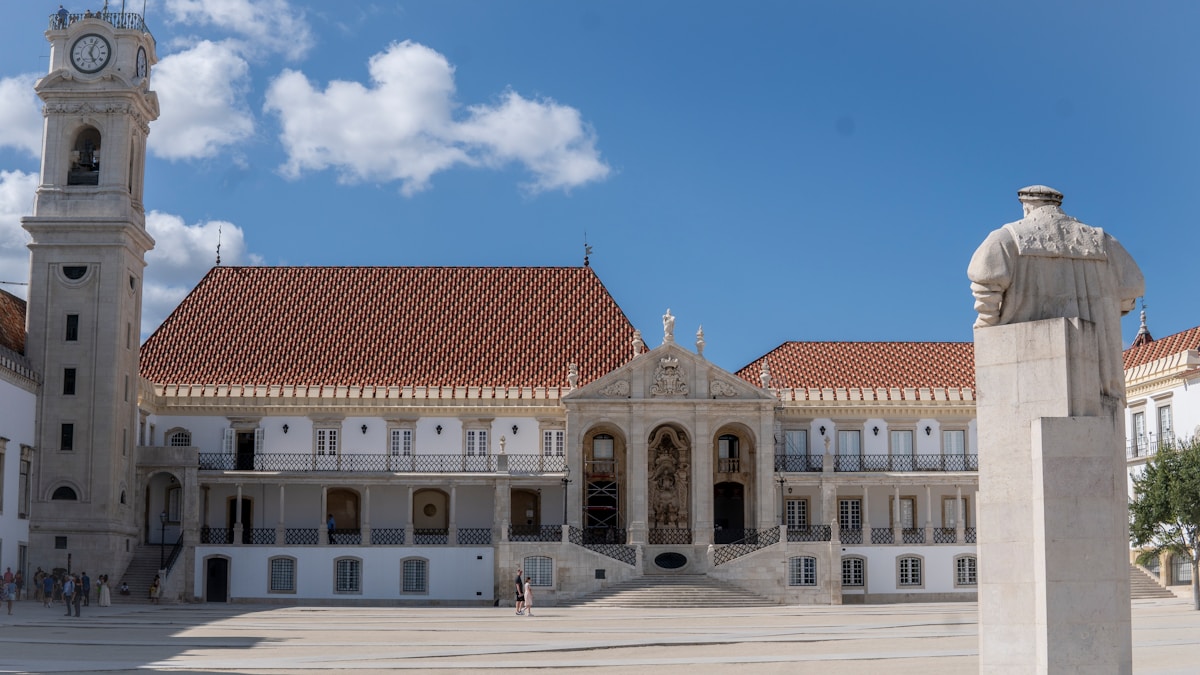
Coimbra sits on the Mondego River in central Portugal, 200km north of Lisbon and 120km south of Porto. Its university - founded 1290, one of the oldest continuously operating in the world - shaped the city entirely. The old university complex sits at the top of the hill above the medieval town; students in black capes fill the streets below. See our Coimbra city guide for transport and accommodation.
Getting to Coimbra
Train: 2 hours from Lisbon (Alfa Pendular, €19–30), 1 hour from Porto (€12–20). Coimbra-B station is the main station (all long-distance trains); a connecting train or taxi takes you to Coimbra-A in the centre (10 minutes, €2, or taxi €7).
Velha Universidade (Old University Complex)
The centrepiece of Coimbra and one of the most significant historical sites in Portugal.
Biblioteca Joanina: The baroque library (1717–1728) is among the most beautiful in the world. Three interconnected rooms with gilded mahogany shelves, trompe-l’oeil painted ceilings, and 300,000 books - including manuscripts from the 12th century. The library is home to a colony of Egyptian bats that emerge at night to eat book-damaging insects; staff cover the tables each evening.
Tickets: €12.50 (covers library plus other university buildings). Timed entry - book online. Slots sell out in summer.
Sala dos Capelos: The ceremonial hall where degree awards happen, hung with portraits of Portuguese kings. Open during non-ceremony periods.
Pátio das Escolas: The main courtyard, with the Iron Gate (Porta Férrea), a 17th-century ceremonial entrance. Free to enter the courtyard.
Santa Cruz Monastery (Mosteiro de Santa Cruz)
In the lower town, 5 minutes from the central Praça 8 de Maio. Built 1131, rebuilt in the 16th century in Manueline style. Contains the tombs of Portugal’s first two kings: Afonso Henriques (founder of Portugal) and his son Sancho I. The sacristy has 16th-century azulejo panels and Flemish paintings.
Entry: free for the church, €2.50 for cloister.
Machado de Castro National Museum
Former bishop’s palace (12th century) above the Roman forum (cryptoporticus). The museum houses one of Portugal’s best collections of medieval sculpture, particularly the 12th–16th century period. The Roman underground passages below the museum (free to explore separately, entrance off Largo da Feira) give a sense of the Roman town’s scale.
Tickets: €6. Closed Mondays.
Jardim Botânico da Universidade
One of the oldest botanical gardens in Portugal, laid out on the slopes below the university in the late 18th century. The 13-hectare garden contains around 1,200 plant species - formal terraced beds, greenhouses, and a giant bamboo grove. A quiet counterpoint to the busy Alta. Entry free; open daily 09:00–20:00 in summer, 09:00–17:30 in winter.
Kayaking the Mondego
The Mondego River running through Coimbra is gentle enough for beginners. Canoa Mondego runs full-day and half-day canoe trips from Penacova downriver to Coimbra (approximately €20–€35 per person including shuttle return, as of 2026). The stretch from Penacova (about 25km, passing forested gorges and small villages) is the most popular. Shorter 1–2 hour loops on the city waterfront cost approximately €10–€15. April–October is the ideal season.
Fado de Coimbra
Distinct from Lisbon’s fado: sung exclusively by men (traditionally male students), in black academic capes, with a more restrained, classical style. Themes are poetry, unrequited love, longing (saudade), and student life.
Where to hear it: A Capella (Rua do Corpo de Deus, renovated medieval chapel), Fado ao Centro (Rua do Quebra Costas, nightly shows €12 with drink), and occasional impromptu serenades on the Quebra Costas stairs in the evenings.
The Student Quarter and Old Town
The Baixa (lower town) and the university quarter (Alta) are both worth walking. The steep Quebra Costas staircase connects the two. At student-facing cafés and tascas, lunch menus run €8–10.
Key streets: Rua Ferreira Borges (pedestrian shopping), Rua Quebra Costas (steep medieval lane), Rua Visconde da Luz.
tours in Coimbra cover guided day trips, themed walks, and activity bookings so you can skip the logistics.
Day Trip: Conimbriga Roman Ruins
Portugal’s most important Roman archaeological site is 16km southwest of Coimbra. Conimbriga was a thriving town of 10,000 until Visigoth raids in the 5th century; excavated ruins cover 13 hectares including extraordinary mosaic floors in the Casa de Cantaber, public baths, and a well-preserved water distribution system. The on-site museum holds glass, coins, and sculpture from the dig.
Combined site + museum ticket: approximately €4.50 for adults (as of 2026). Bus from Coimbra’s Rodoviária terminal runs 3–4 times daily (around 40 minutes). By car: 20–25 minutes; parking free.
Practical tips
Best time to visit: During the academic year (October–July) for the full student atmosphere. Queima das Fitas (Burning of the Ribbons, usually May): the student festival where graduating students burn their academic ribbons - week of concerts, parades, and serenades. The biggest event in Coimbra’s calendar.
Day trip from Lisbon or Porto: Possible but rushed. Allow 5–6 hours on-site - arrive by 10am, see the library and university in the morning, lunch in the lower town, Santa Cruz and Machado de Castro in the afternoon.
Eating: Chanfana (goat slow-cooked in red wine, regional dish), leitão da Bairrada (suckling pig, 20km outside Coimbra in the Bairrada region). In town: Loggia (university terrasse restaurant, good views), A Cozinha da Maria (tascas, low prices, Baixa). Search hotels in Coimbra on Booking.com to compare rates and availability.