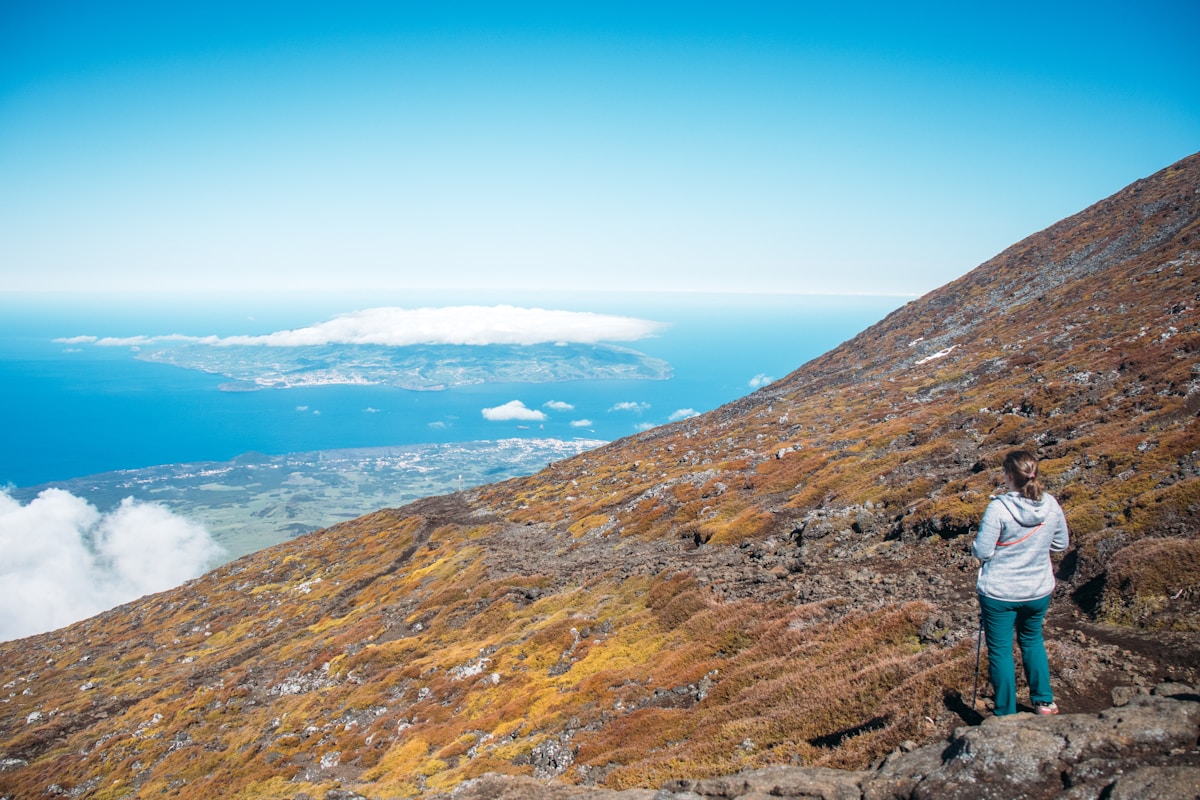
Pico is the most dramatic island in the Azores. Its volcanic cone (2,351m) is the highest point in all of Portuguese territory - including the mainland - and is visible from every other island in the central group. The island’s landscape is defined by black lava: basalt walls running to the sea, lava tube coastlines, dark volcanic rock beaches. Whale watching, the mountain climb, and the UNESCO wine landscape are the three reasons most people come.
Pico Mountain
The highest point in Portugal rises directly from the sea with almost no coastal plain - the island is essentially a single immense stratovolcano. The climb to the summit is the defining activity on Pico.
The standard route begins at the Casa da Montanha (mountain house) at 1,200m elevation - reached by a paved road from Madalena. A guide is legally required for the summit section (above 1,800m). The trail ascends through mist, then moss-covered scrub, then bare lava and volcanic cinder. The summit crater (Pico Pequeno) is reached at 2,240m; the true summit (Piquinho) is a subsidiary cone inside the main crater, involving 15 minutes of hands-and-feet scrambling on unstable basalt. The summit is 2,351m.
Views: on a clear day, all the other Azores islands in the central group (Faial, São Jorge, Graciosa, Terceira) are visible from the top. The view of the cloud layer below is common - Pico’s summit frequently sits above the weather.
Logistics: guides are arranged through the Pico Mountain House (book well in advance in summer). A guided summit costs €30–50 per person. Start before 8am - afternoon cloud is almost guaranteed. The descent takes 2–3 hours. Total time from mountain house to summit and back - 5–7 hours.
Weather window: the mountain creates its own weather. Even in high summer, only 30–40% of attempted climbs reach the summit in clear conditions. If the first day is cloudy, try again on the second.
Whale Watching
Pico was a major whaling island until the industry ended in 1987. The last sperm whale was caught from Lajes do Pico. Former whale spotters (vigias) now work for whale watching companies, using the same clifftop lookout points (vigias) to locate whales for tourist boats. The transition is direct and genuine - this is not a reconstructed heritage attraction.
Sperm whales are the main year-round species. These are deep-diving animals (up to 2km depth) and are regularly found in the deep water between Pico and São Miguel. Sightings rates with established operators are above 90%.
Seasonal species: June–August - blue whales (the largest animal on earth, occasionally sighted in deep water), fin whales, sei whales, Bryde’s whales. Dolphins (common, spotted, bottlenose, striped) are present year-round.
Tours depart from Lajes do Pico on the south coast, 30 minutes from Madalena by car. Most tours run 2.5–3 hours, costing €55–75 per person. The operators with the best reputations are Espaço Talassa and Whale Watch Azores.
Lajido Coastal Walks
Lajido describes the landscape of ancient lava flows that meet the sea on Pico’s northern coast - black rock shelves, channels, and pools where the Atlantic meets the basalt. The best lajido walk is between Calhau de São João and the Areia Larga lagoon on the north coast - 4km of coastal trail with the black rock foreground, the sea, and Faial visible across the channel.
The route is waymarked (PR 14 PIc) but intermittently so. A basic sense of navigation helps. Allow 2 hours one-way; arrange transport back to Madalena unless you want to return on foot.
Swimming: the volcanic rock pools along the lajido at Lajido da Criação Velha on the south coast are excellent for snorkelling when the sea is calm. Clear water, fish, and the unusual experience of swimming among basalt channels.
Pico Wine Landscape
The Verdelho grape was introduced to Pico in the 15th century. The wines - a dry, mineral, slightly saline white - were prized in European courts and exported to Russia and England. The wine region went into long decline following the phylloxera epidemic of the 1870s, but has revived since the 1990s.
The UNESCO-inscribed landscape of Criação Velha covers the southwest coast - an extraordinary geometry of black basalt walls (currais) running down to the sea, each enclosing a small block of vines. The walls protect the vines from Atlantic wind and trap heat from the dark rock.
Adega do Vulcão cooperative - the main wine producer on the island, in Madalena. Tastings available Monday–Saturday. Verdelho do Pico is the wine to try - dry and mineral with a distinctive oceanic quality.
Museu dos Baleeiros (Whale Museum)
In Lajes do Pico, the old whaling factory (Dalmau & Co.) has been converted into the best whaling museum in the Azores. The equipment, harpoons, and oral history recordings from former whalers give a specific account of the industry as it existed until 1987. Entry €2. Allow 1 hour. Closed Mondays.
Tours in Pico cover guided whale watching, Pico Mountain climb support, and vineyard walks - useful where local expertise matters for the summit routes and marine life.
Pick up an eSIM for Portugal for reliable navigation across the islands.
Getting There and Around
Pico Airport (PIX) is near Madalena on the west coast. Flights from Lisbon via Terceira or São Miguel (SATA). The ferry from Faial takes 30 minutes and is the most practical inter-island connection - if you’re visiting Pico and Faial, take the ferry rather than flying.
A hire car is essential on Pico. The island is elongated (43km long) and the whale watching base (Lajes do Pico) is on the south coast, 30km from the airport. Rentals from Madalena town, €35–50/day. Pico is a highlight of the Azores island hopping itinerary. For where to sleep, see best hotels in Pico and the Pico island guide.
Search hotels in Pico Azores on Booking.com to compare rates and availability.