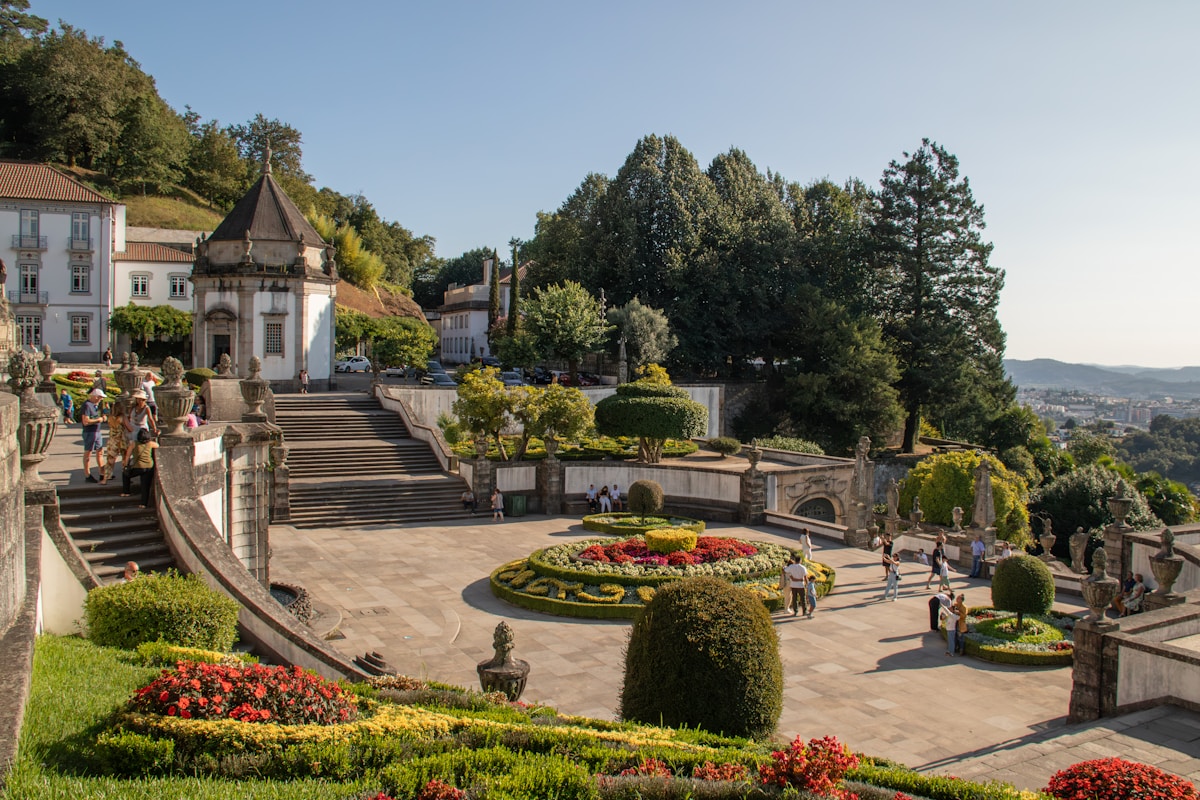
Braga is Portugal’s third largest city (193,000 people) and its historic religious capital. Founded by the Romans as Bracara Augusta, it became the seat of the Archbishop of Braga - the Primate of All Spain - in the 6th century, a position that gave it outsized cultural and political weight throughout Portuguese history. Today it’s also a university city with a growing reputation for food, nightlife, and street art. See our Braga city guide for transport, hotels, and day trip options.
Search hotels in Braga on Booking.com to compare rates and availability.
Getting to Braga
Train from Porto: 55 minutes, €5–8 (Urban/Regional trains), runs frequently. From Lisbon: 3h20 (Alfa Pendular), €30–50. The train station is 500m from the historic centre.
Bom Jesus do Monte
The defining image of Braga: a Baroque pilgrimage church set at the top of a 577-metre hill, reached via an elaborate double zigzag staircase decorated with fountains, chapels, statues representing the five senses and virtues, and stations of the cross. The construction spans 1722–1811.
The staircase is the experience - not the neoclassical church at the top (which is pleasant but unremarkable). Pilgrims traditionally climb on their knees. Most visitors walk up (20–30 minutes, steep); the 1882 funicular (€2 up, €1 down) is an alternative.
At the summit: formal Baroque gardens, viewpoint over Braga and the Minho countryside, cafés and a pousada.
Getting there: Bus 2 from Braga city centre (€1.85, 20 minutes).
Braga Cathedral (Sé de Braga)
The oldest cathedral in Portugal, begun 1070 - the year Braga’s bishop was re-established after the Moorish period. The current structure is a mix of Romanesque (12th century), Gothic, Manueline, and Baroque additions accumulated over 900 years.
Inside: the Barrel organ (1737), two Gothic cloister galleries, the tomb of João I’s illegitimate son Dom Afonso, and the treasury (rich collection of ecclesiastical gold). Entry to the church is free; cloister and chapels €6.
Semana Santa (Holy Week)
Braga’s Easter week processions are among the most elaborate in the Iberian Peninsula - comparable to Seville. Barefoot penitents, candlelit processions, Roman soldiers re-enactors, and three major processions through the city centre. The Ecce Homo procession (Good Friday) draws tens of thousands of spectators.
If visiting Portugal for Easter, Braga is the destination.
Historic Centre and Street Art
Braga’s Baixa (downtown) has been significantly upgraded in recent years. The main shopping street (Rua do Souto, pedestrianised) and Praça da República are surrounded by well-preserved 18th-century architecture.
Street art: Braga has invested in an urban art programme - significant murals throughout the city, particularly around the university area.
Guimarães as a day trip
30km southeast (30 minutes by train, €3.70). Guimarães is called “the birthplace of Portugal” - Afonso Henriques, the first king, was born here in 1110. The medieval castle and Palace of the Dukes of Bragança are the main sites. The UNESCO-listed old town is compact and well-preserved. Combine with Braga in a single day from Porto.
Peneda-Gerês National Park
The only national park in Portugal is 40km north of Braga - a landscape of granite peaks, ancient oak forests, Roman roads, and rivers cold enough to numb your feet in summer. The most popular entry points are Caldas do Gerês (spa village) and Campo do Gerês.
Several Braga-based operators run full-day tours combining hiking, swimming in the Caniçada reservoir, and visits to the Castro Laboreiro plateau. GetYourGuide lists Gerês hiking and jeep tours from around €40–€80 per person (as of 2026). Self-driving takes 45–60 minutes; parking is free at most trailheads.
For swimming, Praia Fluvial da Caniçada and Praia do Rodanho are the best river beaches inside the park.
Citânia de Briteiros
One of the best-preserved Celtic-Iberian hill settlements in the peninsula sits 15km southeast of Braga. Occupied from at least the 3rd century BC through the Roman period, the site covers 24 hectares of circular stone huts, paved streets, and defensive walls at 335 metres altitude. Two roundhouses have been reconstructed to give a sense of scale. Views across the Cávado valley on a clear day reach the Atlantic coast.
Entry approximately €3.50 for adults (as of 2026); open daily 09:00–18:00. Driving is the most practical option from Braga - no regular bus service.
tours in Braga cover guided day trips, themed walks, and activity bookings so you can skip the logistics.
Practical tips
Eating in Braga: Bacalhau à Braga (salt cod with potatoes and olives), rojões (pork pieces in lard with blood sausage, a northern speciality). For sit-down meals: Restaurante Centurium (Rua Dom Frei Caetano Brandão, mains €14–€22), A Cozinha por António Loureiro (one Michelin star, tasting menus from approximately €95, book ahead), Cervejaria Domus (Campo das Hortas, craft beer and petiscos, €10–€15 per person). Saturday market at Mercado Municipal 1 de Maio is good for local cheese, smoked sausage, and bread.
Student city: University of Minho brings a younger population and keeps prices lower than Porto. Several good café-bars in the university quarter.
Best time: Spring (April–May, including Holy Week) or autumn (September–October). Summer gets hot but is manageable.